



🛏️ Accommodation for the first month in Finland 2026: hostel, apartment or room?
Your first nights in Finland: no panic, no overpaying
If you want to understand where to live in Finland at the beginning — so you don't spend your entire salary on a hotel, get stuck living out of a suitcase, and can get a good night's sleep before important meetings — this guide is for you.
The first few weeks in a new country are always the busiest: paperwork, banks, residence permits, SIM cards, searching for long-term accommodation. At this point, it is important to have a simple "base": easy check-in, a hot shower, a kitchen for cooking pasta, and convenient transport to the station or office.
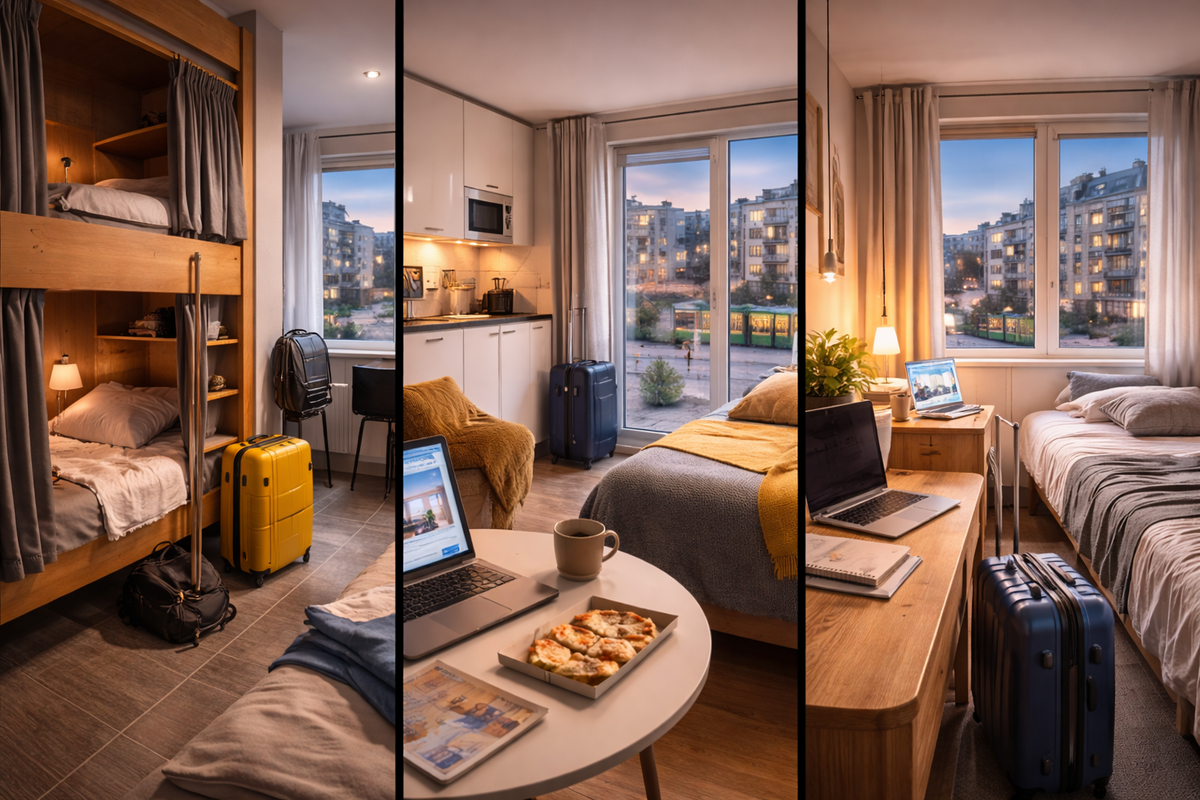
In Finland in 2026, there are three main starter formats:
● Finland hostels — from classic dormitories to very cosy hybrids of "hostel + boutique hotel" with a kitchen and lounge;
● Finland aparthotels — studio rooms with a mini-kitchen, laundry facilities in the building, and often with self check-in;
● room or short-term apartment rentals — through platforms or directly.
In this article, you will learn how these formats differ in terms of cost and living conditions, how to avoid the trap of a noisy hostel or "dead" internet, and why the "live by the tracks" strategy really saves your nerves in the first few months.
Accommodation formats to start with: hostel, apartment, room
Hostel: social, budget-friendly, but not always quiet
Modern Finnish hostels are no longer "dark dormitories with two showers per floor." Often they are:
● separate private rooms + shared dorms;
● a shared kitchen with a stove, refrigerators and basic utensils;
● a lounge, sometimes with tables, a library, even a sauna;
● a laundry room or at least laundry services.
In 2025–2026, the average price of a bed in a Helsinki hostel will be approximately 30–35 USD (about 28–33 €), and a private room will cost 80–95 USD (70–90 €) per night, depending on the area and season.
Pros: cheaper than hotels, there are people around, shared kitchen, often good transport links.
Cons: noisy, shared showers, less privacy — an important factor if you are starting a new job or course.
Aparthotel: a "light apartment" at the price of an average hotel
Aparthotels in Finland are the golden mean between a hotel and a rented flat. The room usually has:
● a kitchenette (stove/induction hob, microwave, refrigerator, basic kitchenware);
● a separate bathroom;
● Wi-Fi, sometimes a workspace;
● shared laundry room or washing machine in the room;
● often — self check-in Finland: codes, key safes, "hotel without a reception".
This is a good option if you are travelling with your family, luggage and laptops: you can cook, do laundry, work and not immediately commit to a long-term rental.
Room or short-term apartment rental
Through platforms and local websites, you can rent:
● a room with hosts;
● a small "all-inclusive" studio for 1-3 months;
● a "working" flat closer to the office/university.
This is closest to the feeling of "I already live here," but there are also more risks: house rules, cleaning quality, and legal issues are not always clear.
If you are planning a long-term rental in Finland, a short-term rental for the first few months is a good way to "scout the area": you will have time to figure out which neighbourhood is right for you and which is definitely not.
Comparison of formats at the start
Practical advice: how to choose and what to check before booking
Location: live "by the tracks" and save time
In the first few weeks, the best superpower is not the beauty of the area, but logistics. It is convenient when your accommodation is:
● 5–10 minutes' walk to a train/underground/tram station;
● 30–40 minutes to the office/campus without complicated transfers;
● there is at least one supermarket within a radius of 500–800 metres.
The strategy of "living by the tracks" (near a major station or public transport hub) makes early flights, visits to Migri and apartment viewings much easier, especially in winter and in the rain.
What to check before booking: mini checklist
- Is there a kitchen and what exactly is in it: a full stove or just a microwave?
- Laundry: in the building, paid/free, by appointment or "first come, first served".
- Wi-Fi: is it included in the price, are there any reviews about its stability?
- Quiet hours: is there a specified quiet time (usually 10 p.m. to 7 a.m.)?
- Access: regular reception desk or only codes/boxes (self check-in).
- Parking: is it necessary and is there a separate fee/reservation.
Many hostels and apartments now offer self-service facilities: kitchens, sometimes washing machines, laundry rooms and self-service check-in.
Self check-in: convenient, but only if you understand everything
Many aparthotels and city studios operate on a self check-in basis in Finland:
● a couple of days before arrival, you are sent a code for the door/safe;
● sometimes you need to pick up the key from a separate box on the street or at a neighbouring hotel;
● there is no reception as such, at most a support telephone number.
It is crucial to clarify before departure:
● exactly when the codes start working;
● whether there is a backup option if the phone runs out of battery;
● where the door/box is physically located (in the photo and on the map).
A little about money: guidelines without shock
Prices vary greatly between cities and seasons, but here is a very rough guide (for 2025–2026):
● a bed in a hostel in Helsinki: on average 30–35 USD/night;
● private room in a hostel: 70–100 USD/night;
● a simple aparthotel in the capital region: as a rule, already at the level of an average hotel in the country (the average price of a double room is 120–140 €/night, plus or minus depending on the region and date).
Therefore, for a month, it is more profitable to look not at the "price per night" but at the "monthly package": many apartments and hostels offer discounts for 28+ nights, sometimes as much as 20–30% off the daily rate.
Scenarios: single, couple, family, relocation for work
Solo travel or student
If you are travelling alone, without children and on a moderate budget, the starting package looks like this:
● 1–4 weeks in a good hostel or inexpensive apartment;
● actively search for long-term accommodation at the same time;
● maximum socialising in shared kitchens and lounges (useful for language and meeting people).
For a very tight budget, it is wise to look for options with shared rooms and kitchens, but with good reviews about quietness and cleanliness.
Couple or partnership
For couples, privacy is often more important than the lowest price. Here's a combination:
● 2–4 weeks in an aparthotel with a kitchen;
● an area closer to your future place of work/study;
● a quiet house, clear rules, normal laundry facilities.
Yes, it's more expensive than a hostel, but considering there are two people and the possibility of cooking at home, the difference in budget is not so dramatic.
Families with children
With children, the value of the following increases dramatically:
● a separate room;
● a kitchen;
● a good night's sleep: no night-time parties behind the wall.
Apartments almost always win here, and hostels only if they are family-friendly with a private room and normal sound insulation.
A separate life hack is to sleep closer to the train station/airport on travel days: children will freeze less during transfers, you will be less nervous, and you won't need to take a taxi at all.
Relocation for work
If your company is relocating you to Finland, be sure to check whether they have a corporate contract with an apartment hotel chain.
● whether they have a corporate contract with an aparthotel chain;
● whether they pay for the first few weeks of accommodation;
● whether they will help you find long-term accommodation.
The option where "the company pays for the aparthotel for 1-2 months while you take your time choosing a neighbourhood" works very well.
"My husband, child and I lived in an aparthotel near Tampere Central Station for a month and a half. Yes, it was a little more expensive than a hostel, but we didn't have to drag a pram through the snow and could return home by train in 10 minutes at any time. During this time, we found a quiet long-term flat."
Common mistakes in the first month and how to avoid them
Now let's talk about where people most often stumble when choosing their first place to live.
The result is noisy nights, a communal kitchen in perpetual chaos, and zero energy to tackle important tasks during the day.
Yes, price is important, but the quality of sleep and access to a kitchen/internet in the first few weeks are crucial for your productivity and health. It's better to save on restaurants than on basic peace and quiet.
Arriving at 11:30 p.m., realising that the code is only activated from 3:00 p.m. the next day, and standing in the snow with your suitcases.
Always double-check: check-in time, access format (keys/codes), whether there is a 24-hour phone number if the code does not work.
A little plain text — to give your eyes a rest.
End up in an industrial area with no shops or transport because "it's cheap".
Before booking, turn on the map and "public transport" mode. The time to the centre/office/university is no less important than the size of the bed.
And another classic mistake is "staying in a hostel for a month and expecting it to be quiet".
In theory, it's "I'm wearing headphones, everything's fine," but in practice, it's neighbours' alarm clocks, early departures, and late-night conversations in the hallway.
If you need to concentrate, look for private rooms or apartments. A shared dorm is a great option for a couple of nights, but not always for a month-long relocation project.
The first roof over your head is not the last: how to approach your starter home
Your first month's accommodation is not your "dream home" but a stepping stone. Your task is to make sure that this stepping stone is stable: with easy access, a hot shower, a decent kitchen, stable internet and access to transport. Everything else is a matter of taste and your budget.
Finland is very rational in this sense: if you understand how hostels, aparthotels and short-term rentals work, you will quickly find the right format for you. At first, you may have to make some temporary compromises, but then, when you sign a long-term contract, you will already know which areas and types of accommodation are right for you and which are only suitable for tourist weekends.
If this guide has helped you feel more relaxed about your first few weeks in Finland, save it, share it with friends who are planning to move, and come back to the comments for clarification — tell us about your experiences with hostels, apartments and unexpected nights at the airport. Your experience is the best guide for those who will arrive after you.
❓ FAQ
In big cities like Helsinki, expect to pay 30–35 USD for a bed and 70–100 USD for a private room. In other cities, it may be slightly cheaper. Prices depend on the season, day of the week, and how "Instagrammable" the hostel itself is, but that's the general range.
For the first month, it's better to consider not only money but also time: an hour's commute each way every day quickly eats away at your energy. In Finland, it's often more advantageous to live near a good train or metro station than strictly "in the centre", especially if you need to travel a lot for business.
In an aparthotel, you almost always have a kitchenette, sometimes access to laundry facilities, and a little more "homeliness." In a classic hotel, you pay for service and breakfast, but you have to rely on outside cafés and laundromats. On a monthly basis, aparthotels are usually more comfortable and sometimes even more cost-effective.
The system of codes and key safes has been in use here for a long time, especially in aparthotels and city studios, and generally works reliably. The main thing is to check the code activation time, the exact location of the door/box and the support number in case of failure in advance. Then even a late night arrival will go smoothly.
Yes, most hostels and aparthotels in Finland offer shared or private kitchens where you can cook your own meals. This significantly reduces costs compared to eating out every day: breakfast and dinner are easy to make at home, and you can take lunch with you or buy it in a canteen/café.
Sometimes yes, but it should be a quiet hostel with family rooms and normal sound insulation. Most families find it easier to stay in apartments: a separate bedroom, kitchen, and fewer random noises in the corridor at night. A hostel is fine for a couple of nights, but for a month it is better to consider a quieter option.
At the beginning, this is a very common conscious choice: you can get to Migri, offices, and universities faster, and on days when you are flying or moving, you save on taxis and stress. Yes, it is noisier around train stations, but for 2-4 weeks, this is a perfectly workable compromise.
Ideally, 2–6 weeks before arrival: by this time, prices are up to date and there are still vacancies. If you book six months in advance, the format may change, and a couple of days before arrival, the choice often drops sharply or becomes more expensive.
Sometimes yes, if you are already in Finland, know the area, have an offer and time to view properties. But most visitors need a "buffer" of 2-8 weeks: while the residence permit is being processed, the tenant's package for Finland is being put together and the hunt for a decent flat is underway. Starter accommodation fills this gap.
Comments about noise at night, Wi-Fi stability, actual distance from transport, and the cleanliness of the kitchen/bathroom. Photos may be old, but live reviews from the last few months give an honest picture. Stories from people who have lived there for 2+ weeks are especially important.
It is worth calculating carefully: if the flat is free or heavily subsidised, an hour's commute may be acceptable. If the company only gives you the contact details of a estate agent and you have to pay yourself, you have the right to say that you are looking for options closer to the office and are willing to discuss a flexible schedule while you search.

0 comments
Log in to leave a comment