



🗣️ Language, "third places" and soft integration into Finland 2026
Finland is not just about courses: what is "soft" integration
If you want to understand what integration in Finland will look like in 2026 without the "martial law" of textbooks — through libraries, clubs, courtyard activities and volunteering — let's take a closer look.
A classic scenario that many have already experienced: intensive language courses, piles of homework, exhaustion by January, and the feeling that you have no energy left to speak any language. Instead, there is growing discussion of the "language & life" approach: language as part of life, not a separate, difficult subject, and "third places" as a bridge between home and work/university.
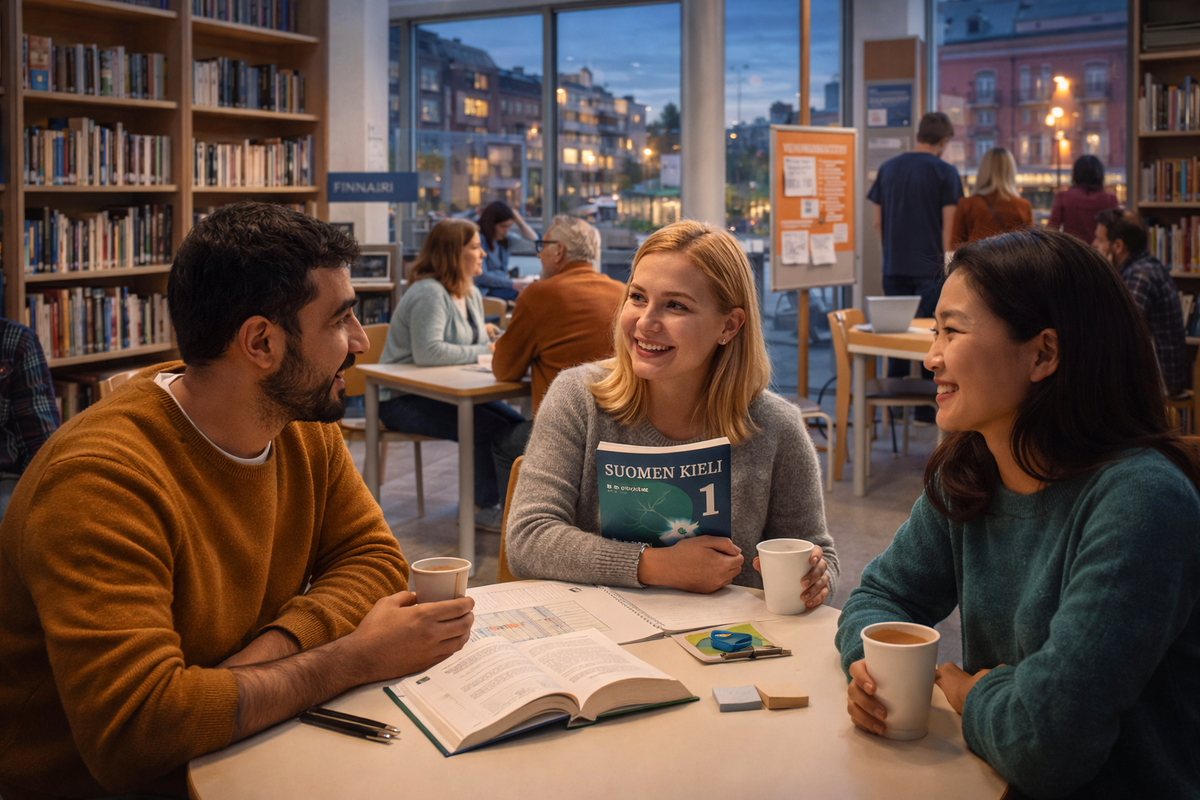
Third places are:
● libraries with open spaces, clubs, makerspaces and language cafés;
● community centres where clubs, lectures, and classes for children and adults are held;
● cafés, language clubs, sports clubs;
● volunteer projects where "the language comes naturally" because you have to agree on what to do.
In this article, you will learn how to build your own integration map from these places: from learning Finnish at the library to making your first friends through volunteering in Finland — without overload and with respect for your own temperament and resources.
"Third places": libraries, clubs, language cafés, coworking spaces
Finnish libraries: your free interest club
Finnish libraries are a bit magical. In Oodi in Helsinki, for example, there are:
● open spaces for reading and working;
● free rooms for meetings and clubs;
● a makerspace with 3D printers, sewing machines and studios;
● language cafés and interest clubs – from board games to film clubs.
In many cities, libraries are a magnet for internationals: they host conversation clubs, parent meetings, IT meetups, and events for children. The library literally becomes a physical "third place" between home and work.
No matter what city you are in, there is almost always at least one library with a programme of events. It is the perfect place to experience how libraries in Finland function as public living rooms rather than "book repositories".
Language cafés and clubs: Finnish over a cup of coffee
In recent years, universities, trade unions, NGOs and grassroots initiatives have seen a surge in the popularity of
● language cafés — informal gatherings where people sit around a table and discuss life in Finnish and other languages;
● language clubs — regular meetings organised, for example, by service workers' trade unions, which help people practise the language and build connections;
● mixed "language + hobby" clubs: running, hiking, cooking evenings.
These are not a substitute for courses, but rather live practice: you catch the "ear" of native Finns, learn to interrupt and clarify in Finnish, and not just answer the teacher's questions.
Sports clubs, circles, hobbies
Not everyone likes to "sit and talk." For many, the way to the city is through:
● running, swimming, group training;
● choirs, orchestras, dance studios;
● table tennis clubs, DnD, photography clubs.
Language is also at work there: you learn how to say "step to the right", "time out" and "pass to him" in Finnish, and at the same time you learn to read non-verbal codes.
Volunteering: integration through action
A separate powerful line is volunteering in Finland:
● participation in city festivals and sporting events;
● helping NGOs working with families, young people and migrants;
● participation in local neighbourhood projects.
Research and integration practices in recent years show that volunteering greatly accelerates the feeling of "I am part of this place," provides initial local recommendations and experience that is later useful in the labour market.
Language for every day: small rituals that work
Courses are important, but they don't work miracles on their own. Language loves small, regular rituals that are built into everyday life.
Ritual 1. "15 minutes of Finnish" as a warm-up
Instead of a heroic two hours once a week, try this:
● 10–15 minutes every day: app, flashcards, phrase repetition;
● another 10–15 minutes in real life: shops, lift small talk, post office.
This way, you turn learning Finnish into a routine like brushing your teeth — understandable, painless, consistent.
Ritual 2. "One Finnish question a day"
Set yourself a goal: one question in Finnish per day to a stranger. For example:
● "Missä on…?" (Where is…?);
● "Mikä bussi menee…?" (which bus goes…);
● "Onko tämä jono?" (is this the queue?).
Short exchanges teach you not only words, but also courage.
- 15 minutes of "dry practice" (app, textbook, flashcards).
- 1 short dialogue in real life: cash register, bus stop, reception desk.
- 1 note or message to a friend in Finnish (at least 2-3 sentences).
Ritual 3. The library as an "office" and "classroom"
Get into the habit of
● once a week, work/study in the library, not at home;
● take a book/comic/magazine in Finnish there "just to browse";
● check the library's events calendar once a month.
This way, the language becomes part of your space, not just your phone screen.
Scenarios: introvert, family, full-time student
Introvert: small steps, no mandatory socialising
If you find it difficult to "fit in" at large, noisy events:
● choose small language clubs and quiet libraries;
● attend regular but short activities (an hour a week is plenty);
● use online communities in your area where you can "warm up" in writing.
Soft integration is about "going at your own pace".
Families with children
For families, the third places are:
● children's areas in libraries and family clubs;
● clubs and nurseries where there are already local children;
● parent groups where they discuss schools, nurseries, house rules, Finland and everyday nuances.
Here, integration often follows the pattern of "children first, parents second": children bring words, rules and acquaintances, and adults follow suit.
Student or intern
Students have their own map:
● student clubs and guilds;
● campus language cafes;
● sports clubs at the university.
It is important not to get stuck in an international bubble: at least one activity with Finns per week — and the dynamics of language and integration change noticeably.
Working full-time
If you work full-time and just want to get to the sofa after work, you need a different strategy:
● one regular activity per week (club, volunteering, sports);
● incorporate the language into your work — ask your colleagues to speak to you in Finnish sometimes;
● short digital rituals: news, podcasts, social media in Finnish.
Don't try to be a hero and do everything at once: consistency is more important than one bright but exhausting course.
"I work in IT, and my only exposure to Finnish was through volunteering on weekends: we helped organise a family festival. After a year, I made friends and my fear of speaking disappeared — simply because I had to solve small tasks on the spot."
Integration mistakes: marathons, overload, and "I'm not like that"
Integration is a marathon, not a sprint. And here, too, there are typical pitfalls.
Three months later — burnout, a feeling of failure, and the desire to hide at home.
It's better to accept right away that small, regular steps are more effective than one big sprint.
Take a breather, then move on to the next one.
Spending years communicating only with those who speak your language and wondering why your Finnish isn't improving.
The international community is a support system, but at least one activity a week with locals is a must if you want to not only live in Finland, but also feel that the country is a little bit yours.
"He learned the language in a year and found a job, but I didn't, so there must be something wrong with me."
Everyone has their own starting point, resources, background, and health. Social media shows the tip of the iceberg, not the hours, money, and nerves spent behind the scenes.
Integration as a collection of small bridges
Integration in Finland is not one big step of "taking a course and passing a test," but many small bridges: the library, a language café, a hobby club, Saturday volunteering in Finland, a conversation with a neighbour on the stairs. Each bridge seems insignificant on its own, but together they give you the feeling that "I am not a guest here, but a resident."
Integration in Finland works best when you don't break yourself, but add new rhythms to your life: a little bit of language, a little bit of local contacts, a little bit of participation in common activities. This is how that very "centre of life interests" emerges, which is then asked about in migration questionnaires — not only on paper, but also inside.
If you like this gentle, "human" approach, save the article, send it to those who are just about to move, and tell us in the comments: which third places became key for you, what worked and what didn't. Real-life stories are the best guide for those who are settling down in Finland in 2026.
FAQ
Start small: make the library your point of reference, find a language club or café, choose one activity that interests you (sport, hobby, volunteering). Don't try to do everything at once — one regular "bridge" a week is enough to start building a life with people and context.
Yes, in many cities, libraries have become community centres: they host lectures, language cafés, clubs and creative events, and there are spaces for work and even makerspaces. It's one of the best places to get a feel for local life and practise the language in a human way.
It is an open meeting where people gather to speak Finnish and other languages in an informal setting: over tea, board games, and discussions of current events. Such cafés are often organised in libraries, universities, or NGOs, and anyone can attend, regardless of their language level — from A1 to "I just want to socialise."
Volunteering provides what courses lack: real tasks, teams and joint decisions. You learn to communicate in Finnish and English, get to know the locals, get used to the working culture and do something useful at the same time. Recent studies directly refer to volunteering as one of the most effective accelerators of integration.
Even 1-2 hours a week, but consistently, is already a lot. For example, one club or volunteer shift + a couple of short conversations in Finnish in your "normal" life. It's not the number of hours that matters, but the regularity and the fact that you are actually meeting people outside your usual bubble.
Yes, but your set will be different: quiet library clubs, small language groups, online communities, small volunteer teams. No one is forcing you to go to a noisy festival — choose formats that are comfortable for you personally.
Ask yourself: what can I do now in Finnish/in this city that I couldn't do a year ago? These can be small things: making a doctor's appointment, discussing talkoot with a neighbour, or laughing at a meme in Finnish. Progress is not only a certificate, but also these small "I can" moments.
Courses are useful and sometimes necessary (for example, for integration measures from TE services), but they are not the only way. Many people combine courses with practice in clubs, libraries and volunteering — this way, the language ceases to be just "academic" and begins to live in real situations.
Children's areas in libraries, family activities in community centres, playground events in courtyards, school and kindergarten celebrations. These are places where friendships are formed and an understanding of how the education system and everyday rules work is developed.
Search through city portals, NGO pages, university bulletin boards, and social networks — many organisations directly state that they need volunteers, including those who speak several languages. There are also projects specifically aimed at supporting international families and newcomers.

0 comments
Log in to leave a comment