


📌 How to look for a job in Finland in 2026: CV, cover letter and the recruiter's first call
Working in Finland: what candidates are struggling with in 2026
If you want to understand how job hunting in Finland will work in 2026, you're probably already familiar with some of the following concerns:
● "Is my CV too long/short/not in Finnish?"
● "Finns are so concise, what should I write in the cover letter?"
● "The recruiter calls unexpectedly, and I stutter and don't understand half of what they say."
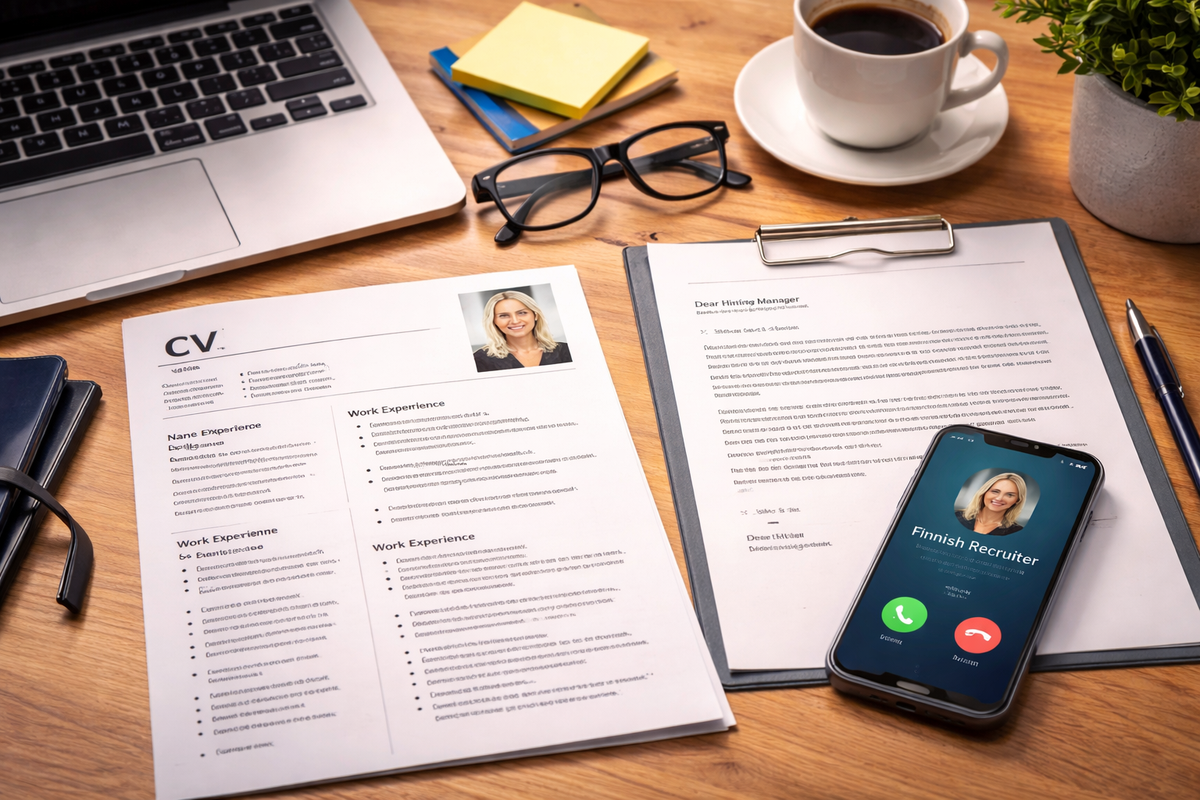
The Finnish job market is pretty straightforward: a short CV of 1–2 pages, specific numbers, calm communication, and respect for time.
At the same time, those who are relocating have their own challenges: non-obvious experience from other countries, imperfect Finnish, lack of local recommendations. In this article, you will learn how to ensure that at least your documents and first contact do not hinder you, but help you: we will analyse a Finnish CV example, a lively cover letter and a recruiter's call — step by step.
It is important to remember that the market is now very digital-first. Public services such as Job Market Finland and TE-services, large portals, and LinkedIn are the standard entry points.
Finnish CV and cover letter: the basics without the myths
What is the "ideal" Finnish CV in the eyes of a recruiter?
Finnish recommendations are very consistent:
● 1–2 pages for most candidates;
● simple, clean design, without frames, flowers or creative fonts;
● reverse chronological order of experience;
● focus on specific results: figures, processes, effects.
Photo — optional. Date of birth, marital status, nationality — not required and sometimes not needed at all. The main thing is what you can do and how you can be useful.
Basic sections:
- Contact details (name, telephone number, email address, city, LinkedIn/portfolio).
- Short profile (2–4 lines in essence).
- Work experience.
- Education and relevant courses.
- Skills and languages.
- Additional information: certificates, volunteer work, projects.
Cover letter in Finnish: why is it still necessary?
Even in 2026, a cover letter remains a must-have for many vacancies. Municipal and state job search services say outright: a good application is a combination of a CV and a cover letter, not just "attaching a CV".
The key feature of a Finnish cover letter:
● ½–1 page, no "Dear Sir/Madam" or "Dear Sir/Madam";
● a clear answer to the question: why this role and how you will be useful;
● minimum embellishment, maximum facts.
Structure:
- 2–3 sentences about who you are and what role you are applying for.
- 1 paragraph explaining why you are interested in the company/field.
- 1–2 paragraphs about relevant experience (with figures).
- 1 paragraph explaining what you can bring to the role and how you see the first few months.
Recruiter call: mini-interview, not a "chat"
Often, after you respond, the first step is not a meeting, but a short 10–20 minute phone call.
Usually, its purpose is to
● to check basic suitability;
● clarify motivation;
● to get a rough idea of your English/Finnish;
● to check expectations regarding salary and terms.
It is very Finnish to warn in advance: "I can speak English/a little Finnish, but if I don't understand something, I will ask again." This relieves tension for both you and the recruiter.
Practice: how to package your experience, figures and references
What to write in your CV profile
A profile is 2–4 lines in which you explain who you are and what you bring to the table. For example:
"Marketer with 5+ years of experience in digital campaigns and e-commerce. Managed budgets of up to €200k/year, helped increase online sales by 20-30%. Looking for a role as a performance specialist in a product company."
The main thing is to avoid phrases like "stress-resistant team player" and stick to facts and focus.
How to translate experience from another country into "Finnish"
Many people fear that experience from the CIS or another country will not be recognised. It is important to highlight three things:
- Scale: teams, budgets, number of users/customers.
- Context: product, industry, type of customers (B2B/B2C/public sector).
- Result: growth, savings, speed, quality.
If you are writing about a large project, add a line explaining what it was: "federal online bank", "regional telecoms company", "international e-commerce".
This is how to find a job in Finland. This is how translating your experience helps: you show that you understand how your results can be scaled to the local market.
Mini-table: CV, cover letter, LinkedIn
Where to look for vacancies and how to tailor your package
Main channels:
● the Job Market Finland government job portal and related services;
● portals for international specialists;
● city and university websites, specialised job boards;
● LinkedIn and direct responses to company websites.
Adapt the following for each type of vacancy:
● your profile headline;
● the first 2–3 bullet points under the role;
● cover letter — for real tasks.
When looking for work in Finland, you will almost always have better luck if you respond to specific roles that match your experience rather than "any job".
Scenarios: junior, mid-level, relocation, student
Junior or first experience in Finland
If you have little experience, the most important thing is:
● internships and real projects (even educational ones, but with results);
● participation in hackathons, student clubs, volunteering;
● how you talk about the future: what you want to learn.
A CV for a junior in Finland may look compact, but with a strong "Projects" section and an honest language level (A2/B1).
Middle/senior with experience in another country
Your task is to scale things down. You can write about teams of 50 people and millions of users, but it is important to add:
● what part you personally led;
● what processes you built;
● which working principles coincide with the Finnish context (transparency, responsibility, balance).
It is useful to include phrases about integration in Finland and willingness to learn the language in your CV and cover letter — this reduces the employer's concern that you might leave after six months.
Relocation for work
If you already have an offer but need to go through HR screening:
● emphasise the connection between your experience and the tasks of the team in Finland;
● show that you understand the local context (distributed teams, hybrid, weak hierarchy);
● don't forget the practical details: moving date, visa status, change of status in Finland or first residence permit.
It is important for the employer to see that you understand not only the technical side, but also the migration/everyday puzzle.
Student and part-time jobs
For students and recent graduates, the map is as follows:
● CV with an emphasis on projects, courses, student initiatives;
● cover letters where you honestly write about your availability in terms of hours (studies vs work);
● a description of how you use work during your studies in Finland as part of your future career, not just as a side job.
It is important to the employer that you do not "drop out" during the exam period and that you understand the rules regarding hours for a student residence permit.
"I thought that no one would be interested in my experience from another country. As soon as I rewrote my CV with an emphasis on numbers and added a cover letter where I linked my background to the tasks of the Finnish team, I started receiving invitations for the first time, instead of silence."
Common mistakes and how not to "mess up" the start
In the Finnish context, this reads as "unable to prioritise and respect other people's time".
It is better to cut out old, irrelevant roles and leave a maximum of 10–15 years of your career, and move internships from 15 years ago to the "other" section.
When the same letter is sent to a bank, an IT start-up and a municipal museum, it is immediately obvious.
Even 2–3 sentences rewritten for a specific role and tasks create the impression that you have actually read the job description.
A little breathing room — and a couple more mistakes.
Spend a month looking for a job, ignore calls "so as not to be disturbed," and then find out that HR tried to call you three times.
You can safely ignore the call and ask them to send a message, but it's better to keep in mind that when you're in the middle of a job search, unfamiliar numbers are often recruiters.
In Finland, it is normal to send a short thank-you note a couple of days later and ask about the next steps.
This shows your interest and gives the recruiter a chance to remember you in a positive light.
Working in Finland is a project, not a lottery
The Finnish job market may seem "silent," but there is a lot of logic to it: clear documents, specifics, polite communication, and patience. When you treat your job search as a project — with a funnel, testing your CV, cover letters, and approaches — your chances of success increase dramatically.
Your CV does not have to be perfect right away. It is important that it is honest, understandable, and lively: with numbers, references, and real tasks. A cover letter is not a school essay, but a bridge between you and a specific vacancy. And a call from a recruiter is not an interrogation, but simply a step towards "let's see how well we suit each other."
If this article has helped you feel more confident, save it, share it with others who are also looking for work in Finland, and tell us in the comments what other questions you would like to discuss regarding CVs, phone calls and interviews.
FAQ
For most candidates, 1–2 pages. There are exceptions for academics and those with very long careers, but even then, conciseness and a clear structure are valued over 5-page "novels".
A photo is not required: many employers are fine with CVs without photos. If you do include one, a neutral portrait photo without creativity or filters, like on a business profile, is sufficient.
For some vacancies, they are critical, especially in the public sector, education and non-profit organisations. Commercial companies sometimes look primarily at CVs and LinkedIn profiles, but a good cover letter still helps you stand out and explain your motivation.
They check whether your experience matches the role's requirements, what languages you speak, when you are available to start, and what your salary expectations are. Sometimes they ask about your visa status and plans to move if you are not already in Finland.
Many IT and international companies actively use LinkedIn, but there are also government portals and local job boards. It is best to combine LinkedIn, Job Market Finland, city services, and direct responses to employer websites.
Yes, especially in marketing, IT, design, and analytics. Tasks are usually limited in time and scope, and it is best to clarify the deadline and expectations for the format. If the task is clearly excessive, you have the right to discuss with the recruiter how to reduce it.
For international companies in Helsinki and the IT sector, English is often sufficient, but Finnish still greatly expands your options and helps you integrate into Finnish society. For government agencies and some service professions, Finnish or Swedish is practically essential.
Check your CV: is it clear what roles you are targeting, are there figures and keywords? Rewrite at least a couple of cover letters for specific vacancies, ask for feedback from recruiters or career services in the city, and test other channels — from searching for work in Finland through government portals to personal networking.
Quite important, especially if you don't have any local experience yet. A couple of contacts (e-mail/phone) from former managers or colleagues show that there are real people behind your words who are ready to confirm your experience.
It varies greatly: from a couple of months to a year, depending on the field, language, flexibility in roles and activity in responses. It is important to make a plan for several months ahead and not expect that the first batch of responses will bring an offer.
You don't need to rewrite everything from scratch, but it is useful to change your profile, the order of your experience points, and a few bullet points for specific tasks. This takes 10-15 minutes, but significantly increases your chances of passing the first filter.

0 comments
Log in to leave a comment