



🧭 Changing the basis for a residence permit in Finland 2026: student → work, business → employment
If you want to understand how changing the basis of your residence permit in Finland works in 2026 — from student to work, from entrepreneur to employment and back — this article is for you.
Life moves faster than plastic cards: you enrolled in a master's programme, and now you've found a full-time job; or you started a business, and now you want a stable salary and scheduled holidays. All of this is normal for the Finnish system, but each such change requires a new basis for residence.
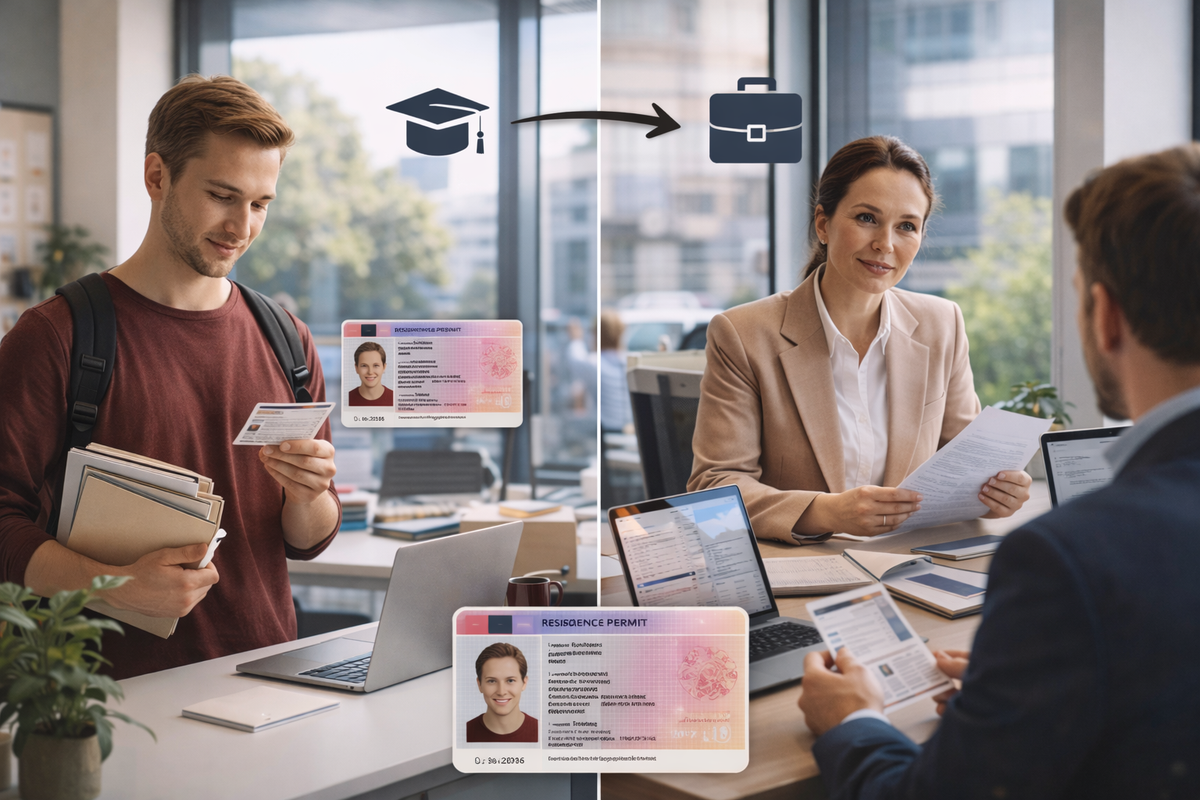
In this article, you will learn:
● what grounds for a Finnish residence permit exist and which ones are most often changed;
● when you need to apply for a new basis so as not to lose your legal right to stay and work;
● how the transitions from "student → work" and "entrepreneur → employment" work, and where the most problematic areas are — contract, finances, address registration;
● what to do about being "tied" to a field/employer and when you need to break that tie with a new application.
The main idea is simple: the basis for a residence permit is not a tattoo; it can be changed. But each time, it requires a new application, a new package of documents, and careful timing.
Residence permit grounds and types: what can actually be changed
The most common grounds in 2026
Formally, there are many options, but in practice the key scenarios are built around four main “pillars”:
What a change of grounds means
A change of grounds is a transition where the main purpose of your stay changes:
Residence permit as a “type” and as a “ground”
It is important to distinguish between two things:
Permit type — temporary (B) or continuous (A). This determines how years of residence are counted towards permanent status.
Ground — studies, work, business, family, etc.
You can change the grounds several times within the same A-type permit and still apply for permanent residence in Finland, as long as there are no major gaps in your residence.
When exactly do you need a new basis?
The rule in 2026 is as follows:
If the purpose of your stay or "tie" (field, employer, business → employment) changes, you must apply for a new residence permit on new grounds.
From the official examples (translated into plain language):
● you are an entrepreneur, you close your business and go to work for someone else — you need to apply as an employee;
● you have an employee residence permit for a specific field, but you want to work in another field — you need a new application for a different field;
● you have a work residence permit tied to a specific employer and want to change employers — you need a new residence permit, and the right to work for the new employer only appears after approval.
However, in the following cases, a new application is not required:
● you have a specialist residence permit and are simply changing employers, but the type of work remains the same;
● you have a residence permit based on a Finnish diploma and you are switching from employment to entrepreneurship or light entrepreneurship — this status allows both.
In other words, it is not the fact that you have found something new that is important, but whether your new life situation falls within the scope of your old permit.
Timing and continuity: how not to "fall out" of status
The golden rule: submit your application before your current residence permit expires
The most important thing is to apply for a new residence permit before your current one expires.
If you apply on time:
● you retain the right to stay in Finland until a decision is made;
● in most cases, you retain your old right to work (while your previous residence permit is valid);
● your period of residence will not be interrupted, and you will continue to accumulate time towards longer-term status.
If you apply after the expiry date:
● this may be a reason for rejection in itself;
● you lose your right to work while the new application is being processed;
● the period may not count towards continuous residence.
Optimal timeframe:
● for student and many work statuses, the advice is no earlier than 2-3 months before the end of the current residence permit;
● for transitions related to a new contract, as soon as you have a real contract in your hands and there is a "window" of a couple of months before the end of your current residence permit.
Mark two dates in your calendar: the expiry date of your current residence permit and the "activity zone" 90-60 days before it. Plan everything related to a new contract or closing your business within this zone, rather than on the last day before your card expires.
What "continuity" means in the eyes of the system
When you think about the long trajectory — from your first residence permit to, say, citizenship — the system looks not only at the years, but also at the "gaps".
You need to make sure that:
● there are no periods in the country without a valid permit;
● you submit new applications on time, without unexplained delays;
● your total time outside Finland does not turn into a life "living out of a suitcase" in another country.
For many people, the goal is to have several years of continuous A permits, which then add up to the right to permanent status. Here, the transition from student to work and then, possibly, to more stable work statuses is one of the most logical routes.
Table: when you need a new residence permit and when you don't
Address, registration, contacts
Another piece of continuity is the registration of your address and contact details.
It is important to ensure that:
● your actual address in Finland is updated in the population register;
● your mail is delivered (especially if you are in the process of changing jobs or moving to another city);
● you notify the authorities of any important changes (marriage, divorce, birth of a child, change of employer) in a timely manner.
This is not about "snitching on yourself," but about ensuring that your life and the data in the system match.
Life transitions: student, entrepreneur, employee
Here, it makes sense to look at a couple of scenarios — they help you to "feel" the timing and risks.
Student → work: first steps after graduation
The most common transition:
- You studied in Finland and found a job closer to graduation.
- You have a signed contract with a Finnish employer and a valid student residence permit.
- Next options:
○ apply for special post-study status (for those who have completed their studies in Finland);
○ or apply directly for a work residence permit for a specific contract.
It is crucial not to delay: the application must be submitted before your student residence permit expires. Then, while your application is being processed, you will remain in the country legally and, in some cases, you can continue working under the old rules.
Entrepreneur → employment: closing a business without failure
The transition from business to employment looks like this:
● you work on an entrepreneurial basis, but the business ceases to be your main source of income;
● a real job offer appears that better meets your financial needs;
● You submit a new application for a work residence permit and honestly state that the business is closing or becoming secondary.
It is important that:
● the contract has already been signed or is very close to being signed;
● the start date of work falls within the validity period of the old residence permit plus a reasonable processing time;
● everything is in order with taxes and business reporting, even if you are closing the business.
Employment → another field or "broad" status
A separate story is when you are already working but want to change in such a way that your old residence permit does not "cover" you:
● Residence permit for a specific field (e.g. agriculture), and you are going into IT → you need a new application for a new field;
● Your residence permit is tied to a specific employer, but you are changing companies → new application, right to work for the new employer — after approval;
● you have a family or "other grounds" residence permit with full right to work, and you change your employer/field — often it is enough to simply notify of the most important changes, no new grounds are required.
Here, it sometimes makes sense to consider a more "broad" status that gives you freedom in terms of work and entrepreneurship and is better suited to your long-term plans.
"I switched from a student visa to a work visa right before the deadline. I wouldn't recommend anyone else do that: while I was waiting for a decision, every call from an unknown number felt like deportation. Now I have three dates in my calendar: the end of my residence permit, the application deadline, and the 'preparation month'."
Changing grounds as part of a long trajectory
Looking at the bigger picture, most people go through several stages:
● study → work;
● work → a freer or "broader" status;
● work/business → family;
● ultimately — continuous A permits, which add up to the right to permanent status or citizenship.
It is important not to be afraid of the change itself, but to keep in mind that each turn is a new application and a new package.
Common mistakes when changing grounds
Now — the very "mines" that are most often stepped on when changing the basis.
Applying for a new residence permit after the current one has expired, counting on "understanding."
From the point of view of the rules, being late is a problem in itself. Yes, sometimes you can explain a serious delay (illness, etc.), but counting on them to "think about it and forgive you" is a bad strategy. Ideally, the application should be submitted 2-3 months before the end of the current residence permit.
After the deadlines, other errors usually arise — already in logic.
Don't tear down your old foundation before you've even applied for a new one.
Stepping into the "void" — quitting your job or closing your business without having a new residence permit or even an application submitted — is a risky move. The system expects you to make sure in advance that your basis does not disappear in a single day.
Another common scenario is confusion about the type of residence permit.
Ignoring the "tie" to a field or employer when both are actually changing.
If your residence permit is written for a specific field or employer, switching to another field or a new employer without a new application may be a violation of the terms and conditions. In Finnish logic, "if we change the terms and conditions, we change the paperwork."
Finally, there is an "internal" error that is not always immediately apparent.
Living for years with one basis, while in reality having completely shifted to another.
For example, a person is registered as a student, but has not been studying for a long time and lives off almost full-time work; or has a family residence permit, but the family has actually broken up, and the main reason for their presence is work. The further the paperwork and reality diverge, the more difficult it is to "clear" the way to longer statuses.
And the final pitfall is communication.
Not notifying the authorities about important changes that clearly affect the basis for your residence permit.
A change of surname, marriage, birth of a child, termination of employment or business — it is better not to hide any of this. In the Finnish system, the logic is simple: you are responsible for keeping your data up to date, and changes that "come to light" retroactively do not look good.
Life changes — your residence permit keeps up with it
Changing the basis for your residence permit in Finland is a normal part of a long journey, not a "contingency plan." You can grow from student status to worker status, from employee to entrepreneur and back again if the business does not work out. One thing is important: your life facts and the plastic in your wallet should tell the same story.
When you plan in advance to transition from student to worker, close your business, change your field or employer, you are actually protecting not only your current status, but also your future steps — from renewals to permanent residence permits. Timing, honesty in your documents, and understanding your "ties" to your field/employer turn a fragile "hope for the best" structure into a clear plan for several years.
If this article has helped you see the whole picture, save it, share it with those who are currently undergoing a similar transition, and come back with any questions you may have. The more real-life experience and clarification there is around such paths, the easier it will be for the next person to follow this path without unnecessary panic.
FAQ
It depends on the type of your permit. If your residence permit is tied to a specific field and you remain in the same field, it is usually sufficient to simply continue working. If your permit is tied to a specific employer or you are working in a new field, you will need to apply for a new residence permit on new grounds.
You need a real employment contract with a Finnish employer and a valid student residence permit. Apply for a new status a couple of months before your student permit expires, without putting it off until the last day. While your application is being processed, you will remain legally resident and, in some cases, retain the right to work.
Closing your business means that the previous basis for your residence permit has effectively disappeared, so you need to apply for a new work residence permit. The best scenario is to apply before closing the company and before your previous permit expires, attaching your employment contract. This way, you avoid a "gap" between bases and maintain continuity.
Usually 2-3 months before the expiry of the current permit, depending on the type of status. Earlier than that, you risk your case being more difficult to assess; later than that, you may lose your right to work and encounter problems with continuity. The focus is always the same: apply before the expiry of the old residence permit.
If you have a work residence permit linked to your field of employment and your new contract is in the same field, you can often change employers without submitting a new application. However, if your card explicitly states that it is linked to a specific employer, you will need a new residence permit when changing companies, and you can only start working for your new employer after it has been approved.
This creates an additional risk: you may lose your right to work until a decision is made and be denied due to late submission. Sometimes valid reasons are taken into account, but the basic logic of the system is "submit on time — your rights are preserved," "be late — you take a risk." It is better to set a time buffer in your calendar.
Yes, if your current status allows you to work in general, and not just for a specific employer. For example, some family and "diploma" statuses allow both employment and entrepreneurship without a separate change of status. The main thing is not to go beyond the terms of your residence permit and not to forget about taxes and reporting for both streams.
It is best to update your address and key life changes (marriage, divorce, child, termination of employment or business) through official channels. This helps to keep your data up to date and reduces the risk of issues in the future, especially when renewing or applying for longer statuses.
The fact of changing the basis does not reset your experience — it is more important that your permits are continuous and relate to the required type (usually A). The time spent with such residence permits counts, even if you switched from studying to working or from working to running a business. It is crucial to avoid "gaps" in your status and long periods of living outside Finland.
Technically, yes: the system allows multiple applications on different grounds, with a separate decision for each. This sometimes makes sense if you have, say, a job offer and a strong entrepreneurial case at the same time. But keep in mind that each application is subject to a separate fee, and you will ultimately only have one status — based on the decision that is made.
It is best to start as soon as you have a real "foothold": a job offer, a business idea with clients, or significant family changes. You can gather the documents and plan gradually, keeping in mind the deadline for your current residence permit. Then changing the basis for your Finnish residence permit will seem like a smooth step, rather than a fire-fighting exercise on the last day of the card's validity.

0 comments
Log in to leave a comment