



🌌 From your first residence permit to a passport: how to build a long-term trajectory in Finland
If you want to understand how to build your path to Finnish citizenship in 2026 — from your first residence permit to permanent status and a passport — you've come to the right place.
It usually starts with a specific step: a contract, studies, family, starting a business. But from the very first card, you are actually choosing not only "what I live on now," but also how the next 4–8 years will unfold.
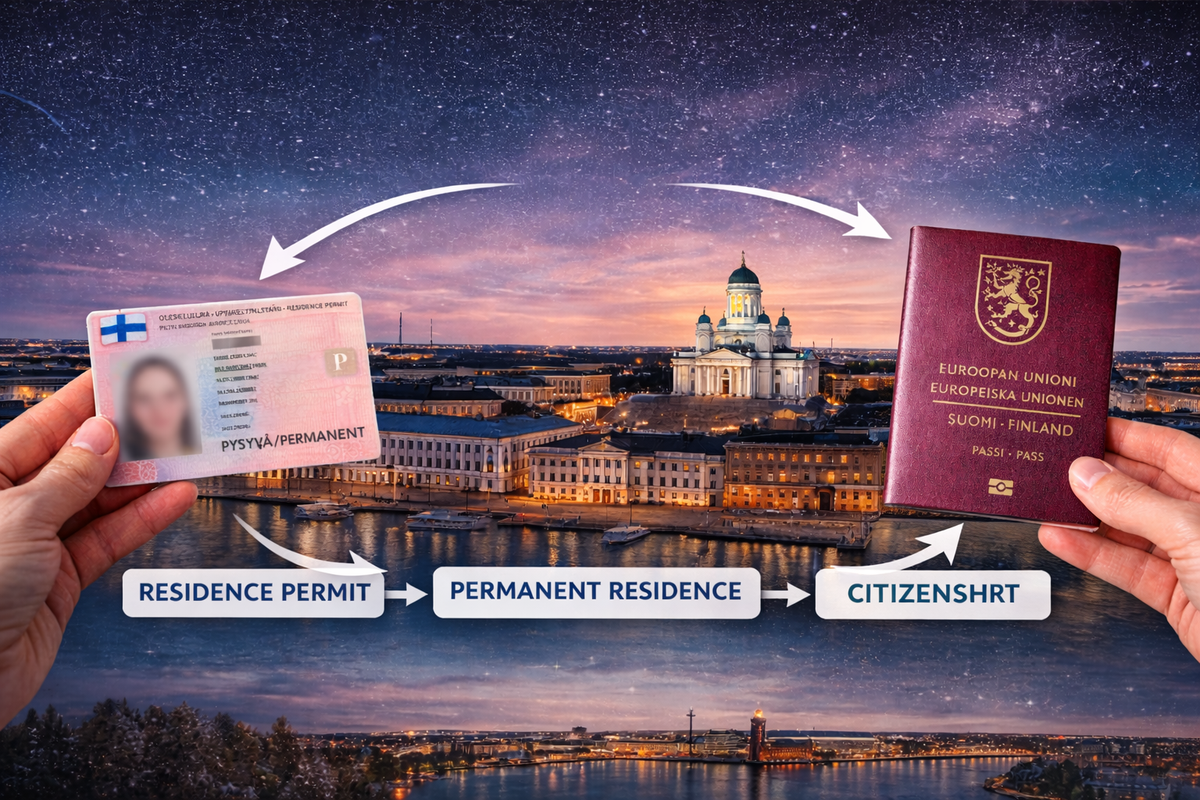
In this article, you will learn:
● the difference between renewal, permanent residence and EU long-term status;
● what "continuous residence" is and why one missed deadline can delay your dream of getting a passport for years;
● how the logic of citizenship changed in 2024–2025 (total period of up to 8 years, language, reputation);
● at what stage which documents and habits really determine the outcome: from stable income to the YKI exam.
The main idea is simple: the long journey begins not with an application for citizenship, but with the first residence permit. And the sooner you see the big picture, the fewer surprises you will encounter along the way.
Types of residence permits and extensions: the basis of a long journey
A, B, P: three letters that determine years
There are several levels in Finnish documents:
● temporary residence permit — type B;
● continuous residence permit — type A;
● permanent — P type, plus a separate P-EU for long-term EU residents.
It's easy to remember:
● B — "temporary", does not count towards permanent residence;
● A — your building material for the future P;
● P — when you no longer need to justify your choices every few years.
Even at the stage of choosing a basis (study/work/family/business), it is important to see which ones will give you an A-type and according to what logic. For example, many student residence permits for higher education have become A-type, while short or vocational programmes can still be B-type.
Renewal: extended permit as a working "routine"
Every temporary residence permit (B or A) has an expiry date. When it expires, the first fork in the road appears:
● you no longer plan to live in Finland → you simply leave without renewing anything;
● you want to continue → apply for an extended permit — a new fixed residence permit.
The official logic is as follows:
● extended permits are granted for a maximum of 4 years;
● the basis must essentially remain the same as before — or be the same as that on which you were granted your first residence permit;
● the best time to apply is ~3 months before the end of your current card.
Important: an extended permit can be both an extension and a change of grounds if you are "rebalancing" your life on a different foundation (for example, after studying and job-seeker status, you are moving on to work).
What counts as "continuity"
For a long trajectory, the key word is continuous residence with A-types:
● you need 4 years with an A residence permit without any gaps between cards to be eligible for P (as of the end of 2025);
● time on a B residence permit does not count towards this four-year period;
● short trips (holidays, business trips) do not break continuity if you live in Finland most of the time.
A separate issue is the government's plans to tighten requirements and raise the threshold to 6 years with an A-type residence permit plus language and work experience. By the time you apply in 2026, the rules may have changed, so it is always a good idea to check the current conditions before applying.
Mini-table: what we live on at different stages
If you have an A-type visa and you know you will be living in Finland for a long time, look ahead to the next 4–8 years, rather than just the term of your current card.
Permanent residence permit and P-EU: when you can breathe easy
Regular P status
A permanent residence permit (P) is when annual or two-/three-year renewals become a rare occurrence, and the right to live and work in the country becomes much more stable.
As of the end of 2025, the general logic is as follows:
● you have lived in Finland for at least 4 years with a continuous A residence permit without any breaks;
● the grounds on which the A permit was issued are still valid (work, family, business, etc.);
● you have actually lived here, not just kept your card in your pocket (there are requirements for actual presence).
At the same time, a transition to a "6 years + language + work experience" model is already being discussed, so the conditions may become stricter by 2026.
The good news is that changing the grounds for obtaining a P permit does not in itself reset your work experience — what matters is the continuity of your A permits, not whether you were an employee the whole time or studied for a period of time.
P-EU: another level of freedom
EU long-term status (P-EU) is a "level 2" after the usual P:
● you need at least 5 years with an A residence permit;
● you have not lived outside Finland for too long (usually no more than 10 months during these years);
● you have sufficient means to support yourself.
P-EU gives you slightly more options for moving to other EU countries under the rules for long-term residents — convenient if you can see your career extending beyond Finland.
When to apply for P / P-EU
It is officially permitted to apply:
● on P — as soon as the residency requirement is met (you can apply even ~3 months before reaching the 4-year mark);
● for P-EU — when the 5-year continuous period is complete.
It is not necessary to wait for the current card to expire: if you have reached the required length of service, it makes sense to switch to a more stable status in advance.
Finnish citizenship: the final stage
Terms: 8 years by default, but there are exceptions
After the 2024 reform, the basic rule is as follows:
● the total required period of residence for citizenship is 8 years;
● in some scenarios, 5 years is sufficient (if language and several other conditions are confirmed);
● for citizens of northern countries, the period may be even shorter.
This does not mean that everyone is required to wait exactly 8 years: you need to look at your combination of status, language, and family circumstances.
Language: YKI and other options
For adult applicants, the standard route is YKI at a minimum level of 3 (B1) in Finnish or Swedish.
There are other options for confirming language proficiency (school certificates, civil service language qualifications), but the vast majority of migrants go through YKI.
If your goal is citizenship, it is wise not to put off learning the language until later.
● not to put off learning the language "until later";
● start gently — clubs, libraries, courses;
● keep your goal in mind: by the time you reach the required length of residence, you will already have the necessary level and document.
Integration and "reputation"
In addition to work experience and language skills, the following are important for citizenship:
● Establishing your identity (documents, consistent history)
● no serious offences;
● a stable centre of life in Finland — work, family, housing, participation in society.
How you have behaved over the years — paying taxes, responding to official mail, responding to requests in a timely manner — becomes part of your invisible "CV" for citizenship.
Common pitfalls and how to avoid them
Now, let's talk about what most often disrupts a smooth trajectory.Treating renewal, P and citizenship as different quests, rather than a single line.
In practice, everything is connected: discrepancies between actual life and the basis for residence, income issues, old fines or unanswered document requests come up during renewal, P consideration, and citizenship. Think in terms of a trajectory, not separate applications.
Many problems start with timing.
Confusing the "application deadline" with the residence permit expiry date and playing with the borderline.
Formally, there may be some nuances, but the general logic is strict: if you apply on time, you remain within the law; if you apply after the deadline, you risk losing your continuous residence and right to work.
The third classic mistake is to ignore the types of residence permits.
Not distinguishing between temporary and continuous residence permits and thinking that any year "counts towards the total."
In fact, it is continuous A-years that pave your way to P and citizenship; B is more of a "buffer" or temporary step. It is a mistake to live on a temporary basis for years and hope that they will automatically convert into seniority.
The fourth mistake is to wait until the very end.
Putting off the language test until "someday," even though it is already required at the P stage and affects the timing of citizenship.
Given the reforms, language begins to play a role earlier — both for permanent status and for a reduced citizenship timeline. It is much easier to take small steps every 5–8 years than to organise a "language marathon" at the very end.
And finally, the fifth — don't sign your story.
Not tracking statuses, not responding to requests for additional documents, not updating data.
In reality, you are the project manager of your own case. The system will send you a letter, but it is your job to respond and provide additional information. A missed request can delay the review or lead to a rejection when everything could have been resolved with a single PDF page.
- I know what type of residence permit I have (A/B) and when it expires.
- I understand when my experience towards P and citizenship starts counting.
- I follow the rule: I submit new applications while my current residence permit is valid.
- I plan to learn the language not "sometime in the future" but within the next 1-2 years.
- I keep a basic set of documents on hand: employment contracts, tax documents, statements.
Your own trajectory instead of random decisions
Finland is a country that loves long-term plans and stable stories. The same applies to migration: the clearer your path is ("first residence permit → renewal → P → citizenship"), the more peaceful your life will be and the easier it will be to explain your steps to any authority.
If you look at 2026 not only as a "year of renewal" but as one of the steps on an 8-year path, decisions become easier: what status is suitable, when to apply, what to improve — language, income, documents.
If this article has helped you to sort out a long trajectory, save it, send it to friends in a similar situation, and feel free to ask questions — real-life cases and clarifications only make such guides stronger and more accurate.
FAQ
Under the current rules, the benchmark is four years of continuous residence with an A-type residence permit without any gaps between cards. However, stricter requirements are being discussed, so it is worth checking the current conditions before applying in 2026. The time spent on a B-type residence permit is not included in this period.
Yes, changing your basis does not in itself reset your length of residence: the continuity of A cards is important. You could have been a student, then an employee, then an entrepreneur — if there were no "gaps" between cards and the basis was always honest, the time is added up.
The general guideline right now is 8 years of residence, but there are scenarios with a 5-year term and even shorter for northern citizens. Additionally, you need language skills, confirmed identity, and no serious violations of the law, so simply "living" the required number of years is not enough.
If you have already accumulated the required length of service under an A residence permit, there is no point in waiting until the end of the term: you can apply approximately three months before or immediately after fulfilling the residence requirement. This helps to stabilise your status earlier and avoid frequent renewals.
If you had an A-type residence permit during your studies, this period can count towards your P residence permit (and, indirectly, citizenship). The time spent with a B status does not count towards the continuity requirement for a P residence permit, but it is still important as part of your history. It is best to check your specific situation against your current residence permit documents.
In most scenarios, yes, you need to prove your language skills in some way, and the YKI exam at level 3 (B1) is the most common way for adult applicants. There are alternatives (school, other certificates), but without proven language skills, it is difficult to obtain citizenship.
Yes, too long absences can interrupt the continuity of residence or make it difficult to prove that the centre of your life is here. Short holidays and business trips usually do not cause problems, but systematically "living in two places" in different countries complicates the process.
Formally, you can apply for citizenship without P status if you meet the requirements for residence, language and other conditions. But for many people, P status is a logical intermediate step: it stabilises their situation and helps them smoothly transition to citizenship.
No, if you did not interrupt your legal residence when changing the basis. It is the period of residence in the country that counts, not how many times you have changed the type of residence permit — provided that you have lived legally and that the facts and the basis coincide.
First, it makes sense to look at P: it stabilises your life and gives you freedom in work and planning. At the same time, you can work on your language skills and integration so that you don't have to start from scratch on the path to citizenship later. If you are already close to the 8-year threshold and meet all the conditions, it may be more logical to aim for a passport right away.

0 comments
Log in to leave a comment