



🏡 Long-term rental in Finland 2026: contract, deposit and hassle-free move-outs
Why long-term rentals are about rules, not just price
If you want to understand how long-term rentals work in Finland in 2026 — what clauses to look for in the contract, what a healthy deposit is, how indexation works, and how much notice you need to give when moving out — you've come to the right place.
Finnish houses, with their thick insulation, warm floors and glass balconies, look like the promise of a peaceful life. But behind the beautiful façade, there is always paperwork: a rental agreement that literally spells out who is responsible for what, when the rent can be raised and how you will leave the flat if life takes a turn for the worse.
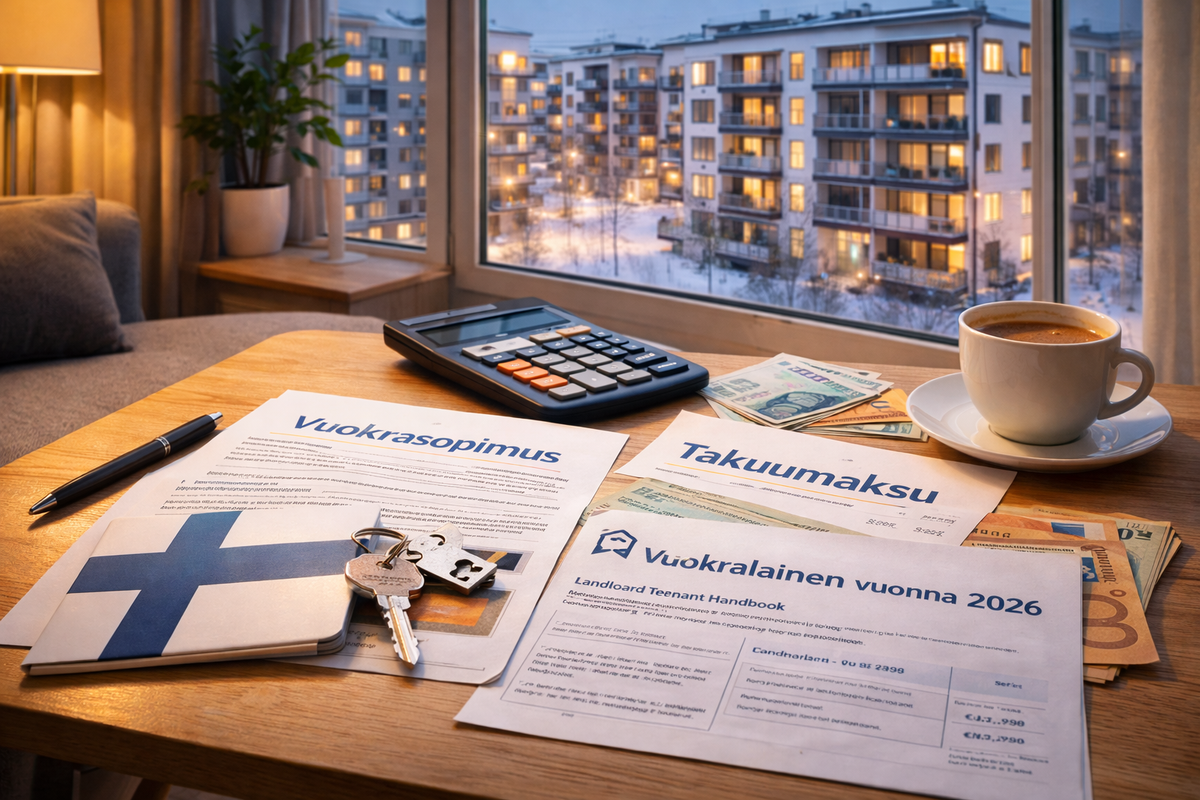
In this article, you will learn:
● the difference between open-ended and fixed-term contracts, which clauses are mandatory and which ones should raise a red flag;
● how rent deposits work in Finland: how many months is the norm, how to protect your money, and when it must be returned;
● what rent indexation is in Finland, which indices are most often referred to, and why it is not legal to simply "raise the rent because everything has become more expensive";
● how notice periods for tenants and landlords work, and why a "month" in Finland is not counted as many people think.
The main goal is to ensure that the contract does not seem like a scary legal document, but is perceived as transparent rules of the game in which both you and the landlord feel protected.
Tenancy agreement: types, key points, red flags
Two basic types: open-ended and fixed-term
In Finland, the vast majority of housing contracts fall into one of two categories:
- Perpetual contract (toistaiseksi voimassa oleva) — valid "until further notice".
- Fixed-term agreement (määräaikainen) — has a specific end date.
Each has its own characteristics:
● Perpetual contracts are convenient because you can terminate them at any time, subject to the notice period.
● Fixed-term contracts are often given to students or for the first few years — but until the end of the term, you are protected from termination by the owner without serious grounds.
Important: with a fixed-term contract, you usually cannot simply "change your mind" and move out earlier, unless this is expressly stipulated as a special condition.
What must be included in the contract
The minimum set of points without which it is better not to sign the contract:
● details of the parties: full name/company name, personal/registration numbers, contact details;
● exact address and apartment number, type of accommodation (room, studio, family, student);
● rent amount, payment terms and method of payment;
● deposit amount and conditions under which it may be partially/fully retained;
● term of the contract (indefinite or fixed term with dates);
● mandatory expenses: whether water, heating, internet, parking, sauna are included in the rent
● rules on smoking, pets, subletting, overnight guests (if registered);
● the procedure for increasing rent (indexation, fixed percentage, pause for the first few years);
● termination procedure: how and how many days/months in advance to give notice.
The more detailed the description, the less chance there is of "misunderstandings".
Table: open-ended vs fixed-term contract
Red flags in the contract
There are clauses that should raise alarm bells:
● a deposit of more than three months' rent — this cannot be legal;
● the phrase "the landlord may increase the rent at their discretion" without a specific mechanism;
● very long notice periods for the tenant (by law, these cannot be increased beyond the norm);
● penalties for "normal wear and tear" — according to the law, normal ageing of the flat is not a reason to write off the deposit.
If you see something strange, it is better to ask a question or show the contract to a lawyer/tenants' organisation you know before signing, rather than after a conflict arises.
Deposit, indexation and notices of eviction
Deposit: how much, how and what it protects you from
A deposit (vuokravakuus) in Finland is not a "gift to the landlord" but a guarantee in case of:
● unpaid rent;
● serious damage to property;
● final cleaning not being done.
By law, the deposit cannot exceed three months' rent, but in practice it is usually 1-2 months. In some municipal/student systems, the deposit may be zero or fixed (e.g. €0 or €500) — this is also normal.
It is very important to understand the difference between
● normal wear and tear (faded paint, slightly scuffed laminate flooring) is not a reason to touch the deposit
● actual damage (burnt floor, broken window, large holes in the walls) — yes, these can be covered by the deposit, but with justification.
The correct practice is to keep the deposit in a separate account and return it "without undue delay" after moving out, if everything is OK with the flat and payments.
This is where it is convenient to build in an anchor: when discussing the deposit for renting in Finland, do not hesitate to ask the owner a direct question — which account it will go to, how it is processed, and when it will be returned after the end of the contract.
Always ask for written confirmation of receipt of the deposit and a separate letter/clause in the contract stating when and under what conditions it will be returned. It may be just one sentence, but it will save you a lot of stress when you move out.
Indexation and rent increases: what are the rules?
The Finnish logic is simple: a landlord cannot simply "raise" the rent unless the contract specifies the grounds for the increase.
Partial options:
- Rent indexation — linking to an index (most often the consumer price index or the cost of living index). In this case, the rent increases in line with official statistics.
- Fixed percentage — for example, +2–3% per year.
- Fixed amount — for example, +30–40 € once a year.
For many fixed-term contracts of less than three years, the indexation clause is considered invalid, i.e. the fixed rent cannot be increased during the term.
This is where the anchor comes in handy: when you see rent indexation Finland in the text of the contract, look for three things nearby — a specific index (in Finnish it will be something like elinkustannusindeksi or kuluttajahintaindeksi), the month of the base value and the month of revision.
Notices of termination: one month is not 30 days
For an indefinite contract, the rule is as follows:
● the tenant can always terminate the contract with one calendar month's notice;
● the landlord can terminate the contract with three months' notice if you have lived there for less than a year, and six months' notice if you have lived there for more than a year (and only if there are legal grounds for doing so).
A subtle point is the "calendar month":
● if you gave notice on 10 March, you can move out at the end of April without paying extra;
● if the notice was given on 31 March, then your last month of payment is April.
It is not possible to increase the notice period for the tenant by contract — this is against the law, even if you have signed such a contract.
Move-in and move-out: report, cleaning, photo documentation
Handover report in Finnish: not always a "report", but always an inspection
In Finland, there is no single mandatory state "acceptance and transfer act", but almost all responsible landlords and housing companies inspect the flat upon move-in and draw up something very similar to an act:
● an inspection form is filled out (on paper or online);
● visible defects (scratches, stains, cracks, chips) are recorded;
● photographs are often taken before or immediately after moving in.
Your task is not just to sign "seen", but to:
● walk around the flat with your phone and take your own photos;
● carefully read the inspection form and add your comments if you see anything else;
● keep a copy of the form and photos (in the cloud, not just on your phone).
Ideally, you should also send the owner/management company a letter with the photos attached and a brief list of defects in the first few days of your stay.
- Walls, floor, ceiling — cracks, stains, large chips.
- Bathroom — condition of tiles, joints, ventilation, no leaks.
- Kitchen — stove, oven, refrigerator, mixer tap, worktops.
- Lighting and sockets — do all lamps and power points work?
- Balcony, storage room, varasto — presence and condition of shelves, locks.
- Common areas (if any): laundry room, sauna, bicycle storage.
Check-out: cleaning, minor repairs and final inspection
When moving out, the logic is the same:
● you do a final cleaning (in Finland, this is taken seriously);
● fill in any holes left by shelves, remove your structures, take out all rubbish;
● return all keys, passes, and key rings.
The management company or owner conducts a final inspection, sometimes with photos and a checklist. It is at this stage that the fate of the deposit is decided:
● if everything is clean, nothing is broken, and the rent has been paid, the deposit is returned in full;
● if there are serious defects, they must show you exactly what is wrong and explain how much of the deposit is being withheld and for what reason.
It is normal to ask for a "cleaning checklist" or moving-out instructions in advance: many companies (especially student-run ones) provide ready-made lists of "what to clean and how".
"My partner and I rented a flat in Espoo and on the first day we walked around every wall with our phones. It seemed like overkill, but then when we moved out, those photos helped us refute claims about 'scratches from you'. We got our deposit back in full."
- Clean the kitchen: oven, hob, fridge (including rubber seals and drawers).
- Clean the bathroom and toilet, remove mould, wipe down the cabinets.
- Vacuum and wash the floors in all rooms and on the balcony.
- Fill in small holes from dowels (if not prohibited by the rules).
- Remove all your decorations, curtains, hooks, unless otherwise agreed.
- Take a couple of photos of the clean flat and only then hand over the keys.
Common mistakes made by tenants and how to avoid them
Let's be honest: most rental conflicts in Finland arise not from malicious intent, but from misunderstandings and carelessness.
And then wondering why "you can't just move out in a month".
A couple of minutes spent finding the start and end dates (or the absence of an end date) in the contract can save you months of unnecessary payments and conflicts.
Paying 4-5 months in advance or transferring money "to a personal card" without basic confirmation.
The law clearly states a maximum of three months, and good practice is to have a separate account and written confirmation. If you are asked for much more or to "just transfer to this IBAN without a contract," this is a red flag.
It is important to insert normal text between errors to give your eyes a rest.
Assuming that "if something is written about the index in the contract, we'll figure it out later."
In reality, the wording can vary greatly. It is better to ask right away: what index is it tied to, in which month is it recalculated, and how will it look in euros. In most cases, it is easier for landlords when tenants understand how the rent increases.
The next pitfall is notices about moving out.
And then receiving a bill for an additional month because Finland counts by calendar months.
You want to move out "exactly 30 days later", but according to Finnish rules, the count starts from the end of the month when you sent the notice. It's easier to accept this math right away than to argue later and pay extra anyway.
And lastly, relax about cleaning and photos.
Hoping for the best and then arguing over trifles that can easily be covered up with a good final cleaning.
A tidy flat + photographic evidence = a high probability of a full deposit refund. All other scenarios are a game of "he said, she said," which few people enjoy.
A home as part of a long journey, not a temporary "address"
When you look at rent as just a line in your budget, it's easy to miss the main thing — the space where you live, sleep, learn Finnish, work, and entertain guests. The contract, deposit, indexation, notifications — none of this is about whether you are loved, but about how predictable your life will be in the coming years.
A good long-term rental in Finland is not an ideal flat in the centre of Helsinki, but a combination of a clear contract, an adequate deposit, understandable rules for rent increases, and respect for the house and the people around you. Once this structure is in place, you can relax and focus on work, study, integration, and the next steps — from extending your residence permit to, perhaps, getting your own mortgage.
If this guide has helped you break down renting into understandable pieces, save it, share it with those who are currently looking for accommodation, and feel free to ask questions or share your stories. The more real-life cases there are, the easier it is for those who are just entering the Finnish rental market to avoid unnecessary pitfalls.
❓ FAQ
If you already know that you will be staying in the city for a long time, an open-ended contract is more convenient: it gives you flexibility, and you can move out with one month's notice. A fixed-term contract is convenient for students and those who have come for a limited project, but it is important to remember that such a contract cannot usually be terminated early without special conditions or agreement with the owner.
By law, the maximum is three months' rent, but in practice, 1-2 months' rent is more common, and in student/municipal systems, the deposit may be fixed or zero. It is important that the amount is specified in the contract and that payment is made by bank transfer with confirmation, rather than "just transferring it to the card".
Only if the basis for the increase is specified in advance in the contract: index, fixed percentage or amount. The format "we will raise it if we want to" does not correspond to Finnish practice. Before signing, make sure that the clause on indexation/increase is clear to you in euros, not just in abstract percentages.
With a permanent contract, the tenant can always terminate the contract by giving one calendar month's notice. This means that if you send the notice in the middle of the month, payment usually continues until the end of the following month. For the landlord, the notice period is longer — 3 or 6 months, depending on the length of the lease.
Not always, but the flat must be really clean: the kitchen, bathroom, floors, windows — everything must be in a condition that is "ready to move in". If the contract explicitly mentions professional cleaning, it is worth discussing this point in advance. In any case, a good final cleaning is the best investment in getting your deposit back in full.
Formally, this is not an obligation, but it is a very strong defence. Before and after photos, plus a short letter listing existing defects, help to separate old traces of life from new damage. In controversial situations, this is often a decisive argument.
It depends on the contract: some allow pets, some prohibit them, and some require separate agreement. If you already have a pet or are planning to get one, it is better to look for options where it is explicitly allowed and discuss the details before signing — noise, odours, and possible damage are also part of the agreement.
Usually, minor household repairs (e.g., replacing a light bulb) are the responsibility of the tenant, while major breakdowns due to wear and tear are the responsibility of the owner or housing company. If you break something yourself, it is quite possible that it will be covered by your deposit or liability insurance, so it is better to report any damage honestly right away.
First, you can politely ask the landlord if they are willing to change the wording. If not, check the basic rules (InfoFinland, KKV, tenant organisations) and, if necessary, show the contract to a specialist. It is important to remember that certain clauses that worsen the tenant's position in relation to the law may be invalid, even if you have signed them.
First, request a written explanation of why the deposit is being withheld and for what amount, with receipts/estimates attached. If the explanation is not convincing, you can try to negotiate directly, and if that fails, contact tenant organisations or the consumer ombudsman. You will have the move-in and move-out reports/photos, letters and rent payment statements on your side.
With an honest understanding of your budget and time frame: how much are you willing to pay for housing, in which area do you want to live, and how long do you plan to stay? Then — advertisements, viewing areas, checking the landlord's reputation, and carefully reading the contract. If you approach this as a project rather than a matter of luck, your chances of finding a peaceful long-term rental will increase dramatically.

0 comments
Log in to leave a comment