



🏦 Money at the start in Finland 2026: bank account, verokortti, insurance and peace of mind
Finland at the start: how much does it cost to "live normally"?
If you want to understand how money works in Finland in 2026 — from bank accounts and verokortti to apartment insurance and a budget "so you don't have to worry until payday" — this article is for you.
Cold air, a quiet tram stop, lights in the windows of neat brick houses... And you, having just moved: a new country, a new system, and the main question in your head: "Will I have enough money, or have I overlooked something?"
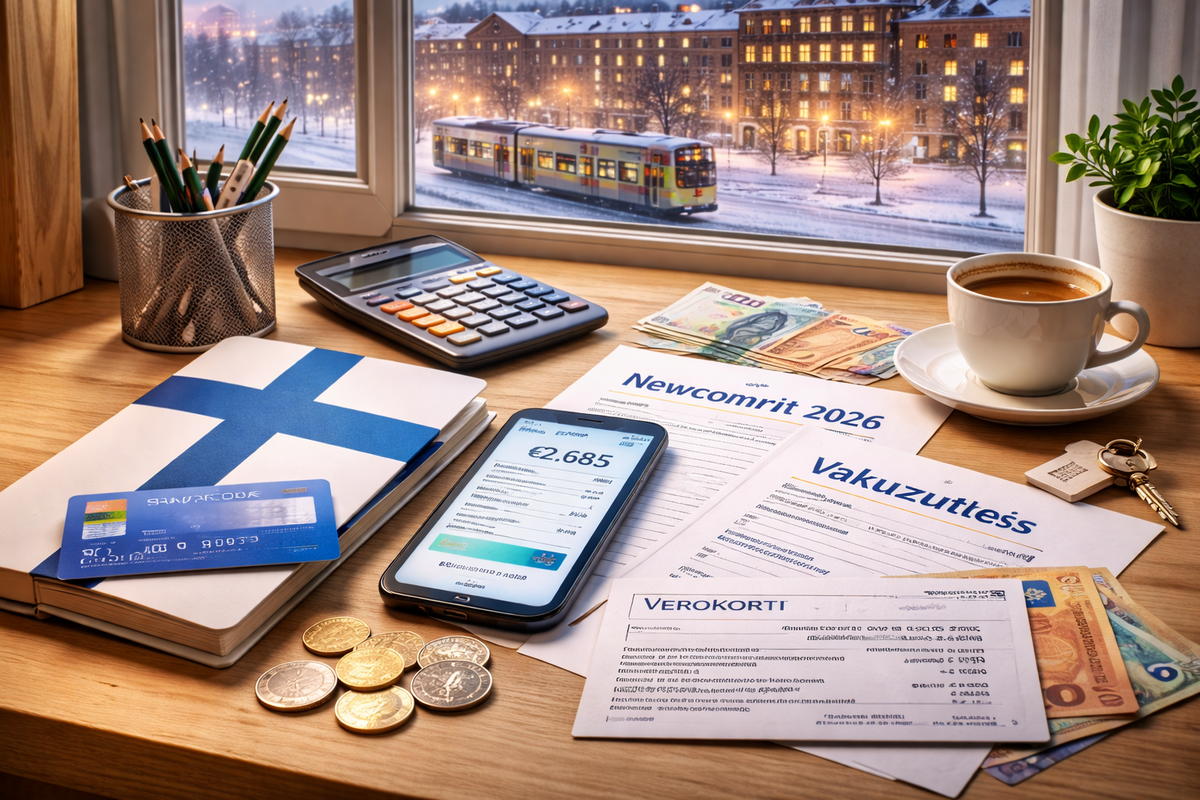
Finland is honest: yes, it's not cheap here, but the rules are transparent. On average, in 2025–2026, a student in a large city will spend €700–1,200 per month, and universities warn that it is more comfortable to budget €1,000–1,300+ per month for living in Helsinki, without any frills. For an adult renting accommodation on the open market, the cost can easily rise to €1,500–2,000 or more, especially in the capital region.
In this article, you will learn:
● how to open an account in a Finnish bank and why you need one, even if you already have a Eurocard from another country;
● what a verokortti is, why 60% of your first salary may be withheld without it, and how the Finnish tax card works in real life;
● which types of household insurance are really important, how home insurance works in Finland, and when a landlord will simply refuse to give you the keys without a policy;
● how to put together a realistic budget and not deceive yourself about the cost of living in Finland by looking at your own figures rather than other people's memes.
The goal is to make money a background factor: not a source of daily stress, but a quiet, understandable system that works for you.
Bank account and verokortti: the financial skeleton
Why do you need a Finnish account if you already have a Eurocard?
Technically, many services work with foreign cards. But in real life, it quickly becomes clear that
● your salary is paid into a Finnish account;
● many landlords want a Finnish IBAN;
● identification in online services (taxes, Kela, public services) is often tied to bank codes.
In other words, having your own account is not just "nice to have" but actually the key to a normal life in the system.
To open an account with a major bank, you usually need:
● a passport or other recognised document;
● a Finnish personal identification code (henkilötunnus);
● residence permit (residence permit or EU registration);
● sometimes proof of address and employment (rental agreement, employment contract, letter from a university).
Banks have the right to assess risks and sometimes refuse or request additional documents — it is not always about you, sometimes it is simply a compliance policy. Therefore, a normal strategy is to apply to 1–2 banks at once and not be offended if one says "no".
Take your "adult life folder" with you to the bank appointment: passport, residence card, rental agreement, employment contract/offer, letter from your university, statement from your foreign account. The fewer questions there are about your identity and the origin of your funds, the smoother the process will be.
Once approved, you will receive:
● a current account (usually with a card);
● online banking + codes for e-identification — these are convenient for logging into government services.
Verokortti: so that 60% is not deducted from your first salary
Verokortti is a tax card with your income tax rate. Your employer is obliged to withhold tax according to the verokortti data; if you do not have a card, they will withhold tax at the maximum rate (up to 60% for some types of income).
To get your first card in 2026, you need:
● a Finnish personal ID;
● an estimate of your annual income (salary, scholarships, part-time jobs);
● documents: passport, employment contract/offer, sometimes a certificate from a university.
There are usually two ways to do this:
- MyTax (OmaVero) — an online tax service where you fill in your details and receive an electronic card.
- Visit the Vero office in person (or International House Helsinki/local service points) — you bring your documents and often receive your card immediately.
It is important to understand how the Finnish tax card works when you start your first part-time job: without it, even a couple of shifts in a café can suddenly be subject to very heavy taxation.
Verokortti, part-time work and multiple sources of income
If you have:
● one job → usually one card with one main percentage is sufficient;
● several part-time jobs, freelance work and, for example, social benefits → you may need separate types of verokortti (for salary, business income, benefits).
The main rule:
It is better to calculate and update your verokortti once than to receive a large tax bill with additional payments at the end of the year.
Do not be afraid to order a new verokortti during the year if your income has changed. This is normal practice, not "too many questions for the tax office".
Home insurance: housing, belongings, liability
Home insurance: insurance for your flat and your belongings
In Finland, home insurance is almost a basic household standard. Rental agreements often state explicitly that keys will not be handed over without it.
The scheme is as follows:
● the building is insured by the owner (housing company);
● you insure your own property and some of the risks (flooding your neighbour's flat, breaking a window, a fire caused by your candle);
● the policy often includes personal liability, which can save you from unpleasant bills if something happens in the flat through your fault.
Therefore, home insurance in Finland is not a formality, but a real working tool.
What a basic tenant's policy usually covers:
● items in the flat (furniture, appliances, clothing, sports equipment);
● damage from fire, water, certain types of theft;
● sometimes — household liability (if you accidentally damage something).
It does not cover (often):
● very expensive "toys" (collections, individual jewellery, etc. — there may be separate conditions for these);
● wear and tear and "broke on its own";
● situations where you have grossly violated the rules (e.g. smoking where it is prohibited).
The cost of home insurance for a small flat is usually around several dozen euros per month — a significant amount, but one flooded parquet floor will easily cover years of premiums.
Other insurance policies worth discussing
The minimum set that makes sense to consider in the first year:
● liability insurance (often included in home insurance, but it is better to check);
● insurance for personal property outside the home (bicycle, laptop in the library, etc., if this is critical for you);
● travel insurance (if you often travel to other countries).
Healthcare is a separate issue: some people are covered by the Kela system and public healthcare, while others have private insurance (especially students from countries outside the EU/EEA). This article focuses on everyday life, but it is also important to keep basic health insurance in mind.
First-year mini-budget: figures by category
Rent: half the budget (and sometimes more)
In large cities such as Helsinki, the cost per square metre on the free market in 2024–2025 will be around €22/m², and in the subsidised sector around €14.5/m².
What this means in real life:
● a 25–30 m² studio on the free market → €550–750 in less central areas, higher in the centre;
● a one- or two-room flat of 40–50 m² → easily exceeds €900–1,200+ in the capital region;
● student accommodation is a world of its own: €450–800 in Helsinki, cheaper in other cities.
If you are still choosing where to live in Finland at the start, it makes sense to "play" with your budget right away: the same profession and salary in Tampere or Oulu can feel much more comfortable than in Helsinki.
Transport, communications, internet
Transport:
● A travel pass for the ABC zone in the capital region easily costs €70–100+ per month.
● it is slightly cheaper in other cities, but the principle is the same — it is more profitable to pay for regular trips with a travel card.
Communications and internet:
● mobile communications with unlimited internet — €15–30 per month, depending on the operator and tariff;
● Home internet — €20–35 (sometimes included in the rent or housing company fees).
Food and basic expenses
Universities and scholarship programmes are honest about this: in addition to rent, you will need at least €400–500 for food and basic necessities (clothes, household chemicals, and other small items).
If you save a lot, shop at cheap chains and cook at home, you can spend less. But it's better to be conservative and enjoy the savings than the other way around.
Total for a "modest" budget for one person in a large city without any particular extravagances:
● rent: €600–900 (depending on the city and type of accommodation);
● transport: €50–90;
● communications + internet: €30–60;
● food and basic living expenses: €400–600;
● insurance, small expenses, clothing: €100–200.
In total, this easily adds up to €1,200–1,800 per month for an adult in 2026, if we are realistic. For a student in inexpensive accommodation, the lower limit is lower, but the magic €500 "for everything" is almost nowhere to be found.
The cost of living in Finland is perceived differently: some find it high, others compare it to large cities in the EU. The main thing is to look at your own figures, not other people's memes.
- Find a benchmark for rent in your city (student accommodation vs market rates).
- Add travel, communications and internet costs — check the websites of local operators.
- Allow at least €400–500 for food and living expenses, plus €100–150 for "small expenses".
- Check that you have at least a small reserve left after all your expenses.
- Compare the resulting amount with your actual income/savings for the first year.
Common financial mistakes made by beginners
Now let's talk about the pitfalls you should avoid.
Ignoring your tax card until your first paycheck.
Result: for the first few shifts or even for several months of work, they may withhold the maximum amount instead of the normal rate. This can be corrected later, but the money is already gone, and at the moment it hurts a lot. It is much calmer to apply for a verokortti before your first day of work or immediately after signing the contract.
Many problems go hand in hand with insurance.
Not taking out home insurance, even if the landlord explicitly requires it.
While everything is calm, it seems like an unnecessary €10–30 per month. But one burst pipe, a fire in a neighbouring flat, or flooded laminate flooring can turn the lack of insurance into a bill for thousands of euros and a very difficult conversation with the landlord.
There is also a more "silent" financial mistake — self-deception in planning.
Building a budget based on someone else's figures without taking into account the city, rent, and your lifestyle.
An honestly calculated "road map" of expenses in your city is much more reliable than any "I somehow survived on €400". If your income is tight, it's worth thinking in advance about a side job, roommates or a more affordable city, rather than living on a constant financial adrenaline rush.
Housing is a separate issue.
Rent accommodation based on its beauty, not your budget.
The Finnish system is relaxed about changing flats and neighbourhoods. It is much wiser to choose a more budget-friendly option at first than to immediately commit to a lease that eats up 70–80% of your income. Only later, when you have a stable income and understand the city, can you look for a long-term lease in Finland on different terms.
And finally, the classic mistake of any move is ignoring the small details.
Not keeping track of regular debits and paid "default subscriptions".
A paid bank account, forgotten foreign streaming services, "extra" communication tariffs, app subscriptions — all of this can easily add up to €50–100 per month. In the first few months, it makes sense to go through your statements every couple of weeks and remove anything that doesn't bring you joy or benefit.
"My husband and I reviewed our budget after the first year. It turned out that most of our expenses were not for rent, but for "subscriptions and fun stuff." After cleaning up our accounts and changing our mobile phone plan, we freed up almost €120 per month — that's enough for a gym membership and additional Finnish language courses."
The financial foundation for a smooth move
Finances at the start in Finland are not about magic or "being able to save on everything." It's about a clear foundation: your own account and access to government services, a working verokortti, basic insurance, and an honest budget that shows not only your expenses but also your savings.
Once these foundations are in place, the country no longer seems like a collection of incomprehensible price tags. You start thinking not about "how to make it to the end of the month," but "what do I want to achieve this year — in terms of work, study, language, travel." And money becomes simply a tool that supports this.
If this article has helped you organise your finances, save it, share it with those who are moving in 2026, and write your questions and stories — real-life cases with figures and life hacks are very helpful for those who are just preparing to move.
❓ FAQ
The sooner, the better: as soon as you have a Finnish ID and residence documents, it makes sense to register with a bank. Then you will be able to receive your salary, pay rent using a Finnish IBAN, and use online identification for government services. A foreign card helps at the beginning, but it is not a convenient long-term solution.
You will need a Finnish personal identification number, passport and annual income estimate, plus an employment contract or at least an offer. You can apply for your first tax card through MyTax or at your nearest Vero office, sometimes at International House. The main thing is to do this before your first salary so that you do not fall under the maximum withholding.
Very often, yes: many rental agreements explicitly state that the tenant must have home insurance. Even if this is not specified in the contract, insurance is still highly recommended — it covers your belongings and part of the liability for possible damage. Without it, any household accident can result in a hefty bill.
In large cities, you should expect to spend at least €1,200–1,500 per month, including rent, transport, food, communications and insurance. Students in inexpensive accommodation can get by on €700–1,200, but this requires careful budgeting. The exact amount depends on the city, the type of accommodation and your lifestyle.
Mobile phone service with unlimited internet usually costs €15–30 per month, and home internet costs around €20–35, although it is sometimes included in the rent. In total, communication and internet rarely cost more than €50–60 if you choose standard tariffs without any "gold" options.
A travel card in large cities will cost around €50–100 per month, depending on the zones and the city. If you travel almost every day, a travel card is more cost-effective than single tickets. In small towns, transport costs are often lower, but then you may need to add a car or bicycle to your budget.
It is highly recommended: even if you have a job or a scholarship, it is risky to leave with nothing. It is normal to have a reserve for at least 2–3 months of living expenses, taking into account your rent and basic expenses. This way, you will be more relaxed about delays with your first salary, housing deposits and possible unexpected expenses.
Yes, you can order a new verokortti during the year if your income changes. After the year, the tax office will recalculate based on actual data, and any excess tax withheld will be refunded. But to avoid living the whole year with an inflated rate, it is better to regularly update the card to reflect your actual situation.
At a minimum, it makes sense to consider personal liability insurance (often included in home insurance) and insurance for important items if they are critical to you. Those who travel a lot will find travel insurance useful, and the issue of medical coverage should be discussed separately, based on your status and Kela coverage.
It is useful to open your bank statement at least once a month and go through all your regular debits: communications, streaming, old services that you no longer use. Some expenses can be optimised (change your tariff, cancel your subscription), and this often frees up tens of euros a month without a noticeable loss of quality of life.
You usually need to have a deposit of 1–2 months' rent plus the first month's rent and money for basic furnishings. Before signing the contract, calculate the total initial payment and make sure that you have a reserve left after that, rather than an empty account. This is a good time to review your first annual budget again and make sure that it covers the chosen option.

0 comments
Log in to leave a comment