



🚧 Residence permit in Finland: top mistakes made by applicants and how to avoid them in 2026
If you are looking for an analysis of mistakes when applying for a Finnish residence permit, you have probably already seen stories like "I had a great contract/offer/university, but I was rejected." And yes, this does happen.
The system looks not only at the "strength" of the facts (salary, top university, marriage), but also at the combination:
● whether the basis has been chosen correctly;
● how accurately the forms have been filled out and whether everything matches;
● whether the application was submitted on time and whether there are any strange "jumps" in legal status.
The good news is that most common mistakes are fairly predictable and therefore manageable.
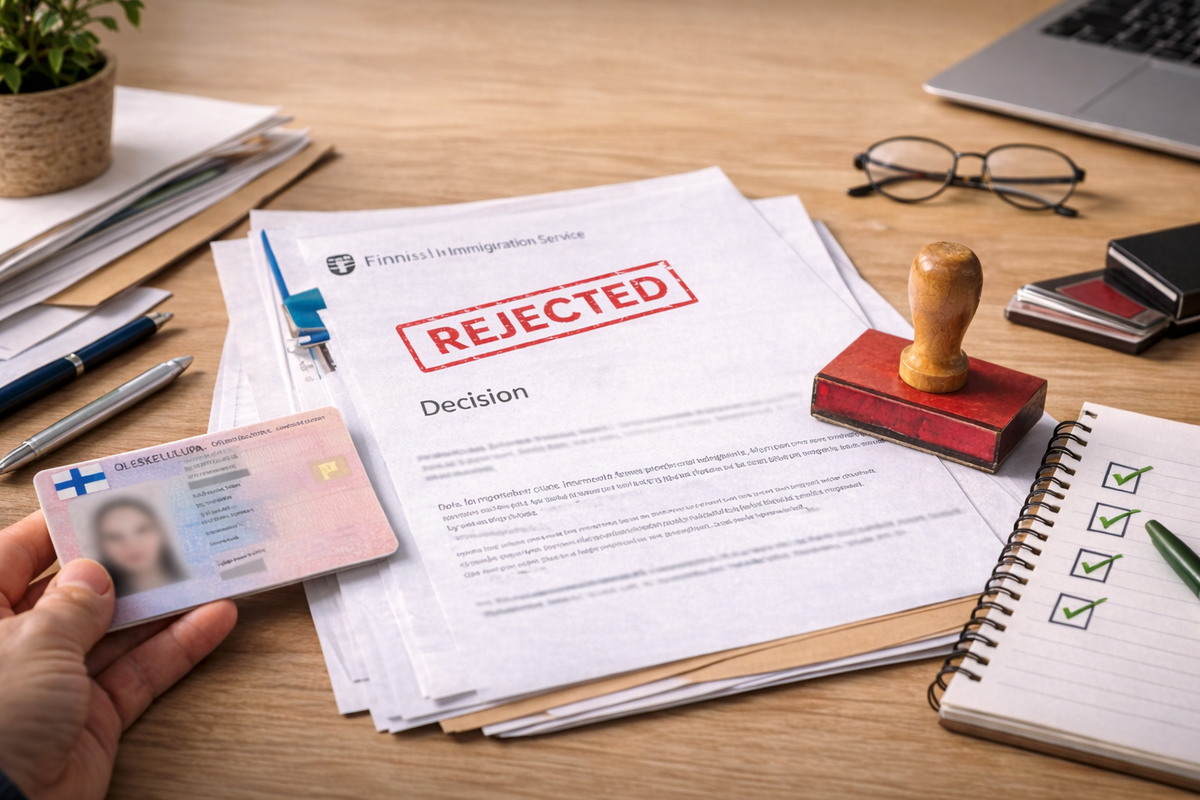
Incorrect basis and "hole-ridden" history
The basis must correspond to real life
A classic failure:
● a person lives off their job but is presented as "self-employed" without a real business;
● the main meaning of life is family, but this is hardly reflected in the application;
● you need to apply on the basis of work, but they choose "other" or too general a type.
The official descriptions of the forms are designed for different situations: work, study, family, entrepreneurship, job seeker, etc. If your reality does not match the stated basis, the application looks "flawed" even with strong facts.
Weak link between "purpose ↔ documents"
Example: in the questionnaire, a person writes that they intend to live and work in Finland on a long-term basis, but the documents show:
● a short contract for several months with no prospects;
● zero savings and no other sources of income;
● no confirmation of accommodation or plans for the coming year.
Formally, everything seems to be in order ("there is a contract"), but the logic of "how the person actually intends to live in the country" does not add up.
Unexplained "gaps" in the biography
The following look suspicious:
● sudden breaks in work or study without explanation;
● frequent changes of employers/cities in a short period of time;
● long trips outside Finland that are not mentioned in the description.
Sometimes a single line in a free field is enough: "During this period, I was unemployed, living with my parents in country X, looking for work" — and the picture becomes clear.
"My first application was rejected because my questionnaire said one thing, my employment history said another, and my bank statements said something else entirely. The second time around, my consultant and I wrote down exactly what I had been doing over the past few years, month by month, and there were far fewer questions."
Forms, documents, transfers: hidden pitfalls
Incomplete or contradictory questionnaires
One of the most frustrating reasons for rejection is when it's not the substance that's the problem, but the technique:
● missing mandatory fields;
● different dates and amounts in the application form and documents;
● outdated information (old address, surname, marital status).
The official position is simple: all incorrect and outdated data must be reported as soon as possible — even if the error seems minor.
Documents without structure
A common scenario:
● a list of downloads from dozens of files: Scan(1), NewDoc_final, IMG_9384;
● the contract is split into 7 photos, some of the pages are upside down;
● translations are separate, with no link to the original.
Imagine that you check dozens of cases a day. Whose case is easier to understand — the person with neat PDFs and clear names, or the one whose file structure is a maze?
Translations and certifications
There are two types of errors here:
● translation into the wrong language (e.g. into the native language instead of Finnish/Swedish/English);
● the required level of certification is not provided where it is mandatory.
Always check the requirements for your specific type of residence permit and your country of origin: for some documents, a regular translation is sufficient, while others require a sworn translator or apostille.
Make a table for yourself: "document → where the original is located → who did the translation → where it was uploaded". This saves hours when you get a request to "send this again".
Timing, renewals and trips abroad
Late submission for renewal
The most common risk is applying for an extension or a new residence permit after the current one has expired.
It is officially recommended to apply approximately 3 months before the card expires, rather than on the last day.
If you are late, you may:
● lose your right to work until a decision is made;
● create a "gap" in your continuous residence;
● be refused solely because of formal deadlines.
Departures and returns
Long trips may affect:
● your right to a permanent residence permit — if you have actually lived outside Finland for most of the time;
● the assessment of your length of residence for citizenship.
Short holidays and business trips are usually not a problem, but if you plan to live a long life "in two homes", it is better to think it through in advance and sometimes consult with someone — especially closer to P and citizenship.
Checklist before submitting your application
Now let's put everything together in one handy list — the very same checklist of documents for a residence permit that you'll want to keep handy in 2026.
- Basis: the correct form has been selected for the actual situation (work, study, family, business).
- Application form: all required fields are filled in, dates and amounts match the documents.
- Documents: passport, supporting documents, finances, insurance, transfers are available.
- Files: readable PDFs/scans with clear names and a logical structure.
- Timing: there are still several months left until the end of the current residence permit, not just a couple of days.
- Comments: all "gaps" in the biography are explained briefly and honestly.
If you honestly go through this list before clicking the "Submit" button, you will automatically avoid 70-80% of typical mistakes.
Applying for a residence permit is a careful project, not a lottery
A Finnish residence permit is not a magic ticket or a lottery of "luck or no luck." It is a project: with deadlines, tasks, paperwork, and the logic of "what I am proving and how."
If you treat the application as a project, most of the scary stories turn into work tasks: correct a contradiction, explain a pause, choose the right basis, submit on time. And then the decisions — even if they are not always perfect — at least become more predictable.
Save this text before your next submission, share it with those who are just starting out, and don't hesitate to ask questions: analysing real cases is the best way to learn from others' mistakes.
❓ FAQ
Most often, these are incorrect grounds, contradictory information in the application form and documents, weak financial evidence, late submission, and ignoring requests for additional documents. Most of these mistakes can be avoided by filling out the form carefully and checking it thoroughly before sending it.
Formally, it is not "fatal," but official instructions ask that even minor errors be reported as soon as possible. Sometimes it is a minor inaccuracy (date, address, amount) that causes additional documents to be requested and delays the review.
Yes, it affects the speed and convenience of verification. Clear scans, combined PDFs, and understandable names help the verifier quickly see the whole picture. A bunch of scattered "Scan(1)" files create chaos and increase the chance that something will be missed or requested again.
This risks a "gap" in your legal residence: you may lose your right to work and ruin the continuity of residence for a future permanent residence permit. The official recommendation is to apply approximately three months before expiry, rather than at the last minute.
Short holidays and business trips are not a problem, but long and frequent trips without explanation may raise questions about whether Finland is really the centre of your life. This is especially important when renewing your residence permit, P permit, or citizenship.
Yes, if it is a real contract or a binding job offer with specific conditions, and not just a "letter of intent". It is normal if the contract includes a clause on dependence on a residence permit; it is not normal if there is no salary, no responsibilities, and no term.
It is better to provide a short and structured explanation of precisely those points that appear unusual: breaks, job changes, trips abroad. Long emotional stories without facts are of little help and may hide important details.
Immediately go to Enter Finland, read the request and send the necessary documents with a brief explanation. The longer the delay, the higher the risk that the decision will be made based on an incomplete package or that the application will be rejected altogether.
You need to honestly answer the question: "What is the main purpose of my life in Finland right now?" — work, study, family, business or job search. Then check this against the official descriptions of the forms and make sure that the required documents match your reality. If you still have doubts, it is better to consult before submitting your application, rather than after it has been rejected.
Yes: go through the checklist — basis, questionnaire, documents, files, timing, comments. If you can honestly tick off each line as "done", you greatly reduce the risk of typical mistakes and give your application a chance to be considered on its merits, rather than stumbling over formalities.

0 comments
Log in to leave a comment