



🧺 Building services in Finland 2026: laundry, storage and shared sauna without stress
The building as a system: why shared services are needed
If you want to understand how building laundries, basement storage rooms (varasto) and shared saunas work in Finland — not as they appear on postcards, but as they really are in everyday life in 2026 — you've come to the right place.
A Finnish house is not just walls and your key. It is a whole little universe: a laundry room, a drying room, a bicycle storage room, a pram storage room, a sauna and club rooms, which residents share according to a schedule and rules.
At first, it all seems like magic: "How do they not argue when they all share one basement and one sauna?" The answer lies in the culture: clear instructions on the walls, unspoken taboos, respect for other people's time and space. Most of the unspoken rules of Finnish homes are based on these shared services.
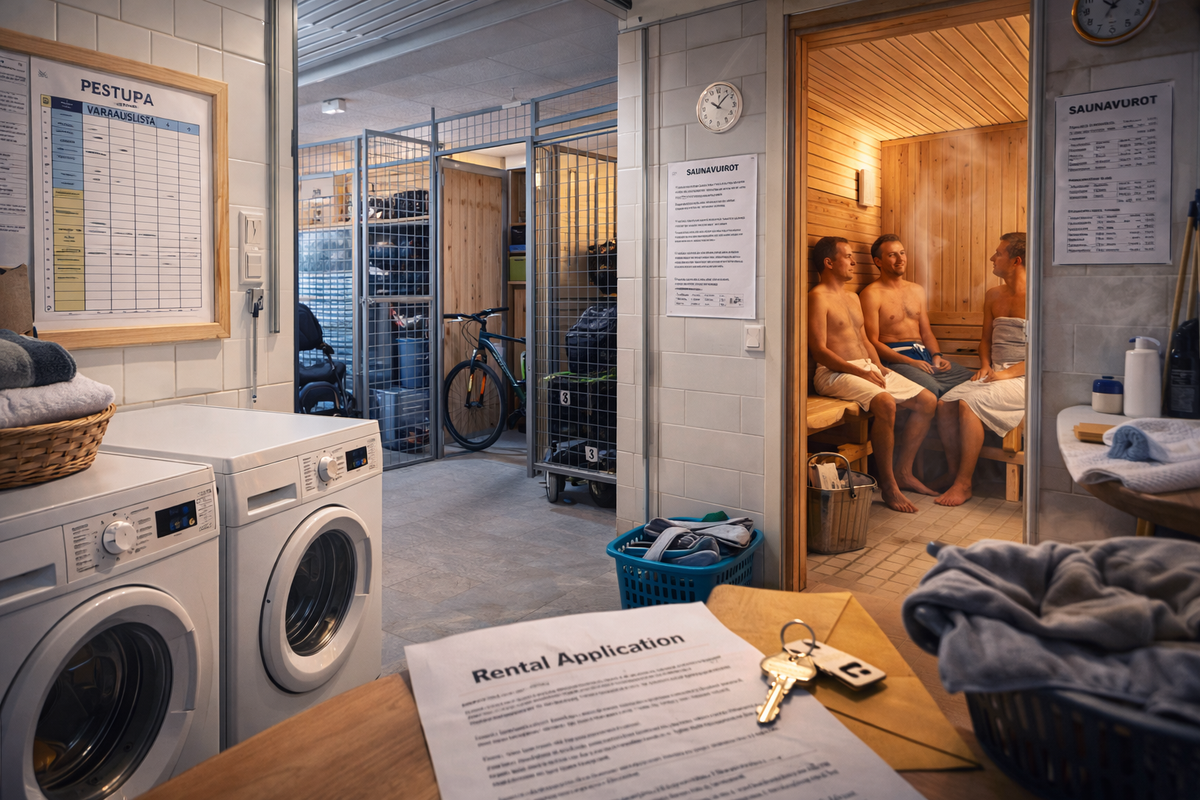
In this article, you will learn:
● how to sign up for the laundry and dryer, what you can wash and what you absolutely cannot wash;
● what a varasto is, how a "bicycle" storage room differs from a personal storage room, and why things are not left in the corridors;
● how the communal sauna works on a schedule, how "women's/men's hours" differ from personal slots, and what minimum etiquette is really important;
● what little things most often lead to conflicts with neighbours — and how not to become the person whose name is whispered about at the house meeting.
The trick is simple: make building services your resource, not a source of stress.
Laundry and dryer: how a domestic laundrette works
What is a building laundry room in Finland?
Many apartment buildings have a communal laundry room (pesutupa) and drying room (kuivaushuone). They are equipped with large washing machines, dryers, and sometimes a separate unit for carpets, and there is a schedule and rules for use posted on the wall.
A Finnish communal laundry room often looks like this:
● 1–3 washing machines with a larger capacity than a domestic washing machine;
● a separate spin dryer or tumble dryer;
● a drying room with clotheslines or racks, sometimes with forced air heating;
● a booking system: a paper sheet, an electronic board or an app.
The overall idea is simple: the building buys heavy washing equipment, and the residents share it by slot, without cluttering up their tiny kitchens and bathrooms.
Reservation: paper, lock or app
Depending on the house, the reservation system may work differently:
● classic: a paper journal on the wall — write the apartment number in the selected slot;
● a system with plastic "tags"/locks that you rearrange for the desired time;
● modern option: an app or website where you can book the laundry room and sauna in a couple of clicks.
Common to all options:
● slots are usually 2 hours long;
● the laundry room is open from 7–8 a.m. to 9–10 p.m.;
● the rule is "if you take it, use it; if you don't use it, free it up" so as not to block others.
- Find the rules on the wall (usually in Finnish + English).
- See how the booking system works: logbook, locks or app.
- Check in advance whether there is enough time for a full cycle + drying.
- Bring your own powder/gel (or check if you can use the shared ones).
- Leave the room clean: wipe the rubber seal, remove any rubbish, check the dryer filter.
What can be washed and what is taboo
The rules almost always include a few strict "don'ts":
● do not wash carpets and "heavy items" in regular machines — sometimes there is a separate unit or outdoor washing machine for this purpose;
● do not use fabric dyes — they damage the drums and seals;
● do not leave items in the machine or dryer after the end of the cycle — the next person has the right to carefully remove them, but it is better not to let it get to that point.
Plus, the classic rule for any home: do not come in drunk, do not bring glass bottles to the laundry room, and do not throw parties there.
Sign: what a typical slot looks like
Varasto and storage facilities: where things live, not clutter
What is varasto and what types are there
In a typical Finnish home, you will find several types of storage:
● personal varasto — small sections with lattice walls or wooden doors, attached to the flat;
● bicycle and pram storage (pyörävarasto, ulkoiluvälinevarasto) — shared spaces for transport and outdoor equipment;
● sometimes — separate rooms for sports equipment, sledges, seasonal tyres.
varasto storage room Finland — this is not a "place where we bring all the junk from the last ten years," but rather a fairly limited space where residents store seasonal items, suitcases, and boxes.
Important:
● most rules prohibit keeping anything in corridors and stairwells — everything must be either in the flat or in the varasto;
● flammable items (fuel, gas, some batteries) cannot be stored in communal storage rooms;
● Bicycles and prams must be stored in designated rooms, not in corridors.
How to use varasto safely
A couple of basic principles:
● label your belongings — especially bicycles and boxes — so that they are not mistaken for abandoned junk;
● do not store anything in varasto that would be critical to lose: locks and walls are sometimes quite symbolic;
● do not set up a "second home" there: furniture, mattresses, piles of belongings — these are fire hazards and will lead to disputes with the management.
- OK: suitcases, boxes of clothes, books, New Year's decorations, sledges, skis.
- OK with reservations: bicycles, if the room is properly locked and dry.
- Not OK: petrol cans, gas cylinders, batteries from appliances.
- Not OK: old mattresses, broken furniture and things "just in case".
Prams, bicycles and fire safety
The Finnish obsession with clear stairwells is not about aesthetics, but about fire safety. Many instructions state in black and white: no prams, bicycles, boxes, shoes or rugs in corridors and stairwells.
This means that:
● prams must be kept either in the flat or in a special room downstairs;
● bicycles must be stored in a bicycle storage room or on a rack outside, but not in the hallway;
● anything unnecessary in common areas is usually ruthlessly removed by management companies.
"At first, we left the pram 'for a minute' in the stairwell. A couple of days later, we received a letter from the management company: please remove it, this is a fire exit. We are not experimenting anymore: there is an excellent pram storage room in the building, we just had to find it."
Communal sauna: schedule, etiquette and unspoken rules
How a communal sauna in a building works
Many buildings have a communal sauna in the basement or on the ground floor. If you don't have your own in your flat, it's basically your own home spa on a schedule.
The typical schedule is as follows:
● there are regular slots (for example, Thursdays from 7 to 8 p.m. is your hour every week);
● there are common "women's/men's/family" hours when you can come to the sauna without a personal reservation;
● reservations are made via the app, website, by calling the office or through the building manager.
Slots are usually 1 hour long: during this time, you can warm yourself up, not the planet, and pass on the heat to your neighbours.
Basic etiquette: a few rules and a lot of sensitivity
A few things that are considered so obvious in a Finnish sauna that they are not always written about:
● arrive on time and leave on time — staying during someone else's time slot is extremely rude;
● cleanliness: shower before and after the sauna, do not leave rubbish behind, do not bring glass inside;
● silence and atmosphere: you can talk, but not so that everyone on every floor can hear you;
● no drying laundry in the sauna — this is both a fire hazard and a violation of the spirit of the space;
● The sauna is not a place for sexual jokes and flirting, especially with strangers.
- Check what type of slot you have: shared (women's/men's) or private.
- Arrive 5-10 minutes before the start so you have time to change and rinse off.
- Do not pour water on the stones without asking if there are already people in the sauna.
- When leaving, turn off the stove/timer, take all your belongings with you, and check the door.
Paid or free?
The final details depend on the establishment:
● in the student/municipal sector, there are often free communal hours, and private hours are available for a small additional fee or also free of charge;
● in commercial buildings, a private slot may cost a few euros per month or be charged separately once a year.
In any case, a sauna in your home is almost always cheaper and closer than a public one, and it greatly helps you get through the winter without emotional burnout.
Typical conflicts and how to avoid them
Even in a very peaceful home, small "wars" sometimes break out: over laundry in the machine, over a pram in the hallway, over noise in the sauna. Let's figure out where the pitfalls are.
The landing turns into a storage room, and the fire escape becomes a maze.
Almost all instructions explicitly state: no personal belongings in corridors and stairwells. Even if it's "just for a minute," it quickly turns into "okay, let it stay." Management companies often simply remove items without lengthy discussions.
A little text between the stickers helps to avoid drowning in anxiety.
The machines stand empty, people wait, the slot disappears.
If you have booked a time slot and realise that you will not be able to make it, please let others know in the building chat or remove your name from the board so that someone else can use the slot. Being known as the person who never shows up is the worst reputation for shared services.
"Well, it's warm and empty, what's the big deal?"
A sauna is a place for relaxation, not a drying room or storage space. By hanging laundry or storing boxes there, you create fire hazards and damage the wood/stove. Plus, it's unpleasant for those who come for peace and quiet, not to see other people's jeans.
A little bit of normal paragraphing makes the final sticker easier to take in.
Ignoring the quiet hours after 10 p.m., washing carpets in a regular washing machine, smoking in common areas.
In fact, house rules are often based on the law and fire regulations. Systematic violations can result not only in cold stares from neighbours, but also in problems with your lease. It's easier to read the "järjestyssäännöt" sheet in the stairwell carefully once than to have to explain yourself to the management company later.
Shared services as part of the feeling of "home"
A communal laundry room, varasto, and sauna are not strange Finnish quirks, but infrastructure that makes life easier if you understand how to use it. You don't buy a big car, drag a sled and stroller through your entire flat, or pay for a commercial spa every week.
The key is to perceive these spaces as a shared "extension" of your flat: with respect for other people's time, belongings and peace and quiet. A little attention to the list of rules on the wall, a few learned Finnish words, the habit of cleaning up after yourself — and your home ceases to be just an address and becomes a community of people who do not interfere with each other's lives.
If you found this guide helpful, save it, share it with those who are just moving to Finland, and write your stories in the comments: which housekeeping services surprised you, which rules turned out to be unexpected, and what, on the contrary, became a pleasant daily ritual.
❓ FAQ
Usually, there are washing machines and dryers in the basement, which residents use by appointment. Times are booked in a logbook, via signs or an app, with a standard slot lasting about two hours. Your task is to arrive on time, not wash prohibited items (carpets, "chemicals") and leave the room clean.
Most often, no: regular machines are designed for clothes, linen, and towels. Sometimes there is a separate machine or outdoor washing facility for carpets — this is indicated in the rules on the wall. If in doubt, it is better to ask the building management or neighbours than to risk breaking the equipment and getting a repair bill.
A varasto is a small storage room where seasonal items are kept: suitcases, boxes of clothes, sports equipment, and decorations. It is not a place for old furniture, bicycles, or flammable liquids. The less clutter there is, the safer it is for you and your neighbours, and the less risk there is that the management company will organise a "clean-up".
Most buildings have separate rooms for prams and bicycles on the ground floor or in the basement. It is not permitted to store them in stairwells and corridors — this is a fire safety and regulatory requirement. If there is no special room, some people keep their prams and bicycles directly in their flats.
Corridors, staircases and entrances are evacuation routes. Any items in the way (prams, bicycles, rugs, boxes) create obstacles and an additional fire hazard. That is why building regulations place so much emphasis on storing all personal belongings either in your flat or in specially designated storage areas.
The options depend on the management company: in some places, you can sign up via an online service, in others via the concierge or building manager, and sometimes via a paper list. You choose a free hour, which is then repeated every week, or use the open "women's/men's/family" slots. The main thing is to arrive on time and leave the sauna clean.
There is no single rule for communal saunas: some people wear towels, others wear swimsuits, especially in mixed or family slots. Follow the local culture: you can politely ask your neighbours or look at the notice on the door. In any case, it is important to be respectful of other people's comfort and not to turn the sauna into a show.
Usually, the principle is: "the last person to use it tidies it up". In the laundry room, this means wiping down the machines, removing rubbish, and checking the floor. In the sauna, it means rinsing the shelves, throwing away used seats/mats, checking that the stove is turned off, and closing the door. Systematic dirtiness can lead to complaints from neighbours and the management company.
In many modern buildings, yes: there are apps and online services that can be used to book all common areas, from the laundry room to the sauna and club room. Older buildings still use paper logs and plastic signs, but the logic is the same: book ahead and respect other people's slots.
Usually, the basic quiet hours are specified in the house rules (a sheet on the stand in the entrance hall or in the tenant's welcome pack). It also describes when you can use the laundry room and sauna, what is prohibited in common areas, and how to resolve everyday issues. A quick glance at this sheet greatly reduces the risk of accidentally violating the unspoken agreement between neighbours.
No, but it is a very common standard in apartment buildings, especially in older and student/municipal buildings. New buildings sometimes have private saunas in the flats and fewer common areas, but there is almost always at least a storage room and space for bicycles. It is best to ask the landlord directly what building services are available in your particular building.

0 comments
Log in to leave a comment