



🔌 230 V and sockets in Finland: how to safely charge your devices while travelling
In this article, you will learn what kind of sockets are used in Finland, whether you need an adapter, what you can plug in without risk, and where it is better not to experiment (especially with hair dryers, kettles, and "2 euro adapters"). Finland generally likes everything to work quietly and predictably — electricity is no exception.
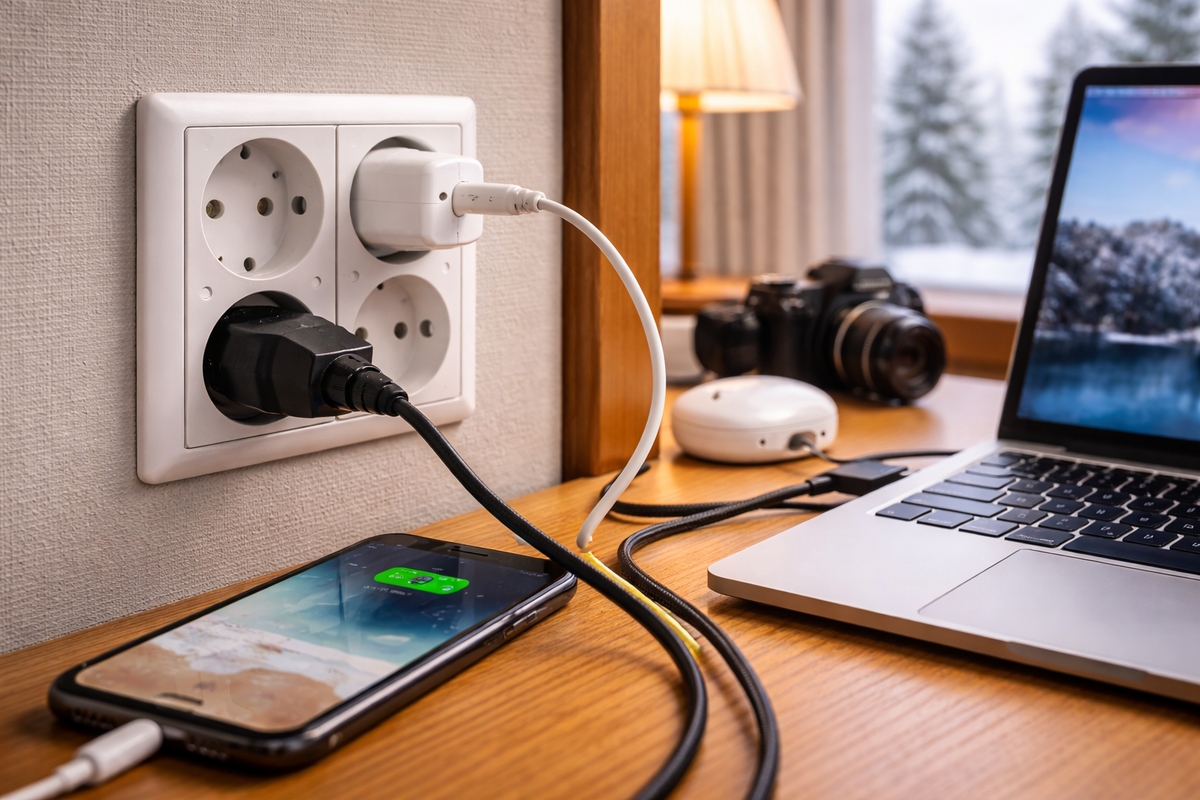
What kind of sockets are used in Finland and what is the voltage?
In Finland, the standard is 230 V / 50 Hz — as in most European countries. Sockets are Type C (Euro plug with two round pins) and Type F (Schuko, with grounding).
What this means in practice:
● if you are coming from most European countries (and from countries that also use Euro plugs), you will most likely not need an adapter at all;
● if your charger/plug is Euro-format, you're already good to go;
● if you are travelling from the USA/Canada/Japan, the issue is usually not only the shape of the plug, but also the voltage (more details below).
- Russia / Ukraine / EU countries → usually not needed (plugs are the same).
- United Kingdom / Ireland → you need a UK → EU adapter.
- USA / Canada / Japan → an adapter and sometimes a voltage converter are required (if the device is 110V-only).
- Australia / New Zealand → you need an AU → EU adapter.
Adapter vs converter: what's the difference and why does it matter?
It's easy to get confused here, because in everyday life everything is called an "adapter".
● An adapter (plug adapter) changes the shape of the plug but does not change the voltage.
● A converter (voltage converter/transformer) changes the voltage (for example, from 230V to 110V). This is heavy artillery, and it is rarely needed.
The good news: almost all modern electronics (phones, laptops, cameras, power banks) support 100–240V and work fine in Finland — you just need the right plug if you're not from the "Euro world".
The bad news: some powerful appliances purchased in 110V countries (hair dryers, curling irons, irons) may be 110V-only. Connecting them directly to 230V is not a matter of "maybe it will work," but a very quick way to smell melting plastic.
How to tell in 10 seconds if your device is suitable
Open the power supply (charger) and find a line like this:
● Input: 100–240V ~ 50/60Hz → everything is fine in Finland (you only need an adapter for the plug shape if it is not EU).
● Input: 110V or 120V only → you'll need a converter.
Laptops and phones are almost always fine. Problems are more common with "home heating appliances": hair dryers, straighteners, travel kettles.
Where to conveniently charge your devices in Finland: hotels, cafés, trains, libraries
Finland is a country of "quiet public spaces," which is unexpectedly convenient for those who have a perennial problem: your phone is at 12% battery, and you haven't even made it to the museum yet.
What usually works well:
● Hotels and apartments: standard sockets, often with multiple outlets near the bed and desk.
● Cafés: sockets are not available everywhere, but they are often found in "work" areas. If in doubt, ask the staff; Finns are fine with such questions.
● Long-distance trains: sockets are often provided, but in reality it depends on the type of carriage/seat.
● Libraries: an almost ideal environment, especially if you need to sit quietly with your laptop and charger.
A mini-dictionary that sometimes helps with signs:
● pistorasia — power socket
● laturi — charger
● adapteri — adapter
Powerful appliances: hair dryers, irons, kettles — why they are most often involved in accidents
In short: Finland loves safety and energy efficiency. And "powerful appliance + questionable adapter + wet bathroom" is a trigger.
Important to remember:
● A hairdryer/iron/kettle is not a "charger". They consume a lot of power, heat up, and a poor-quality adapter starts to heat up with them.
● Hotels often have their own hairdryers. It is usually easier and safer to use them than to bring your own (especially from countries with 110V).
● Rental apartments sometimes have "smart" fuses and sensitive circuit breakers: a cheap adapter can knock out the electricity in half the apartment — no drama, but unpleasant.
If you are planning a trip with equipment that is "on the edge" (e.g., a professional hairdryer, steamer, heaters), it makes more sense to think through the scenario in advance: rent/buy locally or live without it for a couple of days.
Charging safety: water, snow, saunas and "I'll leave it overnight — nothing will happen"
Finland seems calm, but the climate and everyday life here are "about humidity" — especially in winter, in saunas and bathrooms, near wet shoes and jackets.
The golden rules are simple:
● do not place your charger on a wet floor in the hallway;
● do not charge your devices in the bathroom if there is no normal dry area;
● do not cover chargers with clothes/blankets (they need to cool down);
● choose a grounded adapter if you are connecting a laptop or something more expensive than a phone charger.
- Check the power supply unit: Input 100–240V.
- Use a high-quality adapter, preferably with a grounding plug (Schuko).
- Do not leave the charger on the floor in the hallway (snow/water from shoes is a classic).
- Do not connect powerful devices via a "cheap adapter".
- If the circuit breaker trips, turn everything off and only then try to turn it back on.
Common mistakes made by tourists (and how to avoid them without being overly paranoid)
Mistakes are usually the same — and almost always due to haste:
- Confusing an adapter with a converter
An adapter saves the shape of the plug, but does not save a 110V device from 230V. - They take an adapter without grounding
This is often okay for a phone, but debatable for a laptop, especially in older buildings. - Plugging a "powerful" device into a "random" socket in a public place
If the socket looks like it's for service use (behind a counter, next to cleaning equipment), it's best not to use it - Charging a power bank on the bed under the pillow
It sounds like a joke, but this is a common cause of overheating. Chargers like air.
What to do if the socket is not working or the electricity is tripping
The "power outage" scenario is usually easier to solve than it seems:
● unplug the device from the socket;
● check if you have turned on too many powerful devices at the same time;
● if it's an Airbnb/apartment, write to the host (they can often tell you where the fuse box is and which circuit breaker to turn on);
● if you are in a hotel, notify the reception desk; they deal with such issues all the time.
And yes: if you smell something burning, see melted plastic or hear crackling, don't experiment, turn it off and call the staff.
In Finland, electricity is no surprise if you remember the basics.
Finland does not test tourists on electrical knowledge: 230V, Type C/F, reliable infrastructure, and many places where you can easily recharge your devices. Real problems almost always arise when people try to save money on adapters or plug 110-volt devices into the European power grid.
If you want, it makes sense to read on: ALV and tourist receipts: the simple logic of Finnish prices and Transport the Finnish way: train and bus tickets, scooters and bike hire — so that all the everyday "background stress" of travelling is eliminated at once.
If you found this article useful, share it with your friends or save it to your bookmarks: it's better to know these things before your phone suddenly shows 1% battery on a frosty evening. And be sure to write in the comments what equipment you took with you to Finland and where you had questions — we will analyse the cases and add the most common scenarios to the article.
❓ FAQ
Usually not: the plugs are compatible and the voltage is suitable.
A UK → EU adapter is sufficient. The voltage is fine, most chargers are 100–240V.
Often not: many hairdryers are 110V-only. You will need a converter, but it is easier to use the hotel's hairdryer.
Almost never: laptops usually have 100–240V power supplies.
Because of electrical safety regulations. It is better to charge your devices in your room, in a dry area.
Yes, but it is better to choose obvious "public" sockets and not use service points.
If the charger is of good quality and lies on an open surface, it is usually fine. The risks increase when the charger is covered with fabric, lies on the floor near wet shoes, or uses a questionable adapter.
Yes, but it is better to use one that is grounded and of good quality. This is a sensible habit for expensive equipment.

0 comments
Log in to leave a comment