



🚗 Car rental in Finland: what's included in the price, how fuel, fines and borders work — no hidden taxes or surprises
In this article, you will learn how car rental works in Finland in practice: what is already included in the price on the website, where the real surcharges appear, why the deposit is not a fine or a tax, how to read the fuel rules, and what usually results in the most annoying payment — not a fine, but an admin fee from the rental company.
Finland is a fairly relaxed country in this regard: they don't like surprises at the counter, and taxes and excise duties are usually hidden in the price tags. But car rental has its own logic — and it's better to know it in advance so that you don't have to figure out why your card suddenly "won't let you pay" in the Kampi car park on a frosty evening.
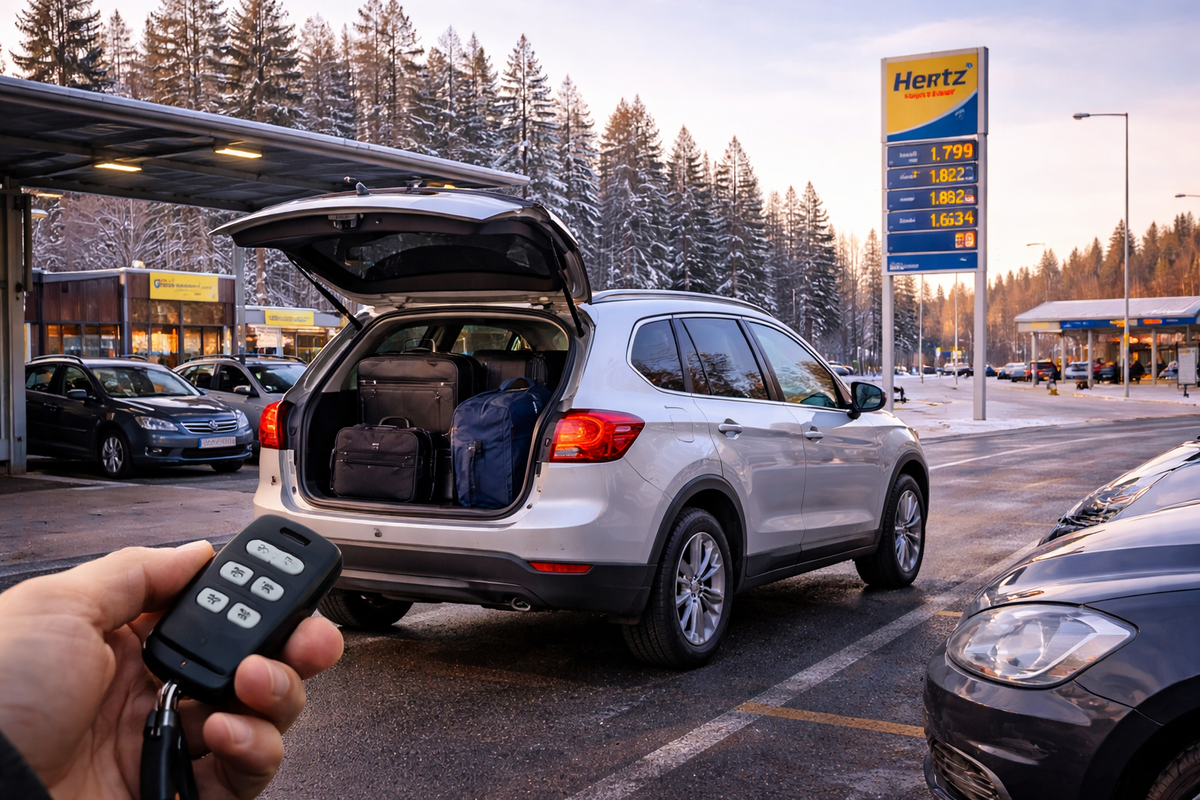
What is already included in the price of car rental in Finland
When you see a rate of "€X / day", the normal scenario is that this is already the price including taxes, and not the "base price without anything".
Usually, the price (or the total amount when booking) includes:
● ALV/VAT (Finnish VAT) — it is not added "later", it is already included. If you want to quickly remember the logic of Finnish price tags and receipts, keep in mind the anchor: ALV and tourist receipt.
● Basic rental (the fact of using the car on these dates).
● Mandatory/standard insurance elements that the rental company includes by default (the names differ, but the essence is the same: basic liability and damage coverage).
● Seasonal preparation of the car, which in Finland is most often perceived as the norm rather than a "luxury" (e.g., winter tyres during the season). The details depend on the company and region, so always check what is specified in the booking and contract.
Important note: if the price on the website or in the confirmation letter looks final, in 99% of cases it is. There is no "hidden tourist tax" here.
💡 What almost always comes as an extra fee — and why it’s not a “tax”
When tourists start to worry (“Now they’re adding taxes!”), it’s usually just additional services — not taxes. The charge comes from your choices or added risk, not from your nationality.
| Extra service | When it’s charged | What you should know |
|---|---|---|
| 🚗 Additional driver | Almost always | Charged per day or for the entire rental period |
| 🧒 Child seat / booster seat | At most rental companies | May be a daily fee or a fixed price |
| 🔁 One-way rental | Pick-up and drop-off in different cities | Can significantly increase the final price |
| 🧑🦱 Young driver surcharge | Young age or limited driving experience | Age limits and rules vary by company |
| 🛡️ Additional insurance | Optional | Reduces excess and expands coverage |
| 🌙 After-hours pick-up / return | Outside opening hours | Common at smaller rental locations |
| 🧭 Extra equipment | When needed | GPS, snow chains, racks — less common but possible |
these are not taxes — they are service terms.
Choose only what you actually need and keep your budget under control.
Deposit, card block and excess
Three similar words that confuse everyone
This is where misunderstandings most often occur: people confuse deposit, excess and actual payment.
Deposit (deposit / security deposit)
A deposit is a temporary hold on funds on your card (pre-authorisation), which is required by the rental company as insurance against risks.
● The money is not "debited" but frozen.
● After a normal return, the deposit is unfrozen.
● The speed of unfreezing depends not so much on Finland as on the bank (sometimes quickly, sometimes several days).
Excess/deductible
The excess is the maximum amount of your liability for damage under the terms of the basic insurance.
● The excess may be higher than the deposit, equal to it, or reflected as a separate line item.
● Additional insurance is usually sold around one idea: to reduce the excess.
Why sometimes "money disappears" even though you haven't broken any rules
A common situation at petrol stations and car rental companies: the system places a temporary hold (for example, on the deposit or on the fuel payment "at the pump"). It looks like a write-off, but after a while it turns into a normal final transaction, and the "excess" is released.
If you want zero stress: take a card with a sufficient limit and do not plan on having your last holiday money "live" on it at the time of rental.
What types of insurance are available for hire and how to understand what you are buying
In the rental agreement, you may encounter abbreviations such as CDW/LDW/TP and other "letter spells". You don't need to become an insurance analyst — you just need to understand the framework.
Usually there is:
● Basic coverage (some standard coverage for damage/theft/liability), which is included.
● Optional products: "lower the deductible," "extend coverage," "remove exclusions," "add roadside assistance," etc.
Practical rule:
If you are renting for 1–3 days and only driving in the city and on the motorway, a standard package is usually sufficient, provided you understand the size of the excess and are comfortable with the risk.
If you are planning to visit Lapland, with its long distances, snow, dark roads and parking lots near slopes, people often purchase a lower excess simply for peace of mind.
And yes: if the manager at the counter is "very insistent," don't argue emotionally, just ask to see:
- the current excess, 2) the price of additional coverage, 3) what exactly is changing.
Finland's strength lies in calm figures.
⛽ Fuel in Finland: why the price is already final
One of the most pleasant moments when travelling in Finland: you see the price at the fuel station — and you pay exactly that. No asterisks, no fine print.
Excise duties and VAT are already included. No one adds anything “on top” at the checkout.
At automated stations, a temporary amount may be held on your card — this is standard practice and released later.
Litres × price per litre = total amount. No hidden fees, no surprises.
what you see in the price is what you pay.
The rental company's fuel policy: where people most often lose money
The most common option is full-to-full:
received the car with a full tank → returned it with a full tank.
Beginners' mistakes here are very human:
● "I'll fill it up on the way" → and couldn't find a petrol station near the return point.
● "I'll fill it up a little" → but the contract required "full".
● "I'll return it with almost a full tank" → but the rental company calculates according to its own logic and charges an unfavourable surcharge.
Here's a tip that really works: fill up 5–15 km before returning the car, keep the receipt, and that's it.
Fines, parking, and the most unpleasant surprise: admin fee
Let's be honest: you can drive perfectly in Finland, but it's easy to get into trouble in a car park near the city centre. Especially in winter, when the signs, zones and times on the signs look like a small exam.
Main point:
● A fine ≠ a tax.
● But a fine is a real payment, and it should not be ignored.
How fines usually come on a rental car
A common scenario looks like this:
- The violation is recorded by the city/police/parking operator.
- The fine goes to the car owner (i.e. the rental company).
- The rental company debits your card for
○ the amount of the fine
○ plus admin fee (administrative fee for processing the fine)
People particularly dislike this admin fee because it looks like a "second penalty". But legally, it is not a state fine — it is a service commission for processing documents.
If you want to understand more about how Finland treats toll zones and where you actually have to pay, keep this link handy: Toll roads in Finland: vignettes, tolls, parking and ferries.
⛽ Fuel in Finland: why the price is already final
One of the most pleasant everyday moments when traveling in Finland: you see the price at the fuel station — and that’s exactly what you pay. No asterisks, no fine print.
Excise duties and VAT are already built in. No one adds anything “on top” at the checkout.
At automated stations, a temporary hold may be placed on your card — this is standard and released later.
Litres × price per litre = total amount. No hidden fees, no surprises.
what you see in the price is what you pay.
Road taxes, vignettes and tolls: things tourists don't usually encounter in Finland
The panic of "where can I buy a vignette?" is a classic among travellers after Europe. In Finland, this anxiety is usually unnecessary: the logic is different, and the road network does not usually require tourists to pay separately for "travel".
Where payment is actually required:
● parking
● private crossings/services (rare)
● fines for violations
Everything else that seems like a "road tax" is usually already built into the country's economy and is not billed separately to tourists.
Borders and trips to neighbouring countries: how to do everything correctly according to the contract
The phrase "let's go to the border" does not in itself imply any payments. But travelling to another country in a rented car is a contractual matter.
How to avoid surprises:
● Check the rental terms and conditions to see if cross-border travel is permitted and to which countries.
● If it is permitted, clarify whether a stamp/additional payment/additional insurance is required.
● If it is not allowed, do not try to "sneak through". Rental companies do not like it when a car is outside the contract area, and insurance conditions can become strict.
● If you are travelling by ferry, check the rules for transporting cars and what exactly is considered "departure" in the context of the contract.
This part is not about politics or customs discussions — it's just about everyday reality: a contract is a contract.
What to check when picking up your car: a 5-minute checklist that will save your nerves
Before you leave, don't rush. Finnish air is cold and honest: it's better to spend five minutes checking than to prove something later with letters.
At the pick-up point:
● Take photos of the car from all angles (body, wheels, windows) — a quick "condition report".
● Check whether existing scratches/chips have already been noted.
● Clarify:
○ the fuel policy (full-to-full and fuel level)
○ where and how to return the car (parking, keys, night drop box)
○ what to do in case of a minor accident/damage (support number)
● Check the winter kit for the season (what is on the car, what tyres) — just so you understand what you are driving.
Before returning:
● Refuel according to the rules.
● Take a photo of the odometer and fuel level.
● Keep the fuel receipt (just in case).
● Return the keys according to the instructions and record the fact of return (photo/time).
Common mistakes made by tourists when renting a car in Finland
These mistakes are not "stupid" but normal human errors, especially if you are visiting a northern country for the first time.
● They take a car with the lowest possible deposit → the deposit blocks their credit limit → they can't pay for their hotel/dinner.
● They don't read the fuel policy → they return the car "almost full" → they get charged "as if it were empty".
● They think that a parking fine is something "optional" → then they get charged + admin fee.
● They don't take photos of the car when picking it up/returning it → the dispute turns into correspondence without evidence.
● They go abroad "on a wing and a prayer" → but this is prohibited in the contract
Finland is generally friendly to newcomers. But the rental agreement is an international thing and quite strict.
A hassle-free car rental is not a matter of luck, but a matter of planning
Renting a car in Finland rarely turns into a quest if you keep a simple scheme in mind:
● the price on the website is usually the final price (including VAT)
● additional charges arise for selected options or for violations of the rules
● the deposit is a block, not a "penalty"
● fuel is paid for at a fair rate, without additional taxes
● penalties may come with an admin fee, which is not a tax but a service commission
● Trips abroad are decided by contract, not luck.
If this article has helped you feel more confident, share it with your friends or in a travellers' chat: car rental almost always causes the same concerns, and a handy reminder can really save you money.
And yes: tell us in the comments where exactly you plan to drive (Helsinki and the surrounding area, Turku and the archipelago, Lapland, national parks) — we can advise you on the most typical "pitfalls" regarding parking, fuel and rental conditions for your routes.
FAQ
No. Taxes are usually already included in the rental price. Additional charges apply for options (additional driver, child seat, one-way) or for violations of the rules (fines).
Most often, this is a temporary block. After returning the car, the amount is released, but the speed depends on the bank.
No. It is simply a transparent breakdown. Tourists do not become Finnish taxpayers because of car rental.
Yes, this happens: the fine goes through the chain, then the rental company issues a write-off. An admin fee is often added for processing.
Final. Excise duties and VAT are already included in the price per litre.
It depends on the rental company and the rate. This should be checked in advance in the contract and, if necessary, agreed upon.

0 comments
Log in to leave a comment