



🗑️ Waste sorting in Finland: fractions, containers, and what a tourist should do
If you’re in Finland for the first time, sorting can feel like a quest on the level of “why do I have three bins in the kitchen.” Spoiler: Finns don’t expect tourists to be perfect. What matters more is the basic container logic, the pictograms, and the habit of “doing it reasonably, not perfectly.”
Below is a practical guide: which fractions you’ll actually encounter, how to sort in a hotel and Airbnb, where to take deposit bottles and cans (pantti), and what to do if there’s only one trash bin nearby.
✅ Clean packaging → muovi (plastic) / kartonki (cardboard) / metalli / lasi
✅ Not sure → sekajäte (mixed waste)
✅ Deposit bottles and cans → a pantti return machine in the supermarket (separate system)
♻️ Why sorting works in Finland (and they’re not trying to “catch you”)
Finnish sorting is not an exam and not a “fine trap.” It usually feels simple for three reasons:
✅ Containers are labelled and often have pictograms. Even if you don’t know Finnish, the picture explains it: a bottle, a can, a box, a banana peel.
✅ The logic repeats from city to city, even though details (like lid colours) may vary.
✅ Hotels and tourist-heavy places simplify the system: often one mixed bin + a separate system for deposit bottles/cans (pantti).
One important nuance: responsibility for “perfect” sorting usually sits with residents/property management, not with a tourist staying for a week. In Airbnb, a host might ask you to separate waste more carefully — not because of a “scary law,” but because that’s how the building’s daily system works.
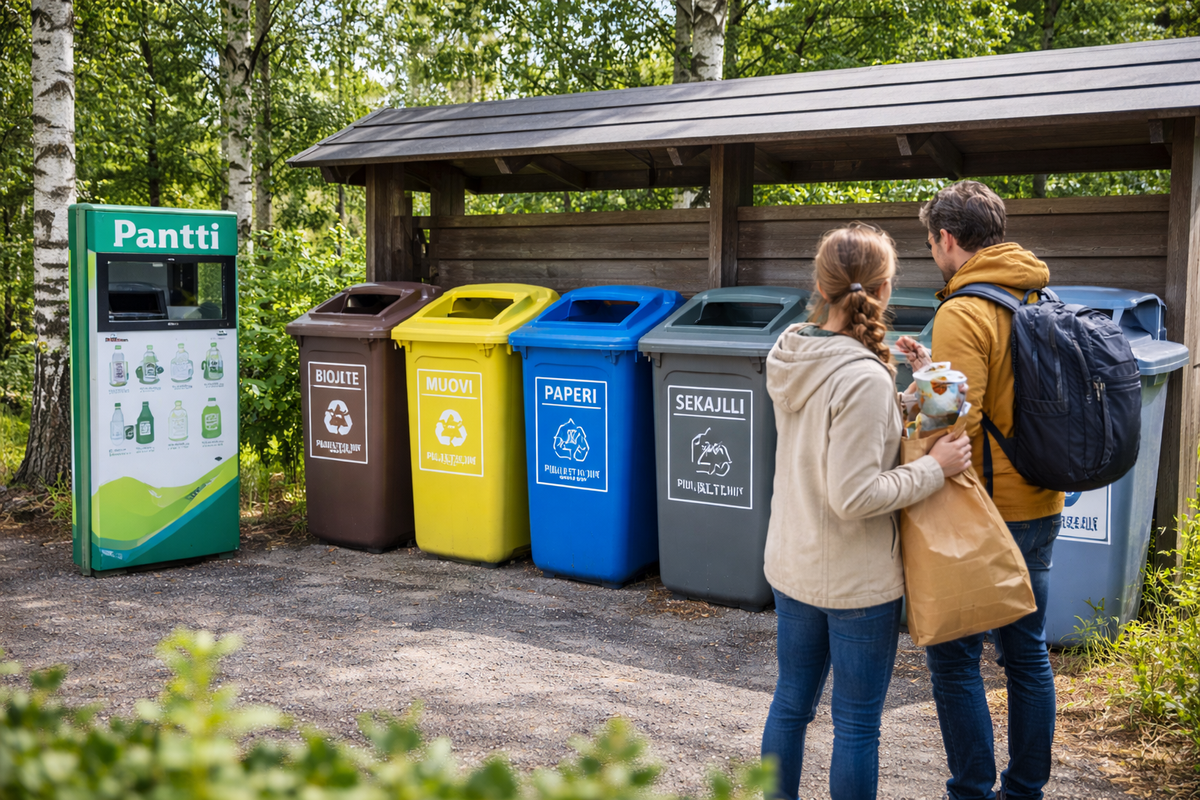
🗑️ The waste fractions you’ll see most often (and their Finnish names)
These are the categories you’ll most often see in apartments, courtyards, sorting points, and near supermarkets:
✅ Bio / biojäte — organic waste (food and anything that “starts smelling fast”)
✅ Muovi — plastic packaging
✅ Kartonki — cardboard and carton packaging
✅ Paperi — paper (newspapers/sheets)
✅ Metalli — metal (cans/foil/lids)
✅ Lasi — glass (jars/bottles without deposit)
✅ Sekajäte — mixed waste (“everything else”)
🎨 Lid colours help, but they’re not a guarantee: what’s more reliable
Yes, Finland often uses colour hints. But there isn’t one single national colour standard — it can vary by city, property management company, and even by courtyard.
So the safer rule is:
✅ Look at the label and pictogram first (muovi / bio / sekajäte),
and only then use the colour as a hint.
🏨 Hotel vs Airbnb: how to sort without stress (and without perfectionism)
In real life, tourists deal with two different worlds.
✅ Deposit bottles/cans are easiest via pantti at a supermarket.
✅ If there’s no “in-your-face” sorting — that’s normal: the system is built for guest flow.
✅ In the courtyard: big bins with labels and coloured lids.
✅ Hosts are usually happy if you separate at least: bio, muovi, sekajäte.
A practical Airbnb scenario that truly works:
✅ Step 1: find the “magic words” on bins — bio / muovi / sekajäte / kartonki.
✅ Step 2: separate organic waste immediately (especially fish, meat, leftovers) — that’s how you avoid a “smell tragedy” in the apartment.
✅ Step 3: packaging can be quickly rinsed (no obsession) — the goal is simply to remove strong odours.
✅ Step 4: if you’re not sure — use sekajäte and don’t torture yourself.
🥤 Pantti ≠ glass: bottles and cans are often returned, not thrown away
One Finnish twist confuses almost everyone at first: some bottles and cans are not thrown away because you get a deposit back (pantti).
In short: you return the container at a supermarket machine, get a receipt, and use it at the checkout.
A detailed breakdown belongs in a separate article: Pantti in Finland: how to get deposit back for bottles, and where to return batteries/lamps.
🔋 Batteries, bulbs, and electronics: where “special” items go (and why not in regular trash)
Batteries, bulbs, and small electronics are not usually thrown into sekajäte or plastic.
In practice:
✅ Supermarkets often have special boxes/containers for batteries and bulbs (usually near the entrance or near the pantti area).
✅ Small electronics (cables, chargers) are often collected at store take-back points or municipal collection sites — tourists only care if something “died” during the trip.
✅ If you’re staying in an Airbnb and end up with “special waste,” the calmest option is to ask the host where people return it in that area.
🌲 If there’s no “right” container nearby: what to do without stress
In central Helsinki/Turku/Tampere, public bins may be simplified: often mixed waste only; sometimes separate bins for bottles/cans appear.
What a tourist should do:
✅ If there’s no suitable bin nearby — use sekajäte (better than carrying garbage for hours).
✅ If it’s deposit bottles/cans — bring them to a supermarket and return via pantti.
✅ After a picnic, it’s easiest to put everything into one bag and dispose of it properly at a big bin — rather than scattering it across small street bins.
❌ Common tourist mistakes (and how to avoid them)
✅ Bottom line: “good enough” is already Finnish-correct
Waste sorting in Finland is designed so you can understand it in one evening: bin labels repeat, pictograms are clear, and sekajäte exists as a safe fallback.
If during a trip you separate at least bio, plastic, and mixed, and return deposit bottles via pantti, you’re already doing what Finns call fiksu — sensible.
If this guide helped, save it and send it to the friend who lives in “where do I throw this?” mode. And tell me in the comments: in which city and in what type of accommodation did sorting feel the clearest (or the weirdest)? Real cases from readers beat theory every time.
❓ FAQ
Usually no: an “on-the-spot fine” for a tourist is not a typical scenario. But in Airbnb, the host may ask you to follow building rules because sorting is part of daily life for residents.
The safest option is sekajäte. In Finland it’s better to do it “reasonably and quickly” than “perfectly and nervously.”
Most often — kartonki. If unsure, look for the pictogram on the bin or the accommodation instructions.
Usually into special containers in supermarkets/stores. If you’re staying in an apartment, the host instructions or the courtyard sorting area often has the answer.
Not “until squeaky clean.” A quick rinse to remove strong smells is more than enough.
Better not. Glass and plastic are separated. If you only have one bin nearby — sekajäte is your safe fallback again.
Because of the deposit system. Details are in: Pantti in Finland: how to get deposit back for bottles, and where to return batteries/lamps.
Yes. Hotels often simplify the system. Your minimum: don’t leave rubbish around, and return pantti containers via supermarket machines if you want to do it the Finnish way.

0 comments
Log in to leave a comment