



🚆🚲 Transport in Finland: how to buy train and bus tickets, ride the tram and scooter — and avoid fines
If you want to understand how transport works in Finland and how to travel stress-free — without saying, "Oh, I didn't know I had to buy a ticket in advance" — you've come to the right place. Here are some simple rules that will save tourists and locals a lot of stress: where to buy tickets, when you need to validate them, how not to miss your zone, and why there are no "hidden taxes" on transport, but there are additional charges for options.
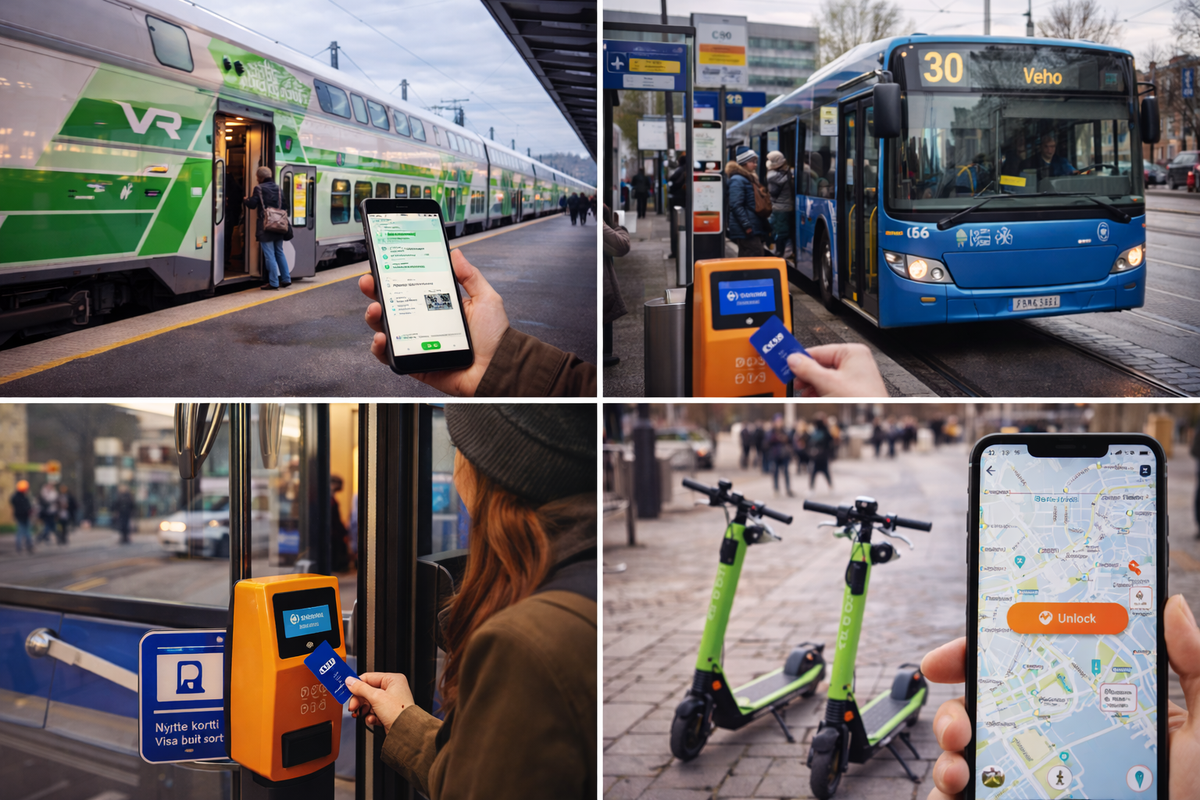
🚆 How to buy a VR train ticket in Finland — and do you need to validate it?
Trains in Finland feel like a "calm northern lift": quiet, predictable, without fuss. The most important thing is to understand the logic: tickets are purchased in advance, and checks usually take place during the journey.
🎟️ Where to buy a train ticket
The most typical scenario:
● purchase via the official app/online from the railway operator (convenient, fast, ticket always on your phone);
● purchase from a ticket machine/service point at the station (if your phone is dead, there is no internet, or you want a paper ticket).
Buying a ticket "on board" is a thing of the past and only possible in exceptional circumstances. Sometimes it is only possible in exceptional scenarios, so the rule of thumb is: assume that you must have your ticket before boarding.
🧾 Do you need to validate your ticket, as in some countries?
Finland is minimalist in this sense: most often, no ticket validators or "before boarding" stamps are required; the ticket is simply checked by inspectors/staff on the train. However, the logic differs for certain types of travel and urban systems (more on HSL below), so let's remember carefully:
● train: the ticket usually "lives" in the app/QR code and is presented during inspection;
● city transport: sometimes the ticket needs to be activated/validated according to the rules of the specific city and ticket type.
🧩 Transfers and "what if I'm late?"
Key point about trains: tickets may be tied to a specific train/time or be more flexible, depending on the fare. Therefore:
● if you are planning a route with a transfer, allow for extra time (especially in winter and especially if you are continuing your journey by plane/ferry);
● when buying, choose your fare wisely: "the cheapest" almost always means "the least flexible".
If you are combining train + plane, keep a simple rule in mind: the risk begins when you try to "fit everything in perfectly". The North does not like perfect connections — it likes time reserves.
🚌 How to buy bus tickets in Finland
Matkahuolto, regional routes and boarding
Intercity buses are the country's second backbone after the railway. Finnish logic applies here too: everything is transparent in the fare, and stress most often arises not from the price, but from the little things — "where to board", "how to show your ticket", "will they accept luggage".
🎫 Where to buy tickets
The most reliable options:
● online (through the official services of carriers/aggregators in a specific region);
● app/e-ticket (QR code or booking number);
at ticket offices/points of sale, if available at the bus station.
It is sometimes possible to buy tickets from the driver, but it is better not to plan on this as a universal strategy: in Finland, there are more and more systems where passengers board with a ticket already in hand.
🧳 Luggage: what is important to avoid stress
Typical practice:
● small luggage — with you;
suitcase — in the luggage compartment (often the driver/staff will tell you where to put it);
● It is best to plan ahead for "non-standard" items (skis, prams, large boxes), as rules may vary between carriers.
Life hack for the cold season: keep everything that is critical (documents, medicines, chargers, warm gloves) in your hand luggage, not in your suitcase "under the bus".
🕒 How early to arrive
A Finnish bus is not a theatre, but the principle is similar: the doors close without drama. Arrive at the stop 10–15 minutes early, especially in an unfamiliar place. The main reason for being late is not the speed of the bus, but "I was standing in the wrong place".
🚋 How public transport works: HSL, zones, validators and inspectors
Public transport in Finland is a prime example of "smart living": each system has its own identity, but the overall philosophy is the same — tickets are purchased in advance and must be valid for your specific journey.
🗺️ HSL (Helsinki, Espoo, Vantaa): zones A/B/C/D — how not to get confused
A zone system is in place in the capital region. For tourists, this means that you choose a ticket based on the zones you will be travelling through.
● you choose a ticket based on the zones you are travelling through;
● the ticket inspector checks that the ticket covers the route.
The most common "tourist" case is airport → Helsinki city centre. The airport is not in the "central" zone, so the ticket must cover several zones. To avoid guessing, do it the Finnish way: enter your route into the planner and buy your ticket right there — the app will suggest the right combination of zones.
🎟️ Types of city tickets: what to buy as a tourist
Most city systems have a similar logic:
● single ticket — for infrequent trips;
● time/day ticket — if you plan to travel a lot;
● travel card — if you live in the city and travel daily.
Finland is straightforward in this regard: "cheap and convenient" usually starts when you stop buying single tickets one at a time.
✅ Validation and "show your ticket or tap it?"
Here's what's important to remember without reference to a specific city:
● if the ticket is purchased in the app, it is often already active (or is activated by you before boarding);
● if the ticket is paper/card, it sometimes needs to be validated (the rules depend on the system: in some places, you need to touch the validator, in others, you need to stamp the time, and in others, you don't need to do anything).
A bad strategy is to hope that "it will work somehow." A good strategy is to buy a ticket in the city's official app: there is less ambiguity there.
🕵️ Inspectors and fines: how to behave calmly
Ticket inspections in Finland are regular. There is no aggression, but "oh, I didn't know" usually doesn't help.
If an inspector approaches you:
- calmly open your ticket (QR/screen) and show it;
- hold your phone so that the screen does not go blank;
- if the ticket in the app is not loading, try switching to offline mode/purchase history (many apps store tickets locally);
- do not argue emotionally — it is better to politely clarify what the problem is (zone, time, ticket type).
And yes: "I only rode one stop" sounds touching, but fines usually don't care.
🚲 Bicycles in Finland: city bikes, rentals and "what they charge extra for"
In summer and during the warm off-season, bicycles in Finnish cities are not a sport, but a norm of transport. The system is usually divided into two worlds: city bikes and private rentals.
🚴 City bikes: who are they suitable for
City bikes are the best option if you:
● live/walk in the city for several days and want to make short trips "here and there";
● don't want to think about locks, servicing and "where to lock it up".
Payment is most often as follows:
● daily/weekly/seasonal access (purchased through the service);
● trips with a time limit for one ride (after which an additional fee applies or you need to "park" the bike at the station).
The main idea is this: the system encourages short trips and bicycle turnover.
💶 Where do additional charges come from?
There is no "secret tax magic" here — additional charges arise for understandable reasons:
● you have exceeded the time limit for a single trip;
● you left the bike outside the rules (depending on the format of the system);
● violated the terms of the lease.
The secret to a smooth ride is to read the 30-second rules in the app. Finland loves people who read first and ride second.
🛴 Electric scooters in Finland: how to ride and park without conflicts and fines
Scooters in Finnish cities are the perfect way to get around quickly, as long as the weather doesn't decide to teach you a lesson in humility. But this is where there are the most "unobvious" penalty scenarios — not because of taxes, but because of parking rules and zones.
💳 How scooter payment works
The scheme is almost always the same:
● unlocking (sometimes free, sometimes paid);
● pay-per-minute;
● additional modes: minute packages/daily limits/subscriptions (depending on the operator and season).
If you see a "service fee" in the app, consider it part of the fare, not a tax. The Finnish logic is transparent: before you start, you can see how much each minute will cost.
🅿️ Parking: where plans go wrong (and why)
Most cities now have the following approach:
● parking is only allowed in certain places/zones;
● completing a trip sometimes requires a photo of the parking spot;
● incorrect parking can result in a fine/surcharge.
Where tourists most often make mistakes:
● leaving their scooters in a "nice square" where it is not allowed;
● leaving them at the entrance to the underground/on a narrow pavement, blocking the passage;
leaving it in the snow "on the off chance", and it falls over and gets in the way of others.
Do it the Finnish way: park → look around → ask yourself, "Is this getting in the way of someone with a pram?" If it is, then you have parked incorrectly.
🧊 Winter, darkness and caution
In winter, a scooter turns from a "superpower" into "thin ice on thin ice". It's better not to be a hero in icy conditions: falling on ice is one of the most common winter scenarios.
If the topic of "how not to waste money" is close to your heart, you may find the related article Toll roads in Finland: vignettes, tolls, parking and ferries useful — the logic is similar: you don't pay "everywhere", but in specific places and according to clear rules.
📱 What to do without the internet, with a dead phone or if your card doesn't work
Finland is digital, but the north always leaves room for "what if".
🔋 No charging
Rescue plan:
● a paper ticket from a ticket machine (if available at the station/hub);
● a ticket purchased in advance and stored in the app;
● power bank in your pocket (in winter, your phone runs out of power faster than you can say "moi").
📶 No internet
Prevention is the best cure:
● buy tickets in advance while you still have Wi-Fi;
● take screenshots only where it is clearly permitted (often the ticket must be "active" in the app).
💳 Card not accepted
Sometimes the problem is not in Finland, but with your bank, limits or online checks. Have a backup plan for such cases: cash, a spare card, Apple Pay/Google Pay, or a ticket purchased in advance.
If you regularly encounter this situation, it will be useful to read the separate article Card not working or ATMs not working: how to pay in Finland in emergencies — it tells you exactly what to do right now, without panicking.
✅ "60 seconds before departure" checklist to avoid fines
- Route: understand where you are going and how (train/bus/public transport/scooter).
- Ticket: purchased in advance, opens in the app, does not "load forever".
- Zones (for HSL): the ticket covers the entire journey, not just "the bit to the next stop".
- Phone: battery charge + screen brightness (the ticket inspector won't wait while you search for the QR code).
- Winter: gloves + hood — a small thing, but it makes a big difference at the stop.
- Scooter: I know in advance where I will end my trip and where I can park.
🏁 Finnish transport — clear rules, no surprises
It's really easy to get around in Finland: taxes are already included in the price, interfaces are usually straightforward, and routes are logical. Almost all problems start not with "it's expensive" but with "I didn't have time to buy a ticket" or "I parked my scooter in the wrong place".
If you switch from public transport to renting a car, I highly recommend reading Car rental in Finland: deposit, insurance, fuel and fines — it covers the same Finnish principles: what is included, where additional payments are real, and how to avoid unnecessary fees.
If you found this article helpful, save it and share it with anyone who is planning to visit Finland (or has just moved there and is still confused about zones and apps). Please write your scenario in the comments: which city, which transport, and where was the "most confusing" — we will analyse it and add real-life cases to the cheat sheet.
Hours, fares, and rules are subject to change (especially for scooters and city systems), so check the current conditions in the official apps and on the carriers' websites before your trip.
Updated: December 2025.
FAQ
Usually, there is no separate ticket validation ritual: tickets are checked on the train. But the rules depend on the type of ticket and the system — the safest approach is to buy a ticket through an official channel and follow the instructions on the ticket/in the app.
Sometimes, yes, but as a default plan, it is unreliable. The Finnish standard is to board with a ticket, especially on popular lines and during peak season.
Don't guess. Enter your route into the planner and buy your ticket there — the system will tell you the zones you need (for example, trips to/from the airport usually require a ticket for more than just the "central" zone).
Immediately try to open your purchase history/offline section of the app, increase the brightness, and turn off energy saving mode. If you have purchased a ticket, the main thing is to show it; if you don't have a ticket or it is incorrect for the zone/time, arguing rarely helps.
Most often, the reason is the fare (unlocking + minutes), simple "time dripping", or a fine/surcharge for incorrect parking. Before starting and ending your trip, check the tips in the app.
City bikes are usually designed for short trips with a time limit and are tied to stations/zones. Private rentals often give you more freedom, but also more responsibility (lock, return, conditions).
A ticket purchased in advance (stored in the app) + a power bank. If a ticket machine is available, a paper ticket is also an excellent lifesaver.
In practice, it is better to assume that the rules are the same for everyone. The Finnish system is fair but strict: "I didn't know" rarely cancels out responsibility, especially in transport.

0 comments
Log in to leave a comment