



🥤♻️ Pantti and “special” waste in Finland: how to get your deposit back and where to take batteries, bulbs, and chemicals (without turning it into a quest)
If you’re in Finland for the first time, pantti can feel like magic: you buy water — and later “pull some of your money back out” using a machine near the supermarket entrance. And it really is convenient: the deposit is built into the price, and the return takes minutes.
But there’s an important nuance: pantti is not “any bottle.” It applies only to containers that are part of the deposit-return system. And batteries, bulbs, and small electronics live in their own category too — but you can return them calmly, without bureaucracy and without stress.
- Pantti = the deposit is already included in the drink price.
- Look for the pantti symbol/mention and the amount on the label — that’s the key marker.
- Return the container in a machine (palautusautomaatti) → get a receipt.
- The receipt is usually used at the checkout as a discount, or exchanged according to store rules.
- Take batteries/bulbs/small electronics to store collection points (often right by the entrance).
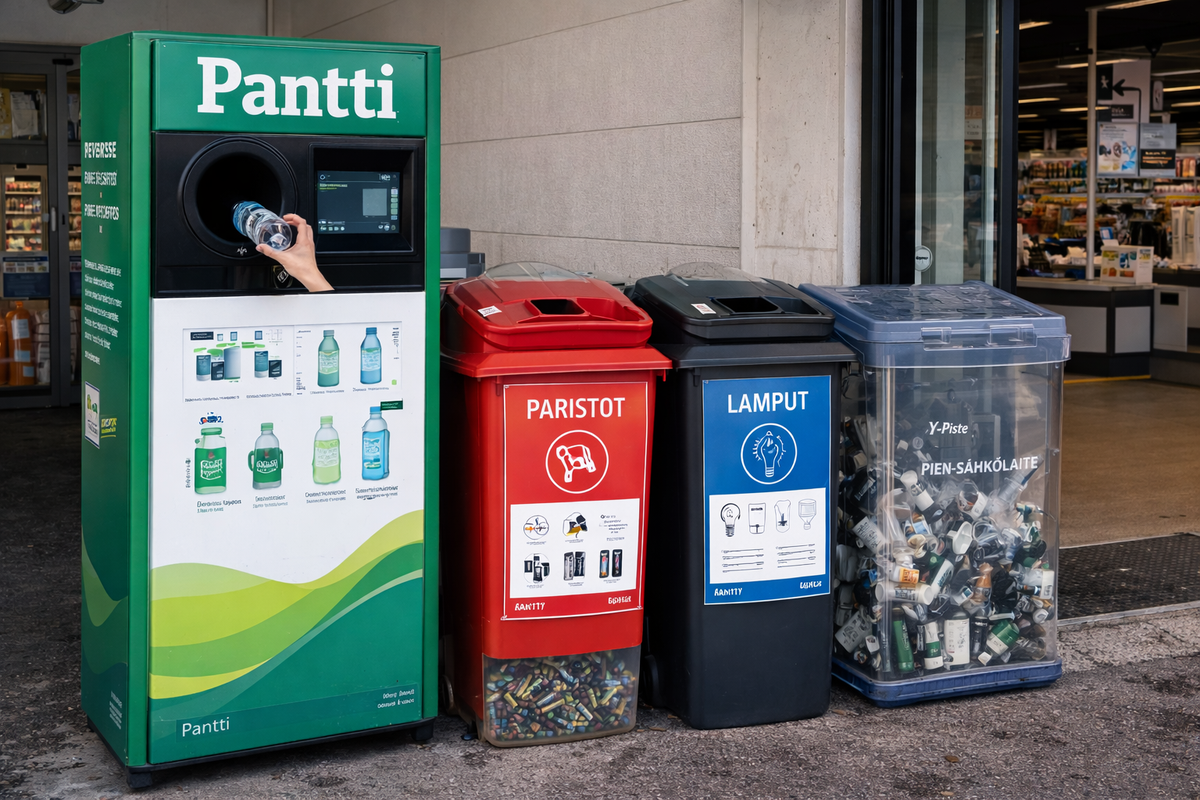
🧾 What pantti is — and how to spot it (so you don’t confuse it with regular trash)
Pantti is a deposit on a container (bottle/can) that’s “hidden” in the drink price. You pay it when you buy the drink, and you get it back when you return the container in the machine.
A simple Finnish rule makes it easy:
- If the package shows pantti and/or a deposit amount, you can return it in the machine.
- If there is no pantti marking, it’s regular packaging and goes into sorting (and that’s where the guide Waste sorting in Finland: where tourists should throw what is useful).
And yes: the machine is not a “judge.” It simply checks the system. If the container isn’t part of the deposit system — or the barcode/label is destroyed — it won’t accept it.
🤖 How pantti return machines work: step-by-step, without stress
Return machines exist in almost all supermarkets, often near the entrance or in a separate “pullonpalautus” area.
The routine is always similar: insert → wait for confirmation → take the receipt at the end.
Why the machine “rejects” a container
Most of the time it’s a simple, non-dramatic reason:
- the label is torn / unreadable;
- the bottle is crushed so the machine can’t recognise the shape;
- the container has no pantti (common with imported drinks);
- the machine is full or temporarily glitchy — there’s often a second one nearby.
If you’re unsure, don’t try to “argue with the machine.” Put it back in the bag and solve it at another location.
🧃 What is pantti-returnable — and what isn’t (a no-confusion cheat sheet)
The most common tourist mistake is thinking that any glass or any can is pantti. In Finland, these are different worlds: deposit containers vs “regular glass/metal.”
Key idea: pantti is determined not by the material, but by participation in the deposit system. That’s why the marking matters more than “it looks like a bottle.”
🔋 Batteries, bulbs, and small electronics: where to take them — and why it’s easier than it seems
Finland treats batteries and bulbs as “small sources of big harm,” so there are usually dedicated collection points.
For a tourist, a calm real-life system looks like this:
✅ Batteries (AA/AAA/button cells) — special collection containers in stores.
✅ Bulbs (energy-saving/LED) — separate boxes, often near the battery container.
✅ Small electronics (cables, old mouse, small gadgets) — electronics take-back points in large stores or municipal collection points.
If you’re staying in an Airbnb and you find a “battery box” in a cupboard — that’s normal Finnish household magic. Don’t be surprised.
And one important note for travellers: even if nobody is “fining you on the spot,” throwing batteries into regular trash is a bad idea. This is one of those cases where doing it “the Finnish way” means taking one extra step.
🧪 Chemicals, aerosols, oils, solvents: how not to complicate your trip
“Special waste” includes anything potentially toxic or hazardous: paints, solvents, car fluids, some household chemicals, gas cartridges, some aerosols.
A simple, no-heroics strategy helps tourists most:
✅ Don’t buy big volumes for a short trip — leftovers can be hard to dispose of properly.
✅ In a rental, ask your host where the nearest “dangerous waste / erityisjäte” point is (locals usually have an established routine).
✅ If something is left after a renovation or long stay, it usually goes to a municipal collection point (in the Helsinki region you’ll often see the word Sortti; elsewhere, local names vary).
Psychology matters: collection points aren’t “the tax office.” You’re not paying a “trash fine” — you’re just returning items that shouldn’t go into regular bins.
🧳 Typical tourist scenarios: how to do it right without idealism
Hotel. Sorting in the room is often minimal. There may be lots of pantti containers — collect them in a bag and return them at the nearest supermarket machine.
Airbnb. You usually have basic sorting under the sink and larger bins in the courtyard. If you’re unsure, split at least into “mixed waste” and “pantti containers” — that’s already half the win.
Picnic / road trip. Bring a separate bag for pantti containers — it’s lighter than it seems, and at the end it becomes a receipt at the checkout.
Longer stay. Then the logic is: return pantti at the machine, sort the rest, and collect batteries/bulbs in a small bag to return in one trip.
- 🧴 Collected pantti containers in a bag and returned them in the machine
- 🔋 Put batteries/bulbs aside and dropped them into the store collection box
- 🧪 Didn’t buy excess “strong” chemicals for a 1–2 day trip
- 🧳 In Airbnb, checked the host’s waste instructions (often two lines, but lifesaving)
- ♻️ If I’m unsure — I use “sekajäte” and don’t torture myself with perfectionism
🌿 A small Finnish moral: why pantti feels so satisfying
Pantti is a rare case where ecology doesn’t feel like a lecture, but like a clear everyday game: bring it back — get it back. In a country that values quiet, order, and predictability, it fits perfectly: you’re not “saving the world,” you’re just doing a small action within a system.
And if you also sort the basic fractions, it becomes a quiet habit that often stays with you after the trip.
Pantti in Finland isn’t a complicated “reform,” but a simple everyday life hack: the deposit is already included in the price, machines are nearby, the receipt becomes a discount or payout, and batteries and bulbs can be returned literally “on the way to buy bread.” The key is not to confuse deposit containers with regular glass/metal — and not to buy extra chemicals for a short stay.
If this guide helped, save it and share it with friends heading to Finland. And tell us in the comments where you returned containers and what surprised you — these “real-life details” help other travellers the most.
❓ FAQ
Usually not. The machine accepts containers that are part of Finland’s deposit system. If there’s no pantti marking, sort it as regular glass/plastic/metal.
It depends on the container. The deposit amount varies and is usually printed on the label. Even a small bag of bottles often turns into a pleasant discount at checkout.
Check whether the label is torn or the container is crushed too much. If everything looks fine, the machine may be full or temporarily out of service — often there’s another one nearby.
Nobody expects perfect sterility, but a quick rinse is a good habit (and it’s nicer to carry the bag).
Usually to special collection boxes in stores and supermarkets. It’s the simplest and correct option.
Most often into dedicated bulb boxes in stores. If you don’t see one, ask staff — it’s a normal question in Finland.
Most often no. That glass is sorted as regular glass in a “Lasi” container.
If the amount is small, it’s best not to buy extra. If you already have them, ask your host/accommodation manager where to return “special waste” — usually there are municipal collection points.

0 comments
Log in to leave a comment