



⚡ EV charging in Finland: connectors, payment, pricing, etiquette, and freezing temperatures — a practical guide
If you’re driving in Finland with an EV (your own or a rental) and want charging without surprises, you’re in the right place. This article explains the Finnish EV ecosystem in a clear, practical way: which connectors you’ll see most often, how a charging session starts, why the “price” isn’t always only per kWh, and what matters most in winter.
Important: pricing, terms, and station availability can change. Always check the current price and station status in the network app/map before you set off.
- Connectors: most commonly Type 2 (AC) and CCS (DC).
- Payment: usually via a network app/QR or a network RFID card.
- Pricing: can be per kWh, per minute, plus an idle fee after charging ends.
- Winter: a cold battery = a slower start. Preconditioning helps.
- Etiquette: don’t “camp” at fast chargers — leave at around 70–80%.
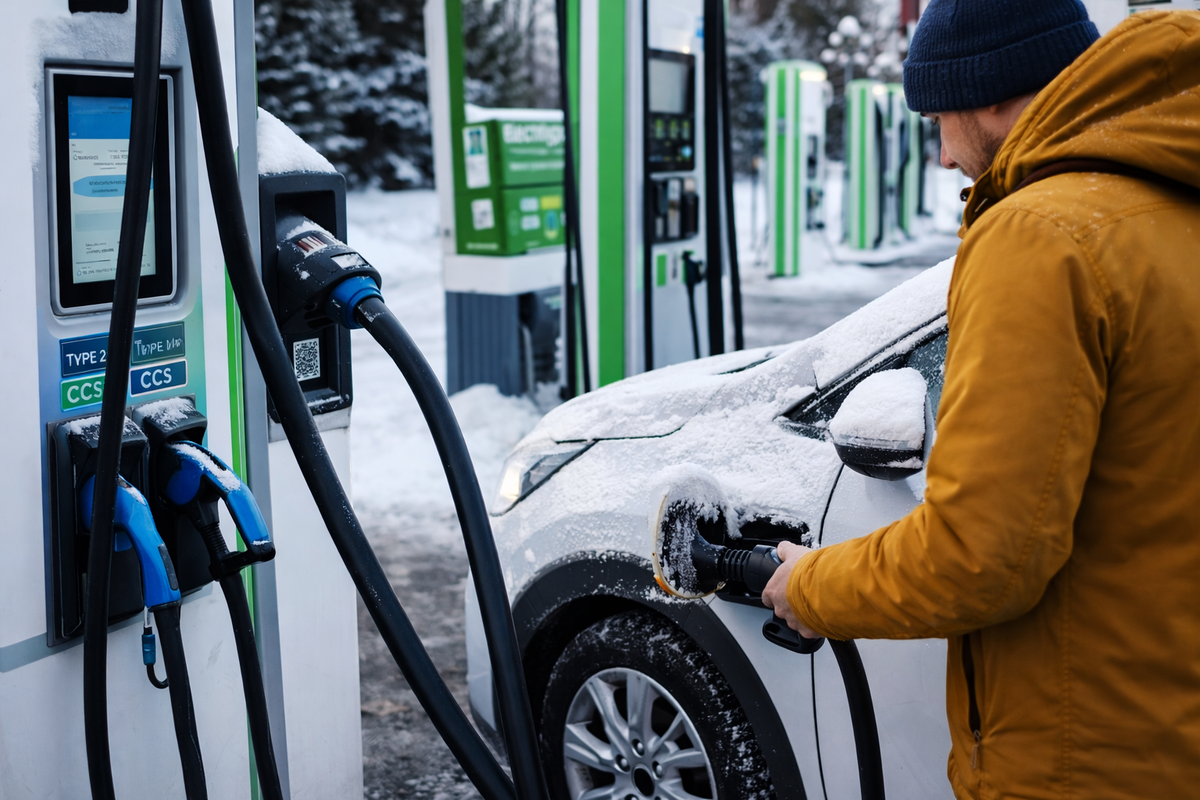
🔌 Connectors: what you’ll see most often in Finland
Finland follows the standard European charging logic — which is great for travellers: if your car is “European spec,” you’ll almost always find a compatible station.
✅ Type 2 (AC) — the standard for “slow/medium” charging. Common in cities, parking garages, hotels, offices, and near shops.
✅ CCS (DC) — the standard for fast and ultra-fast charging on highways and at major hubs (shopping centres, service areas).
⚠️ CHAdeMO — still exists but is less common. If your car depends on CHAdeMO, don’t rely on luck: filter stations by connector in advance.
A helpful habit: before your trip, check your car settings once to see the maximum power it can accept on AC and on DC. That explains why your car might charge at “50 kW” on a “150 kW” station.
⚡ Charging types: AC, DC, and HPC — what to choose on a trip
In Finland you’ll typically meet three levels:
✅ AC (roughly 6–22 kW) — perfect for overnight stays, museums, long walks, work.
✅ DC (roughly 50–150 kW) — ideal for a “coffee + restroom + 20–40 minutes” stop.
✅ HPC (150–300+ kW) — for quick top-ups on route, especially in winter.
Key nuance: charging speed is almost never constant. On DC/HPC it often drops after ~70–80% — that’s normal. The car protects the battery, and networks want turnover.
📲 Authorisation and payment: how a session starts
Finnish style: minimal talk, maximum automation. In most cases you’ll use one of three methods:
✅ QR code on the charger → opens a web page/app → start session.
✅ Network app (or an aggregator) → choose station → start.
✅ Network RFID/NFC card → tap on reader → start.
What matters for tourists and first-timers:
- “Pay by bank card right at the charger” exists, but not everywhere.
- Internet can be everything: if you’re heading into less populated areas, think about roaming/eSIM.
- Some networks have two layers of pricing: “charging price” plus an “idle fee” after charging ends (to prevent spot blocking).
If you’re renting an EV, ask the rental company in advance: do they provide a network card/access, or do you pay via your own apps? A related guide like Car rental in Finland: deposit, insurance, fuel and fines helps here — especially what’s included vs not included.
🧾 Pricing: per kWh, per minute, and “idle fees” — where people most often get caught
The biggest tourist trap is thinking: “I’ll pay for electricity and that’s it.” In reality, pricing models vary:
✅ Per kWh — the clearest: you pay for the energy delivered.
⚠️ Per minute — common at fast chargers to encourage turnover.
⚠️ Mixed — kWh + minutes, or kWh + a fixed start fee.
⚠️ Idle fee — applies if charging has finished but the car stays parked.
Finnish rule of thumb: if there’s an extra fee, it’s usually shown in the app before you start. Do a 10-second check: price, unit, and idle-fee terms.
If you want a calm framework for “what’s a fee vs what’s a tax,” a separate article like Fees in Finland: eco fee and service fees — what they are and when they appear can help reduce stress around “extra lines.”
🖥️ What the numbers on the charger screen mean: a quick decoder
You’ll usually see:
- kW — current power (how fast it’s charging right now).
- kWh — energy delivered so far.
- Time — session time or estimate.
- € — cost (not always shown on the charger; often only in the app).
- % — battery state of charge (often only in the car, not on the charger).
Why “kW drops” — and why it’s normal:
- the battery is cold (especially in winter);
- the battery is close to 80–90%;
- the charger shares power between two outlets;
- the car limits intake to protect the battery.
🧊 Charging in freezing temperatures: what to consider in Finnish winter
Charging works in Finnish winter — but battery physics still applies. Cold does two things:
- Lower initial charging speed, especially if the battery is very cold.
- Higher highway consumption, because heating and winter resistance eat range.
What genuinely helps (and saves time):
✅ Battery preconditioning (if supported). Many cars heat the battery when you navigate to a charger.
✅ Don’t drive to “0% panic.” In winter, it’s easier to keep buffer and do more short DC stops.
✅ Choose “warm stops.” Chargers near cafés/malls/service stations: you warm up, the car charges, your mood survives.
✅ Be gentle with cables. If something feels stiff in the cold, don’t yank — stop the session properly and try again.
- ✅ Navigate to the charger (if your car supports preconditioning, it may start automatically).
- ✅ Check in the app: pricing (kWh/min) and whether there’s an idle fee.
- ✅ Plan the stop where you can warm up (café, mall, ABC-style service stations).
- ✅ Don’t push to 100% on fast chargers — it’s often better to leave at 70–80%.
- ✅ Keep gloves handy: cables and connectors in freezing temps are their own sport.
🤝 EV charging etiquette: rules Finns read instantly
Finns rarely confront you directly, but “neighbourly respect” is strong. At chargers, it looks like this:
- ✅ HPC/DC isn’t parking. Plug in → charge → leave.
- ✅ 70–80% at fast chargers is a sensible ceiling. After that, speed drops and you block a spot.
- ✅ Don’t occupy an EV spot without charging. Even “for five minutes” might be someone’s only chance.
- ✅ Queues without drama. If there’s one charger and it’s taken, people wait calmly.
- ✅ If it doesn’t work, don’t fight the hardware. Stop the session, restart, try another port, move to another charger.
🧭 Where to find chargers: don’t depend on a single network
To avoid “network X doesn’t work here / won’t accept payment,” use a simple tactic:
- keep two sources to search stations (e.g., a map aggregator + a network app);
- filter by connector and power;
- check recent status/reviews if available;
- on long routes, mark two DC options (main + backup).
Ideal tourist strategy: “I know the two nearest DC options and one AC near my accommodation.”
🧳 Practical scenarios: how travellers should plan charging
1) “I’m in the city for 3–5 hours”
Best logic: AC at a parking/mall/hotel. While you have coffee, visit museums, or simply enjoy Finnish slow pace, the car builds range.
2) “I’m driving and need a quick top-up”
Use DC/HPC, and treat it as a pit stop. The winner is the one who doesn’t turn fast charging into an “overnight session.”
3) “I’m driving to Lapland in winter”
Winter “I’ll do it in one go” can become “I’ll do it on heating.” A working strategy: more short stops, less stress. And yes — warm gloves for the cable suddenly matter more than half your travel gadgets.
4) “I have a rental EV”
Clarify in advance: what’s included in the rental price, how charging is activated, and how billing works. Two common nuances: deposit/holds and “admin fees” (these are not taxes). For peace of mind, keep a related guide in mind: Rental, fuel and borders: what’s included and what isn’t.
✅ Conclusion
EV charging in Finland is logical: standard connectors, frequent stations, and payment that usually works without cash desks or conversation — via app or QR. Most “horror stories” come not from Finland, but from small details: pricing may not be only per kWh, fast stations dislike long occupation, and winter means the battery needs a bit more planning.
If you understand three things — your connector, the station’s tariff model, and your Plan B — your trip becomes what it should be in a northern country: calm, predictable, and low-stress.
If this guide helped, save it and send it to someone who’s driving an EV in Finland for the first time. And share in the comments: which cities/networks you used, what was easiest, and where you saw glitches — real experiences make these guides truly useful.
❓ FAQ
✅ In most cases: Type 2 (AC) and CCS (DC). If you use CHAdeMO, filter stations by connector in advance
✅ Sometimes, yes — but very often payment is via app/QR/RFID. It’s best to have mobile internet and 1–2 apps set up.
✅ Normal behaviour: the system protects the battery, and fast sites are built for turnover. It’s often better to leave and charge again later.
✅ Generally yes. But initial speed can be lower due to a cold battery. Preconditioning and a “warm stop” strategy help.
⚠️ Not a “fine,” but many networks charge an idle fee. Terms are usually shown in the app before you start.
✅ A practical rule: have at least two options (a major network app + an aggregator/map) so you’re not dependent on one service.
⚠️ EV stations are for cars. Charge scooters and gadgets only from regular outlets in permitted places (hotel/café), following safety rules.

0 comments
Log in to leave a comment