



🚻 Sanitation and "little mysteries" of buildings in Finland: doors, ventilation, water and drainage — what is normal and what is a warning sign
In this article, you will learn how sanitation works in Finland: why bathroom doors close "like a safe", where the smell of sewage comes from even in a perfect bathroom, why you need a floor drain, why water sometimes turns yellow after use — and when it's time to stop Googling and write to the host/reception.
The presentation will be practical: short explanations + quick actions to make you feel confident in a hotel, Airbnb, or Finnish public toilet.
🚪 Why bathroom doors in Finland close "tightly" and even slam slightly
Finnish buildings often feel "put together": doors close with a door closer, locks click, and the gaps under the door are sometimes more noticeable than you would expect. This is not "rigidity" for the sake of rigidity — this is how engineering logic works.
✅ What's behind a "tight" door:
● 💨 ventilation flow: air must move predictably (especially after a shower)
● 🧊 humidity control: in a country with long cold seasons, indoor humidity is the main enemy of walls
● 👃 odour protection: the door helps prevent odours from spreading to areas where people eat/sleep
● 🔥 fire safety: door closers and a tight fit are part of the overall safety scheme
⚠️ What not to do:
● 🚫 Do not prop the door open with a towel "to ventilate" for hours
● 🚫 Do not remove the door closer or prop the door open so that it remains half-open at all times
If the bathroom is stuffy, below is a clear scenario on how to ventilate in the Finnish way (quickly and effectively).
💨 Why ventilation in Finland works constantly (and why it cannot be turned off)
In many homes and hotels, ventilation feels like "invisible climate control": it quietly removes moisture, odours and excess warm air. Sometimes, out of habit, people try to "improve" it — by taping up the grille, covering the valve, blocking the gap under the door... and then they wonder why it has gotten worse.
✅ Normal effects of working ventilation:
● 🪟 windows fog up less (or only fog up after a shower)
● 🧺 things dry faster
● 🧊 there is no "swamp" in the room in the morning
● 👃 odours do not linger for long
🚫 What can happen if ventilation is blocked:
● 🌫️ Constant humidity and condensation will appear
● 👃 Sewer odours will intensify (yes, paradoxically)
● 🧱 In the long term, the risk of mould and material "fatigue" will increase
If you are interested in the topic "why Finns are all about air and heat," save this for future reference: 🔥 Heating and ventilation in Finland: radiators, heated floors, and "smart" buildings.
👃 Sewer smell in the bathroom: dry trap, floor drain and "quick water ritual"
One of the most common alarming scenarios on Airbnb: you walk into the bathroom and smell something like sewage. At the same time, the flat is clean, well-renovated, and tidy. This really happens in Finland — and most often the reason is not scary.
Why does this happen?
Bathrooms often have floor drains (drains in the floor) and/or rarely used drain points. Inside them is a water trap (siphon): a water "plug" that prevents odours from the sewer from returning to the room.
If the water has not been used for a long time (sometimes 1–3 days is enough), the plug can partially evaporate — and the smell rises.
What to do in 1 minute
✅ Quick steps:
● 🚿 Run water into the sink for 10–15 seconds
● 🧼 Pour water into the shower/bathtub
● 🕳️ Be sure to pour water into the floor drain (if there is one)
● 🫧 You can add a drop of soap: it sometimes helps to "gather" the plug a little more tightly
Usually, at this point, the problem disappears without any drama.
🚿 Floor drains and "lots of grates": why Finland needs them
For Finns, water and ice are a daily reality: rain, wet snow, temperature fluctuations, rapid thaws, and frost again. That is why they love a clear drainage system both outdoors and indoors.
✅ What you may notice in your home:
● 🕳️ floor drain in the bathroom (sometimes more than one)
● 📐 a slight slope of the floor "towards the grate"
● 🔇 the drain may work quietly, but not like a vacuum cleaner — this is normal
● 🧊 the bathroom is often warmer because of the floor/ventilation
If the drain seems "slow", first check the most obvious things: hair and soap scum near the grate. In Finland, it is not customary to pour aggressive chemicals into rental accommodation "by eye" — it is better to write to the host and clarify what is permissible.
For the future, if you want to understand the household logic of the home without stress: 🗑️ Waste sorting in Finland: fractions, containers and rules for guests.
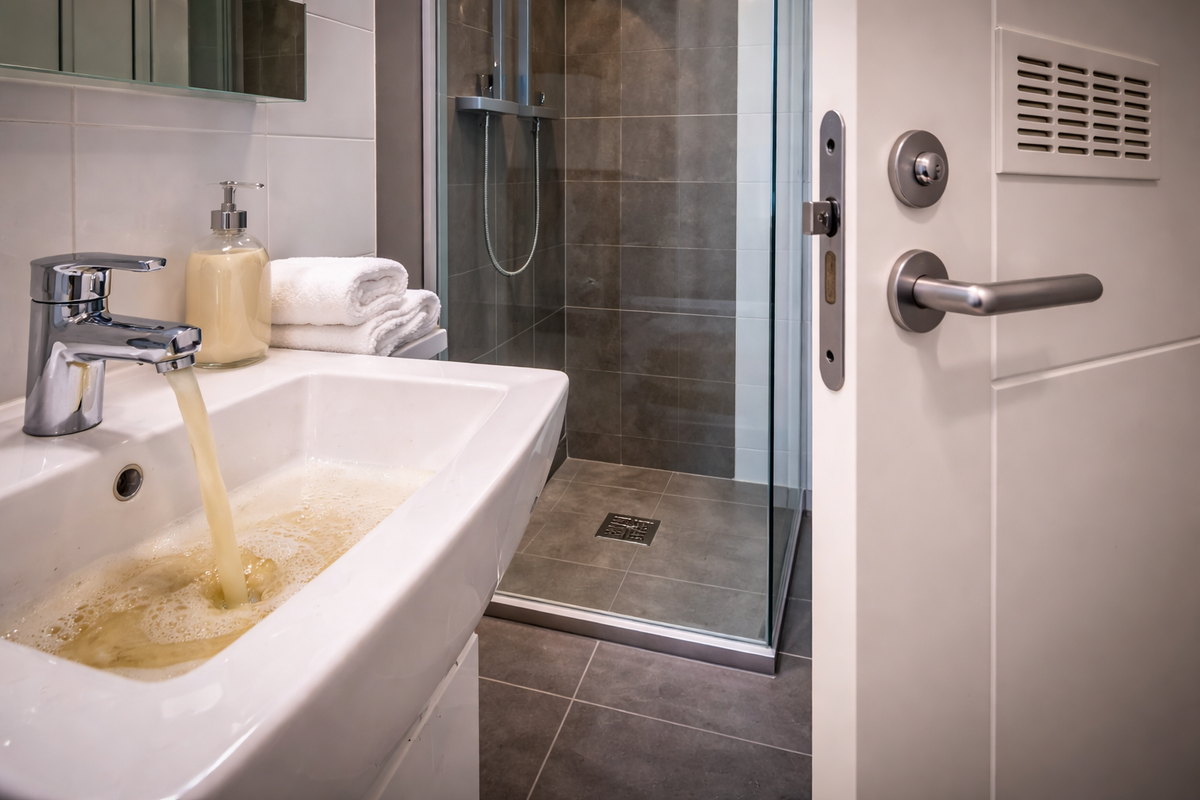
💧 Why water sometimes turns yellow after work (and how to know that everything is okay)
Yellowish or slightly cloudy water most often appears:
● 🛠️ after washing/repairing pipes in the area
● 🧱 after work in the house (especially in older neighbourhoods)
● 🚰 during short-term pressure switches
✅ What to do:
● 🚿 turn on the cold water and let it run for 1–3 minutes
● 🫗 Do not pour this water into the kettle immediately (it is better to wait until it becomes clear)
● 🏨 in a hotel — check with reception to see if there has been any maintenance work
⚠️ When to be wary:
● 💛 the tint persists for a long time (roughly 15–20 minutes or more)
● 🧪 There is a strong unusual smell (not "pipes", but "chemicals")
● 🧱 the water leaves a noticeable residue
In this case, it is best to write to the owner/manager: the problem is usually solved at the housekeeping level.
🚻 Public toilets in Finland: what you will see inside and why they are convenient
Finnish public toilets are almost always "no surprises", even if they look minimalistic.
✅ Common features:
● 🚻 WC sign — universal
● ♿ Invavessa / Accessible WC — toilet for people with reduced mobility
● 🧻 Toilet paper is usually available (and often good quality)
● 🧼 soap and dryer/paper towels — depending on the situation
● 🚪 doors can close very tightly — again, for ventilation and privacy
Sometimes there are gender-neutral toilets — in Finland, this is taken in stride: functionality and respect for others are more important than a sign.
If you want to know in advance how the "culture of calm assistance" works, save this: 🚑 Emergency assistance in Finland: how 112 works and what to say without panicking.
🏠 Hotel or Airbnb: what guests should do to avoid making things worse
The most valuable rule for tourists: you are not a plumber, and that's okay. You don't need to dismantle siphons, unscrew panels or do "YouTube repairs".
About money and "who pays"
Tourists usually do not pay for utilities separately and do not "repair at their own expense" what broke on its own.
If you have clearly damaged something (dropped something heavy, broken something, torn off a fastener) — that's a different story, but everyday nuances such as "the siphon has dried up" or "the water is yellowish after the work" are not your fault and not your financial responsibility.
🚨 When we don't wait and don't "hope it will go away": red flags
There are times when it is better to act quickly — not out of panic, but out of practicality.
🚨 Write/call urgently (to the host, reception, emergency number of the house) if:
● 💦 water is leaking and there is a risk of flooding (the puddle is growing)
● 🚽 the toilet/drain is overflowing
● ⚡ there are sockets/extension cords/appliances near the water
● 🧯 there is a smell of burning or "electrics"
● 🧊 a pipe bursts/a radiator/standpipe leaks in winter (yes, this is rare, but it cannot be ignored)
✅ Mini-conclusion: Finnish sanitation — about engineering peace of mind
Finland builds houses so that they do not fight the climate, but work with it: warm air, moisture, ventilation, water, drainage — everything is subject to the logic of "let it be dry, clean and predictable".
That's why a "tight door" here is not an annoyance, but part of the system. Odours are most often solved with water, and the yellowish water after work usually disappears faster than you can finish your morning coffee.
🤝 Share and write in the comments
If this article has helped you stop being afraid of Finnish "solid doors" and strange gurgling in the toilet, share it with your friends or in a travellers' chat.
And in the comments, tell us what "everyday moment" surprised you the most in Finland: ventilation, ladders, public toilets, water after work? Your questions make it easier to update the guide so that it remains practical — not theory, but a real cheat sheet.
❓ FAQ
Almost always, the door closer is to blame: this is how ventilation, humidity and overall safety are maintained. If it is too loud, you can gently hold the door open, but do not leave it open for long periods of time.
In most homes, ventilation should be running constantly. Covering the vents often leads to dampness and odours — it is better to reduce discomfort by ventilating properly rather than "breaking the system".
Not necessarily. A common cause is a dry trap or floor drain. Pour water into all drains, and in most cases, the smell will go away.
A floor drain is a normal Finnish practice: it helps to cope with moisture and safely drain water. For a climate with wet snow and heating, it's actually more convenient than it seems.
Most often, this is a result of maintenance work: sediment has "risen" in the pipes and will quickly pass. If the colour persists for a long time or smells "chemical," it is best to check with the host/reception immediately.
It is better not to. ✅ Toilet paper is fine. 🚫 Napkins/wet wipes/hygiene products should be disposed of in the bin, even if they "seem to dissolve".
Yes. There are toilets in shopping centres, museums, libraries and stations. In the centres of large cities, everything is usually well thought out — just look for the WC sign.
Guests are not usually charged for normal household issues (dry siphon, ventilation issues, temporary cloudiness of water after work). If you have clearly broken something, then this will be discussed separately.
Safety first: move appliances and extension cords away, limit the water as much as possible (if you know how), then immediately write/call the host/reception. If there is a real threat (short circuit/smoke/sparks), act as you would in an emergency.

0 comments
Log in to leave a comment