



🏠 Visiting the Finns: shoes, gifts and "Kiitos" without awkwardness
Finns don't often invite people to their homes "just because", but when they do, it's usually a sign of trust. For them, home is a place of tranquility, not an "open office", so it's important for guests to behave a little more delicately than they are used to, but without being overly formal.
Here's a relaxed, practical guide on how to enter, where to leave your shoes, what to bring with you, and how to say "thank you" so that everything looks natural and Finnish.
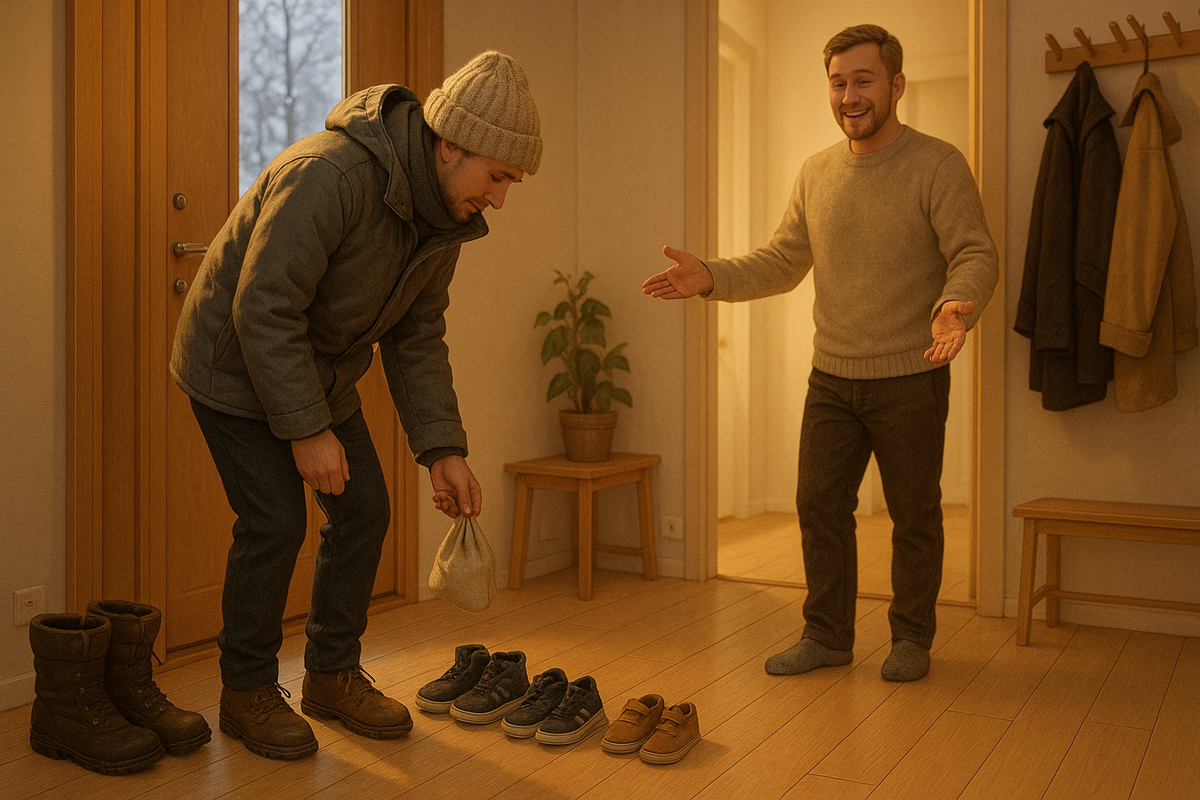
👟 Shoes at the door: a rule with almost no exceptions
In almost every Finnish home, shoes are taken off at the front door. Even if the carpet seems "inviting," it is better not to take any chances.
What to do:
● Come in, say hello, and stop at the entrance.
● Look at the shoes by the door — this is the easiest indicator.
● You can ask right away:
"Pitäisikö kengät ottaa pois?" — "Should I take off my shoes?"
● In 99% of cases, you will hear "joo" and be told where to put them.
Life hack: clean socks are a must. Bringing clean socks or light slippers in your bag is a plus, especially in winter.
🎁 Gifts: no luxury, but with attention
Finns do not expect "wow gifts" and may even be embarrassed by overly expensive items. However, they greatly appreciate modest but thoughtful gifts.
What is usually appropriate:
● a box of good chocolate or sweets;
● coffee, tea, small sweets;
● flowers for the home (no overly elaborate bouquets);
● something "from home" — a small edible souvenir or an item with a story behind it.
You can add a short note or say on the spot:
"Pieni tuliaisia teille, kiitos kun kutsuitte."
"A small gift for you, thank you for inviting me."
It is not necessary to bring alcohol — Finns are relaxed about this, but it is not a "mandatory element".
🙏 "Kiitos" in Finnish: gratitude without many words
The Finnish style of gratitude is:
● a short “Kiitos” (“thank you”)
● at the right moment: when entering, for food, when leaving;
● sometimes — a short message the next day.
Examples:
● “Kiitos paljon illasta.” — “Thank you very much for the evening.”
● “Oli tosi mukavaa, kiitos kutsusta.” — “It was very nice, thank you for the invitation.”
Finns do not need long emotional monologues. A clear, sincere "thank you" at the right moment sounds more appropriate than ten phrases of "you are amazing people, thank you, thank you, thank you."
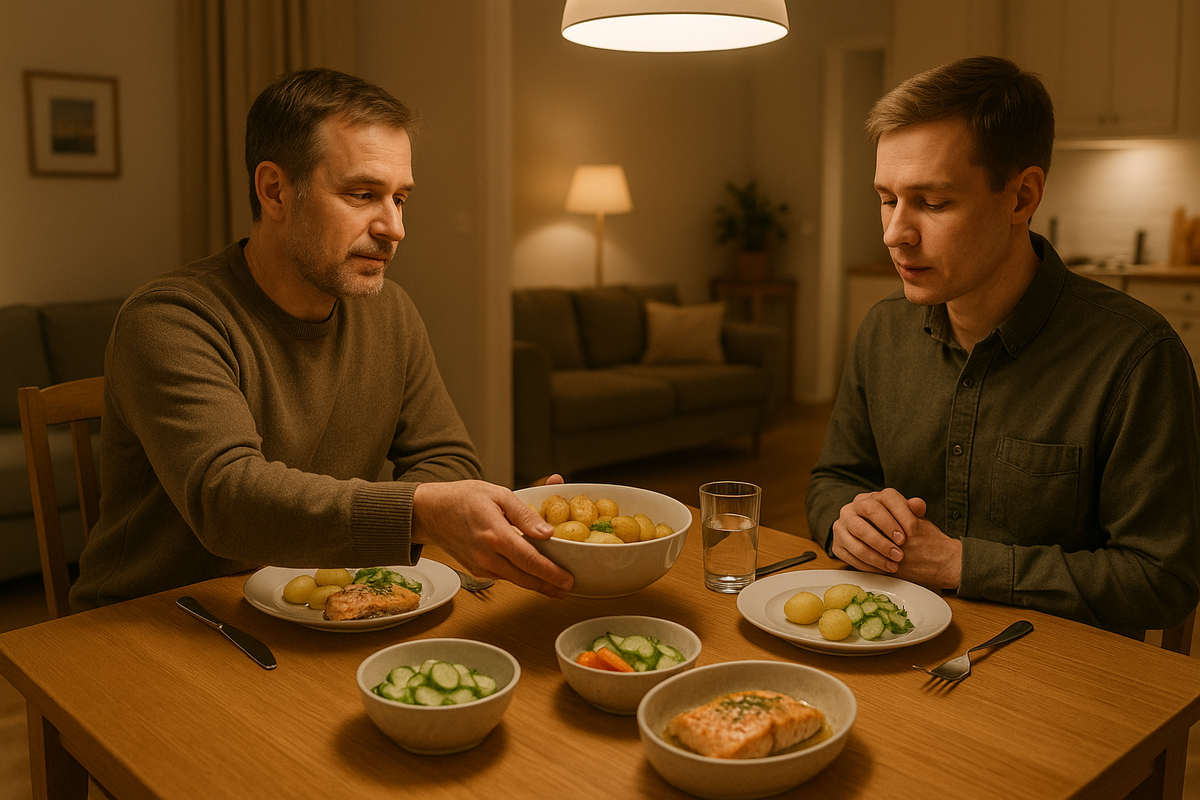
🍽 Behaviour at the table and when visiting: a "quiet guest" is the best guest
The main principle is not to take up more space and attention than necessary.
● Wait to be invited to sit down and start eating.
● If you are unsure about having seconds, you can ask:
"Saako ottaa lisää?" — "May I have some more?"
● Do not criticise the food or the interior (even "jokingly").
● Helping to clear the table is a plus (if the host does not refuse).
● If you spill something, calmly mention it and offer to help clean it up.
The same principle applies on the sofa and in the kitchen — observe what the hosts are doing and adapt accordingly.
💬 Conversations: what to talk about and what to avoid
Comfortable topics:
● travel and nature in Finland;
● work in general terms (without asking about salary);
● hobbies, sports, music, gardening/cottage life;
● the weather and the season — classic topics.
What to avoid when visiting:
● comparing "you have it worse/better than we do";
● actively discussing money, personal life, politics/religion;
● making overly direct compliments about the appearance of the household members.
A good rule of thumb: before asking a question, ask yourself if it would be appropriate if you had just met in a neutral place.
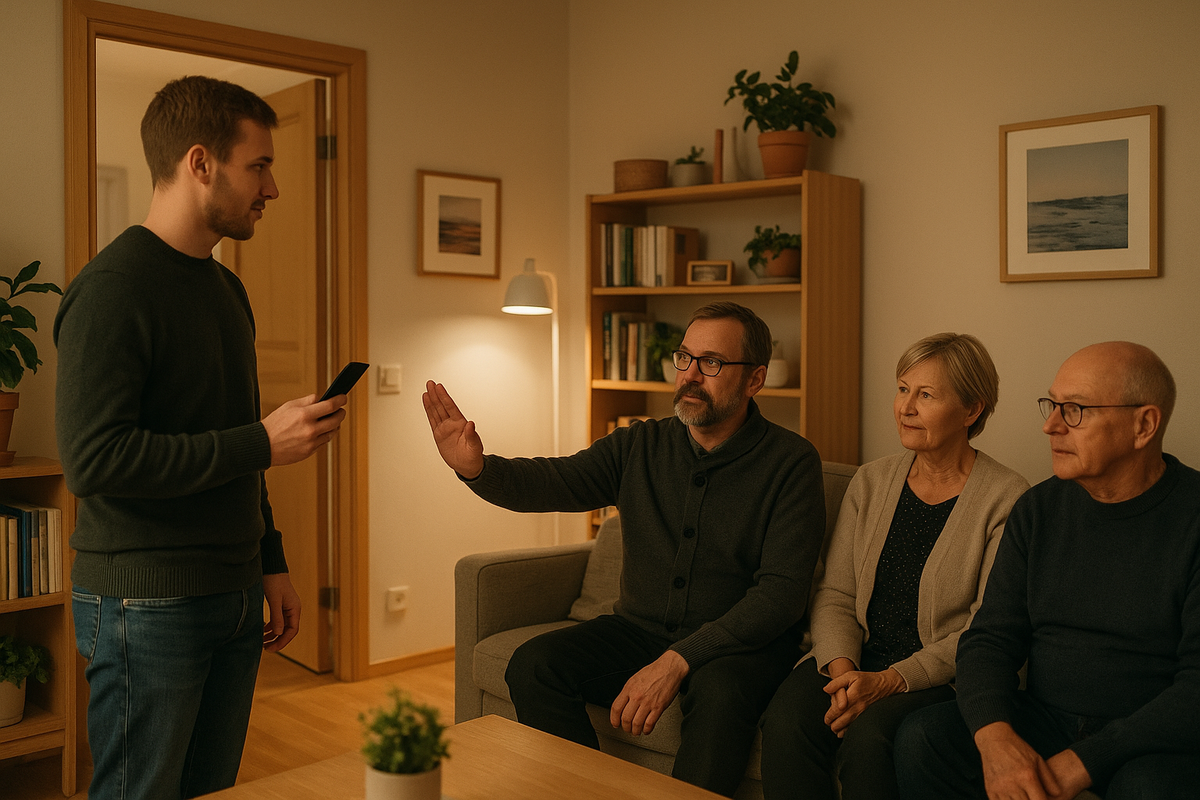
📸 Photos at guests' homes: better one extra question than one extra shot
Finns are sensitive about privacy, so:
● always ask before taking photos of people in the house;
● do not post close-up photos of the interior with other people's personal belongings without their consent;
● if it is a family celebration, check whether it is okay to share photos at all.
The simplest formula:
"Onko ok, jos otan kuvan?" — "Is it okay if I take a photo?"
And if you hear "mieluummin ei" ("better not") — that's a definitive answer, no questions asked.
🚪 Leave on time: don't linger or run away
Finns appreciate it when you respect their time and fatigue, even if the evening is very warm.
● Do not stay until your hosts are exhausted.
● Signs that the evening is coming to an end: the host begins to actively tidy up, talk about tomorrow's plans, and restrict access to drinks/snacks.
● Formula for leaving:
“Kiitos vielä, oli tosi mukava ilta. Minun täytyy lähteä nyt.”
"Thanks again, it was a very pleasant evening. I have to go now."
You can send a short message afterwards: "Thank you for yesterday evening, it was very cosy."
💌 Write about your experience
If you've already been to a Finnish home, tell us what surprised you the most: shoes at the door, silence at the table, the absence of "mandatory" alcohol, or, conversely, the warmth of communication. Your stories and tips help other guests to feel at ease and confident in a new culture. Let us know in the comments – we read them all and add new useful details to the guide.
❓ FAQ
It is desirable, yes. It does not have to be an expensive gift: a box of chocolates, coffee/tea, small sweets or flowers are a nice gesture and a sign of gratitude for the invitation.
It is better to apologise immediately and take them off as soon as you notice: "Oh, I didn't realise, I'll take them off now." Finns value honesty and usually react easily to such "mistakes".
You can, if you are sure that the hosts are comfortable with it. But it is not necessary. If in doubt, it is better to ask in advance or bring a neutral gift — sweets, coffee, something from your country.
A few short "Kiitos" at the right moments and, if you wish, a short message the next day are enough. Long, very emotional speeches are perceived as unusual.
It is always better to check in advance. Many Finnish homes are quite compact, and the hosts plan the tableware/seating and schedule — an extra guest, especially a child, can change the dynamics of the evening.
Signs: the hosts start actively cleaning up, talking about tomorrow, some of the guests have already left, drinks and snacks have been cleared away. If in doubt, aim for a 2-3 hour visit, unless otherwise agreed.
Yes, it is considered polite. If the host says "no need," you can at least collect your dishes and take them to the sink — small help is still appreciated.
It is better not to. Arriving 5-10 minutes early is fine, but arriving half an hour or an hour early may catch the hosts in the middle of preparations. The best option is to arrive at the exact time or a little earlier/later with a short notice.
It is better to warn them in advance. If this is not possible, calmly explain at the table: "I can't eat this for health reasons" or "I don't eat X" without criticising the food/cooking.
In most cases, yes, especially if you are the same age or in an informal setting. Gently ask, "Saako sinutella?" and see how they react; most often you will hear "joo".

0 comments
Log in to leave a comment