



🚑 Emergency help in Finland: how 112 works, what to say, and what to expect without panic
If you want to understand how to call an ambulance/help via 112 in Finland and not freeze in the moment — this article is for you. No scary stories, just a calm algorithm: when to call 112, when 116 117 is better, what to tell the operator, what happens next (ambulance, emergency department and triage), and how to act as a tourist, an expat, or someone who has lived here for years.
Finland’s emergency system is designed so that, in a critical moment, it’s not emotions that run the show — it’s order. But order is easier to switch on when you know the basics in advance — especially in winter, when ice, darkness, and long evenings can turn a small thing into “suddenly scary.”
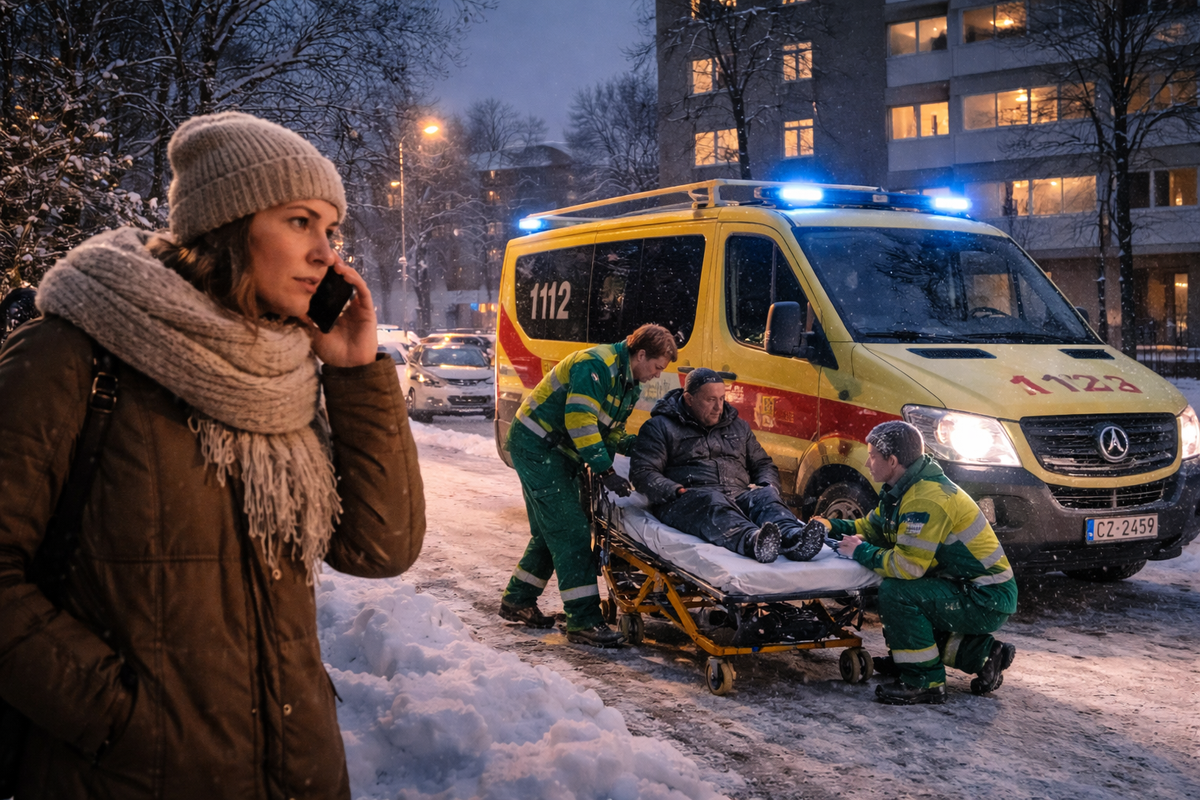
🧊 Why it’s worth understanding 112 in advance (not “when it hits”)
Picture a normal Finnish December: a dim yard, snow creaking under your shoes, you’re walking home — and suddenly sharp chest pain, severe dizziness, a child becomes unusually lethargic, someone falls on ice and can’t get up. In moments like that, the brain often makes two mistakes: panic, or downplay symptoms (“I don’t want to bother anyone”).
This article is here so you have a simple “northern framework” in your head:
- which number to dial and why;
- which words actually matter (and which you can live without);
- what will happen after the call;
- how to handle waiting in the emergency department without feeling it’s unfair;
- what to do if your language isn’t perfect and fear makes it hard to explain.
The goal is practical: so that in a real situation you have not only fear, but also a plan.
📞 112 or 116 117: how to choose in 10 seconds
In Finland, the line between “emergency” and “urgent but not life-threatening” is kept fairly clear.
- 112 — when there is a threat to life or a high risk of serious harm (medical, fire, police, rescue — all via 112).
- 116 117 — when you feel unwell, but there are no signs of immediate life threat: you need symptom assessment, to decide whether to go to emergency care (päivystys), what to do at home, and where to go next.
To remove the constant “what if I’m calling for nothing?” anxiety, use three criteria:
- Breathing and consciousness
Not breathing normally / losing consciousness / not responding appropriately — call 112. - Suddenness and severity
Severe chest pain, sudden severe headache, seizures, sudden weakness/paralysis, slurred speech, heavy bleeding — call 112. - You cannot safely reach help on your own
Serious injury, you’re alone, there’s a child or an elderly person with you, you’re outside/in the forest/on a train, and you can’t get to care safely — often 112.
If even one point feels “red” — call 112. If you’re worried but breathing is normal, consciousness is clear, and you can move — it often makes sense to start with 116 117.
If there’s a risk to life
- difficulty breathing, choking
- loss of consciousness / person is “not here”
- severe chest pain, suspected stroke
- seizures, serious injury, heavy bleeding
- a child suddenly very lethargic, “not like usual”
If you feel unwell but there are no critical signs
- fever, viral symptoms
- flare-up of chronic pain without “red flags”
- allergy without breathing problems
- uncertain whether to go to päivystys
- need a quick medical assessment by phone
Normal human logic: if you’re unsure and you’re genuinely scared about breathing/consciousness — choose 112. Better to be safe than to miss something dangerous.
🧭 What a 112 call is like in Finland (and why it’s not an “interrogation”)
Most important: the operator doesn’t need perfect sentences. They need a minimum set of facts to make a decision and send help.
A call usually follows a predictable flow:
- The operator quickly assesses urgency via key signs (breathing, consciousness, severe pain/bleeding/injury).
- They confirm location: address, landmark, floor, entrance, door code (if any).
- They confirm who: age, child/elderly, important chronic conditions (if you know).
- They give instructions on what to do before help arrives (follow them — it matters more than “nice phrasing”).
- They dispatch help or direct you to another pathway if it’s not an emergency.
The Finnish logic is calm: you’re not calling to “ask permission” — you’re activating an assistance algorithm.
🗣️ What to say to the 112 operator: a short script without extra words
Keep a simple formula: Where → What → Who → Breathing/conscious?
Perfect language isn’t required. Structure helps most.
Mini cheat sheet: phrases that “work”
- “We are at … (address / landmark)”
- “He/she has severe chest pain”
- “He/she is not breathing normally”
- “He/she is unconscious / not responding”
- “Child, (age) years old”
Here’s a table you can mentally run as a checklist.
| Step | What to say | Why |
|---|---|---|
| 1) Location | City + address + landmark, entrance/stairwell, floor, door code (if any) | So help arrives without losing time |
| 2) Core issue | One phrase: “severe chest pain / not breathing / heavy bleeding / seizure / fall injury” | Urgency assessment and resource choice |
| 3) Who | Age + child/elderly, pregnancy, important chronic conditions (if known) | Correct priority and instructions |
| 4) Conscious/breathing | “Conscious / not conscious”, “breathing normally / hard to breathe” | These are the two key “red flags” |
If your English is weak — what to do?
You can say directly: “I don’t speak English well, please speak slowly.”
Operators are used to accents and short answers. Sometimes “yes/no” plus keywords (“breathing”, “pain”, “child”, “address”) is enough.
🧠 What to do while waiting for help (the main thing: don’t try to be clever)
While waiting, it’s easy to spiral: call friends, google symptoms, worry whether you explained well. Switch to three actions instead:
- Stay on the line and follow the operator’s instructions, if they give any.
- Make access easy: open doors/gates, ask someone to meet the crew, turn on lights, prepare intercom codes.
- Warm and calm the person: in winter, preventing chilling matters (especially after a fall). A jacket/blanket and a calm voice are real help.
If you’re in an unfamiliar place: open maps and give landmarks (stop, shop, intersection). The address is gold.
🚑 What happens next: ambulance, hospital, and triage (and why “later” can be “sooner”)
After a 112 call, this is typically what happens:
- The operator dispatches a unit or gives phone instructions (often both).
- An ambulance arrives. Timing depends on priority, workload, and conditions (often faster in big cities, slower in remote areas).
- Medics do a first assessment: blood pressure, pulse, breathing, level of consciousness, basic checks based on symptoms.
- They decide whether hospital care is needed and where.
In the emergency department, triage kicks in — sorting by urgency. From the outside it can feel unfair: “we arrived earlier, but someone went first.” Inside, the logic is: those with higher risk go first.
Human translation:
If you can sit and wait, it often means your risk is lower — and that can be good news.
👶👵🧊 Special situations: kids, elderly, falls on ice, and mental health emergencies
👶 Kids
Parental fear in a foreign country is loud — and that’s normal. In Finland, people won’t judge you for being cautious, especially with breathing and a child’s overall condition.
- High fever, child drinks, responds, breathes normally — often start with 116 117.
- Seizures, breathing problems, sudden lethargy, “this is not my child” — better call 112.
👵 Elderly
Risks are higher and symptoms can progress faster. Especially in winter:
- falls on ice
- head injuries
- sudden worsening on top of chronic conditions
If an elderly person falls and there’s severe pain / suspected fracture — it’s often wiser to call 112 than to “lift and drive them yourself.”
🧠 Mental health emergencies
Panic attacks, severe anxiety, suicidal thoughts — these can also require help.
If there’s an immediate risk of harm to self or others — 112 is appropriate. If there’s no immediate danger but you need medical assessment, you can often start with 116 117 and follow their guidance.
🛡️ No insurance, EHIC, or a policy: what actually happens
A common fear for tourists and new expats: “if I don’t have insurance, will they even treat me?”
Practical answer: in an emergency, care comes first. The Finnish system isn’t designed to leave you without help “because you don’t have the right paper.”
But the financial part can come later — and it helps to separate:
- getting care (in emergencies, you get it)
- paying (the bill can be significant without coverage)
People usually think of scenarios like this:
- No insurance and no EHIC
You’ll get care; a bill may follow. - EHIC (European card) but no separate travel policy
Public-system access can be closer to local terms, but not everything is always covered “as you’d hope.” - Travel insurance (and EHIC if you have it)
The calmest option: less financial stress and more reimbursement options.
Future cross-link idea: if you’re planning a trip, it’s worth reading a separate guide туристическая страховка Финляндия and building a basic first-aid kit via что взять в аптечку для поездки в Финляндию — it reduces “small crises” that drain your energy.
🧳 Mini checklist “so you don’t freeze in an emergency” (save to notes)
In real life, it’s not heroics — it’s preparation.
- 112 and 116 117 in favourites
- Your address (exact, with postcode) + door/intercom code
- An ICE contact (who to call if you’re unwell)
- A short list of medications and diagnoses in English (2–3 lines)
- Offline-access photos of passport/ID and insurance
❌ Common mistakes tourists and expats make (and how not to repeat them)
These mistakes are human — and very common.
- “My situation isn’t serious enough to bother anyone”
In Finland, it’s normal to check, normal to ask, normal to request help. - “I’ll wait until morning”
Winter and nighttime don’t follow your schedule. If it gets worse — act. - “I can’t explain where I am”
Fixable in advance: save your address, landmarks, area/hotel/stop name. - “We’ll take a taxi, it’s faster”
With suspected stroke/heart attack and other critical symptoms, an ambulance is usually the better choice: help can start immediately and you’re taken on the correct pathway.
And one more important layer (for peace of mind, no panic): the difference between emergency care and “regular healthcare.”
If you live in Finland or are staying for a longer period, a separate guide — How to Access Healthcare in Finland — will be useful. It explains clinics, appointment booking, and the differences between public and private healthcare, without involving an “112 situation.”
🧊 A northern algorithm instead of panic (conclusion)
Emergency help in Finland isn’t magic and isn’t a “save button.” It’s a set of very practical things: 112, an operator with a protocol, a crew, an ER, and triage. It’s designed so you’re not forced to solve bureaucracy in a crisis.
Your part is small but decisive:
- remember the difference between 112 and 116 117
- be able to say where you are and what is happening
- don’t be embarrassed by broken English — facts matter more than perfect speech
- keep a minimum set of info on your phone (address, meds, ICE)
Then even on the coldest night, when the world shrinks to one breath and one call, your head won’t be empty — you’ll have a clear path.
❓ FAQ
Yes. In an emergency, care is provided first. Payment can be handled later and depends on your status and documents.
Life-threatening signs: breathing problems, loss of consciousness, severe chest pain, suspected stroke, seizures, heavy bleeding, serious injury.
Yes. English is common, especially in larger cities. If it’s hard, ask them to speak slowly and answer briefly.
Yes, 24/7. Waiting times can vary by region and workload, but the algorithm is the same.
If the child struggles to breathe, becomes suddenly very lethargic “not like usual,” has seizures, or loses consciousness — call 112.
If there’s severe pain, suspected fracture, head injury, or they can’t move safely — often 112. If they can walk but it hurts, 116 117 may be enough for guidance.
Because of triage: sorting by urgency. Higher-risk patients go first.
Save 112 and 116 117, your address, an ICE contact, a short meds/diagnoses list in English, and offline photos of documents.

0 comments
Log in to leave a comment