


🎄 Christmas markets without filters: Helsinki, Stockholm, Oslo and Copenhagen
December in the north: four capitals, four moods
If you want to understand where to go for Christmas markets in Scandinavia in the 2026 season, you will have to think not of one country, but four.
Helsinki with its sea views and sea breeze, picture-postcard Stockholm with Gamla Stan, warm and fiery Copenhagen, and slightly harsher but honest Oslo — these are four different winter stories, even if there are mulled wine stands everywhere.
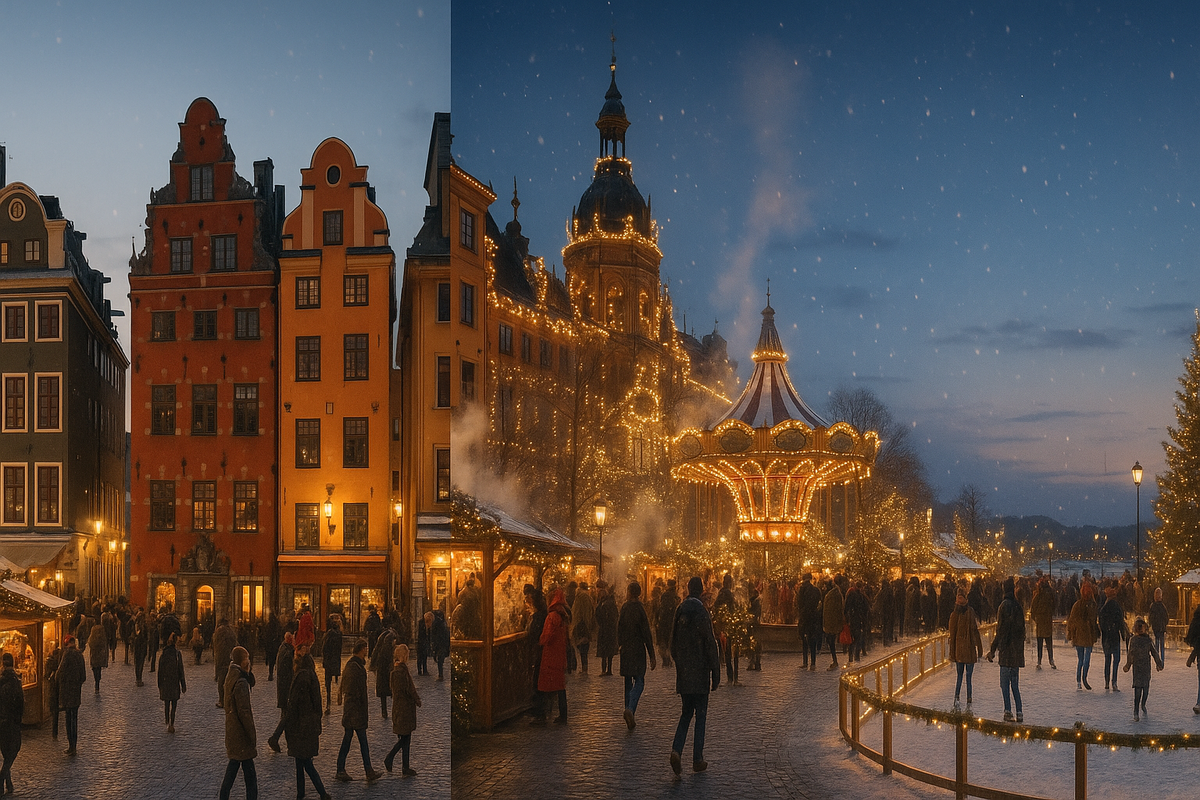
In the evening in Helsinki, you walk out to Senate Square: a white cathedral, a Christmas tree, neat rows of wooden kiosks. The wind from the sea reminds you that you are on the north coast, not in a Pinterest fairy tale. In Stockholm, you walk across the bridges towards the Old Town, and suddenly everything really does look like a postcard: gingerbread facades, soft lighting, cobbled streets. In Copenhagen, Christmas is essentially a giant attraction: Tivoli, carousels, illuminations, mulled wine smoke and sweet air. Oslo stands apart: less glitz, more air and views of the fjord, but with its own Winter Wonderland, ice rink and cinnamon buns right in the centre.
In this article, you will learn:
- how Christmas markets in Helsinki, Stockholm, Oslo and Copenhagen really differ — without marketing filters;
- where it is cosier and more ‘homely’, and where it is more like a tourist amusement park;
- what to expect in terms of prices, food and crowds in December 2026;
- how to plan a 4-7 day Christmas market tour of Finland so that you don't end up hating your suitcase and the queues.
The main idea is simple: there is no ‘one right’ city. There is you, your pace, and how you want to spend a few short winter days.
The character of the markets: Helsinki, Stockholm, Oslo, Copenhagen
Helsinki: an intimate northern postcard
Helsinki is about ‘human scale’. The main fair on Senate Square is neatly tucked between the cathedral, the square and the view of the rooftops of the old town. It's not huge, but it's very Finnish:
- lots of local crafts and gastronomy;
- fewer garish garlands, more wood, candles and calm lights;
- there are crowds, but more often you will see families with children and people with thermos mugs after work.
It is not an amusement park, but rather an open-air winter living room. If you want a quiet evening with mulled wine and the feeling that ‘I live here, I'm not just here for the show,’ Helsinki is a great choice.
The best Christmas markets in Scandinavia rarely rank Helsinki as number one in terms of scale, but in terms of tranquillity and ‘authenticity,’ it easily competes.
Stockholm: an open-air museum
Stockholm is already a classic Christmas postcard. The main attraction is the fair in Gamla Stan:
- the tiny Stortorget square, surrounded by historic houses of different colours;
- the smell of mulled wine and almonds;
- a very dense flow of people, especially in the evening and on weekends.
The second important player is the fairs at Skansen and in the open-air museums: here you can walk around old houses and buy gingerbread and candles at the same time. Stockholm visually wins over almost everyone: photos and videos from here are pure Instagram fodder, which is why those who want ‘it to be like in the pictures’ often go here.
But there is a nuance:
the closer it is to Christmas and the later you arrive, the more you feel that you are in a very beautiful, but still crowded place.
Oslo: less marketing, more air
Oslo is often underestimated. Against the backdrop of ‘hyped’ Copenhagen and ‘picture-perfect’ Stockholm, the Norwegian capital is often perceived as a strict aunt in a wool jumper. And that's a shame.
What Oslo has to offer:
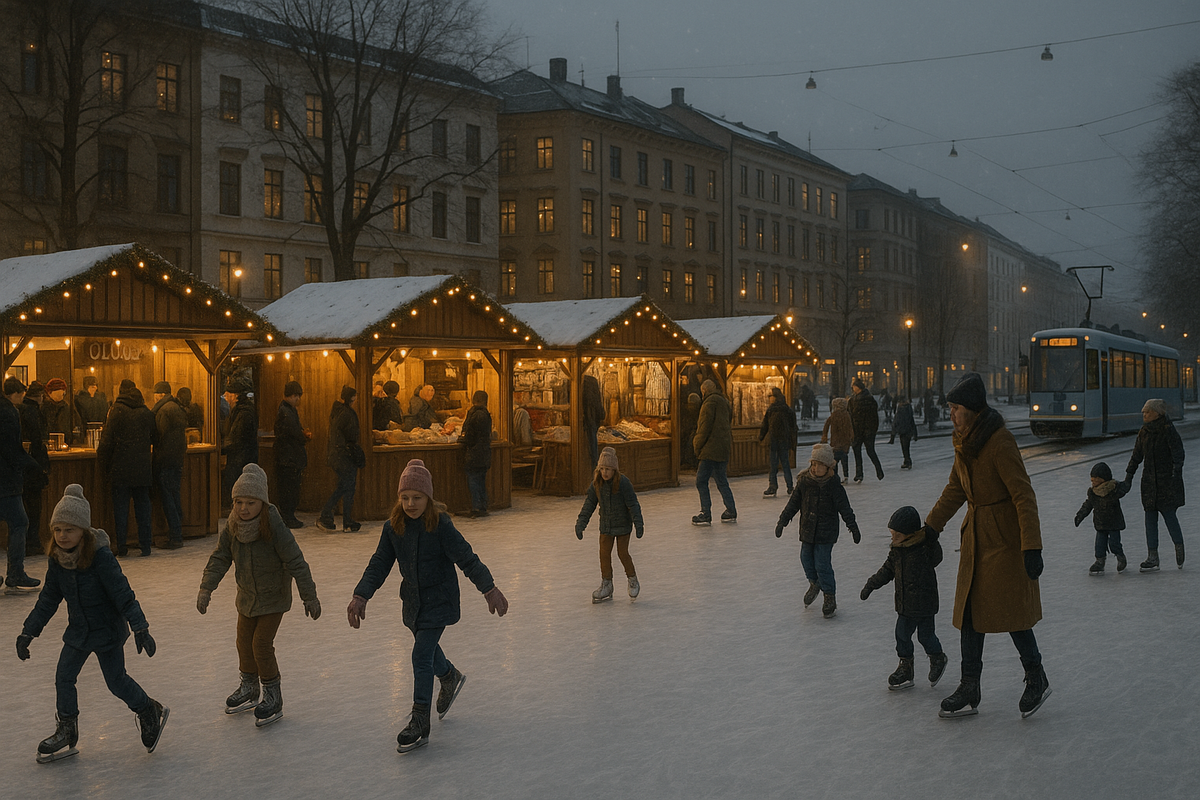
- A central winter zone (often around Spikersuppa) with an ice rink, street food, market stalls and a view of the main avenue;
- Smaller scale and crowds than its Swedish neighbours — easier to breathe, especially with children;
- A feeling of a “living city” rather than a purely tourist show.
If you want a fair as part of your winter walks around the city, rather than the main purpose of your trip, Oslo is a pleasant compromise. There is less food and souvenirs than in Copenhagen, but the basic set of ‘mulled wine, cinnamon, knitwear, wool, candles’ is there.
Copenhagen: Tivoli and the hygge attack
Copenhagen is, without exaggeration, a separate universe. The main argument is Tivoli Gardens:
- ticket entry, inside — a full-fledged amusement park with Christmas decorations;
- attractions, carousels, shows, restaurants and endless garlands;
- it is not a ‘fair’ in the classic sense, but a Christmas theme park.
In addition to Tivoli, the city is dotted with smaller markets: along the canals, in squares, in quiet neighbourhoods.
Many people go to Copenhagen specifically for the feeling of hygge: a cup of gløgg in your hands, a wool blanket, soft light in the windows and the feeling that the whole city is one big living room.
But it's important to be honest here:
- Copenhagen is almost always more expensive than Helsinki and Stockholm in terms of food and accommodation;
- Tivoli can be very crowded on weekends, especially with children.
If you want a calm northern evening, choose Helsinki or Oslo. If you’re looking for lights, sights and maximum buzz, go for Stockholm – and especially Copenhagen.
When to go and how much it costs
Season 2026: key dates and ‘risk zone’
All four capitals have a common pattern: the main fairs usually run from late November to Christmas, sometimes until early January. But the scenario for 2026 will be something like this:
- Late November – first half of December A quieter time: the fairs are already open, but there are no mass holidays yet. A good time for those who don't like crowds.
- Mid-late December, especially the 20th–23rd Peak days: maximum traffic, high accommodation prices, queues for food and at Tivoli.
- 24–26 December This is where the nuances begin:
- in Finland and Norway, Christmas, not New Year, is the main family holiday. Many places close, and cities come to a standstill;
- in Denmark and Sweden, some of the fairs are open but with reduced hours, and life moves closer to the family table.
If you want both atmosphere and working infrastructure, the most comfortable window for travel in 2026 is approximately 5 to 20 December. The closer to the 24th, the greater the risk of encountering semi-closed cities.
Prices: food, drinks, souvenirs
Prices will, of course, be ‘Scandinavian’. It is important not to remember the exact amounts, but to understand the order of magnitude:
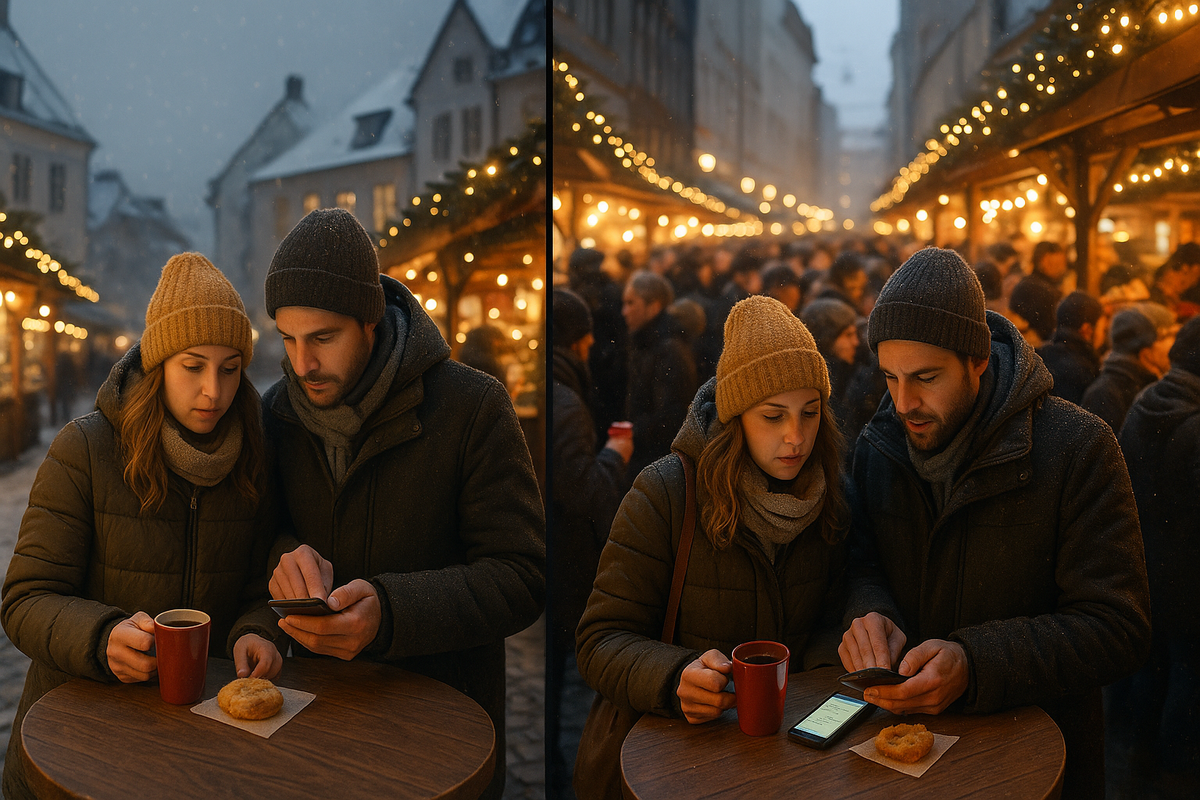
- Drinks: hot mulled wine/glögi/gløgg, coffee, cocoa — on average, from not cheap to ‘well, once a year is okay’. Copenhagen is often the most expensive, followed by Stockholm and Oslo. Helsinki may be slightly cheaper, but there are still no cheap surprises.
- Food: from sausages and soups to more complex dishes, fish or vegetarian. A hearty snack at the fair is almost always more expensive than in a regular inexpensive canteen, but you are also paying for the atmosphere.
- Souvenirs: candles, textiles, ceramics, wooden toys, knitted items. The basic logic is the same everywhere: if it is handmade Nordic design, it will not be cheap.
Useful life hack:
set yourself a ‘fair limit’ — a fixed amount for the evening.
This will immediately relieve your inner stress and you won't spend half the evening calculating how much you've already spent on buns.
Accommodation: some are more expensive, some are cheaper
On average, the picture is as follows:
- Copenhagen is usually the most expensive in terms of accommodation (especially central hotels and cute boutique hotels).
- Oslo is also not budget-friendly, but sometimes offers interesting options for weekends.
- Stockholm is slightly more affordable, especially if you look at areas outside the heart of Gamla Stan.
- Helsinki can be a pleasant compromise, especially if you are planning a winter weekend in Helsinki and Stockholm with overnight stays in both cities.
The closer it gets to 20–26 December, the more sense it makes to book everything in advance: accommodation, tickets to Tivoli, and ferries.
- Accommodation within walking distance of one of the fairs or convenient transport.
- Tickets to Tivoli (Copenhagen) and other paid locations for a specific date.
- Flight/ferry route between capitals — so you don't have to rush to catch connections.
- Warm layers of clothing and shoes that you can stand and walk in for several hours.
- Basic daily budget for the fair: drinks, food, 1–2 souvenirs ‘as a memento’ .
3–7-day itineraries: how to combine capitals
The great thing about Scandinavia is that cities are connected by ferries, trains and short flights. Even if your base is Finland, it's not difficult to put together a combined itinerary of fairs.
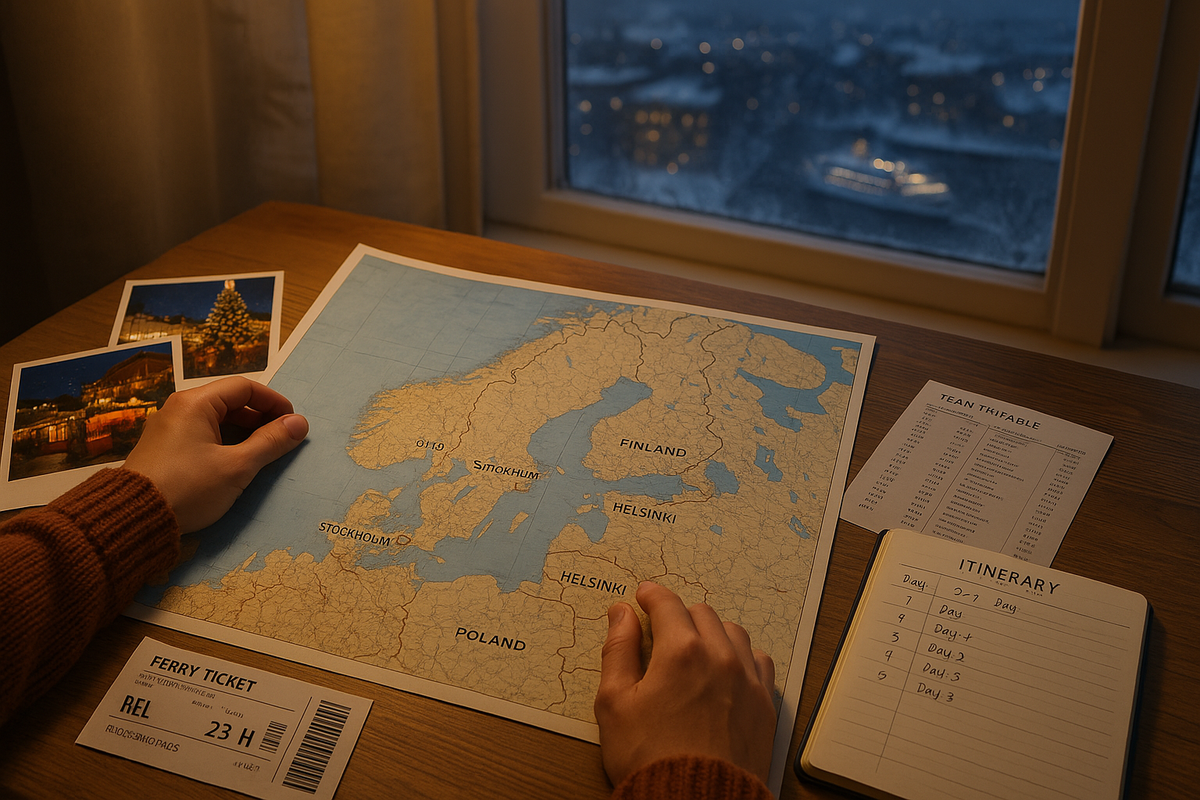
Option 1. 3 days: just one capital city, without any extra stress
Who it's for:
those who are flying in specifically for the fairs or live in the country and want a ‘panoramic’ weekend.
Examples:
- 3 days in Helsinki: a day in the city centre and the main fair, a day at designer markets and museums, a day walking by the sea and visiting the sauna.
- 3 days in Stockholm: the first day — Gamla Stan and its Christmas market, the second — Skansen and museums, the third — walks along the embankments and modern districts.
- 3 days in Copenhagen: an evening in Tivoli, a day in the city centre and canals, and another day in less touristy areas with local cafés.
Oslo is perfect for this scenario: a market in the city centre + museums + a fjord in one compact package.
Option 2. 4–5 days: Finland + Sweden
This is a classic for those who are starting from Finland (or want to start there).
Route:
- Arrival in Helsinki, two nights in the city.
- Take your time getting to know the markets, the city centre, the embankments, and pick up your first gifts.
- Night ferry to Stockholm.
- This is an experience in itself: a cabin, a view of the winter sea, sometimes a full-fledged ‘mini-cruise’ with a programme.
- One or two days in Stockholm.
- Gamla Stan, Skansen, walks, fika, fairs in different parts of the city.
This format allows you to avoid choosing ‘either/or’ and instead collect a set of Christmas markets in Sweden and Denmark, starting from Finland, without blowing your budget on flights.
Option 3. 6–7 days: three or four capitals in one trip
This is already a ‘mini-tour’ of the northern capitals. The main thing is not to try to ‘see everything,’ but to honestly choose your priorities.
Basic 7-day itinerary:
- Days 1–2: Helsinki Arrival, fairs, a few museums, walks, possibly a sauna.
- Days 3–4: Stockholm Flight or ferry, old town, historical fairs, museums.
- Day 5–6: Copenhagen Flight, Tivoli, city markets, hygge coffee shop routes.
- Day 7: Oslo (or, if you want to take it easier, an extra day in one of the cities) Short flight, walk through the centre, fjord, winter zone.
If you live in Finland, it is convenient to start and end your trip in Helsinki, and plan a Christmas market route from Finland as a combination of a ferry and a couple of short flights.
"We were living in Finland and spent a long time deciding what to do in December. In the end, we decided to spend one day at the fairs in Helsinki, take a ferry to Stockholm, spend two days in Gamla Stan and Skansen, and then fly to Copenhagen for Tivoli. It was a busy trip, but we didn't feel like we were just moving from place to place with our suitcases.‘
Common mistakes at Christmas markets
Even if you've seen Reels and TikTok from northern capitals a hundred times, in reality there are several pitfalls that tourists and newbies fall into en masse.
Expecting Helsinki’s markets to be as big and noisy as Tivoli in Copenhagen. Helsinki is much more intimate; if you arrive expecting a “huge amusement park”, you’ll be disappointed.
Helsinki's focus is on tranquillity and local attractions. Therefore, if your main goal is to see amusement rides and giant installations, it is better to plan your trip to Copenhagen instead.
Arriving in one of these cities on 24 December and expecting everything to be lively. In reality you may find closed shops, reduced opening hours and very quiet streets.
In Scandinavian countries, Christmas is a dominant family holiday. If you don't specifically dream of ‘empty streets and closed doors,’ it's better to plan your trip for before the 23rd or after the 26th.
Betting everything on one evening: “We’ll fly in, go straight to the fair and manage to do everything.” If the flight is delayed, the weather turns bad or everyone is tired, you may not experience the city at all.
Plan at least one spare slot ‘for the fair’. Especially if you are travelling with children or via transfers.
And a few more common mistakes that are better to know about in advance:
- Clothes ‘for photos’ rather than for a northern evening. Jeans, trainers and a light coat are classic mistakes. You need normal layers, a hat, gloves and shoes that you can stand in, not just walk in.
- Trying to see too many cities in one trip. ‘Seeing four capitals in five days’ looks good on the map, but in reality, you'll end up with a mix of train stations, airports, and hotels, rather than Christmas markets in Helsinki or Oslo ‘as you experience them.’
- Don't underestimate small expenses. One gløgg, a bun ‘to try’, ‘oh, what a cute candle’ — and suddenly you're spending the evening in a nice restaurant. It's better to set aside a separate budget for the markets and relax.
How to choose ‘your’ city for fairs
If you try to rank the northern capitals by “mood”, it will look something like this:
- Helsinki — for those who value the sea, light, a calm rhythm and the feeling of ‘I'm in a living city, not a theme park’.
- Stockholm — for lovers of historic centres, narrow streets and picture-perfect views.
- Oslo — for those who want to combine a fair, a fjord and walks without excessive noise.
- Copenhagen — for those who want attractions, an overdose of lights, hygge and are willing to put up with the prices.
If you only have three days, it's easier to choose one capital and take your time exploring it. If you have a week and are willing to fly or take a ferry, you can visit two or three cities and see how different Christmas in the north can be.
Christmas markets in Sweden and Denmark offer more glamour and media images, while Finland and Norway offer more air and silence around you. There is no right answer — it depends on your personality and current needs.
If you already live in Finland, it makes sense to start with Helsinki and gradually add Stockholm, Copenhagen and Oslo to your itinerary — this will make it easier for you to compare and choose your ‘favourite’ routes for the coming years.
After all, the goal of Christmas markets is not to tick off ‘I've been to all the capitals’ but to feel warmth in the midst of the northern darkness: a hot drink, lights in the windows and people who slow down for a couple of days.
If you feel that something is missing from this text — routes for children, ideas for a specific budget, or answers about logistics — please write your question or share your experience. The more real-life stories we have, the more accurate our guide to winter in Scandinavia will be.
❓ FAQ
If you want to get acquainted with the northern winter at a leisurely pace, start with Helsinki or Oslo. For a more vibrant atmosphere and hustle and bustle, it makes more sense to fly to Stockholm or Copenhagen. If you are really unsure, consider visiting both capitals in 4–5 days.
Helsinki and Copenhagen are usually considered the most ‘family-friendly’. Helsinki has fewer crowds and simpler logistics, while Copenhagen offers plenty of entertainment for children at Tivoli. Stockholm and Oslo are also suitable, but it is important to plan warm breaks and routes without unnecessary climbs in advance.
Yes, if you fly to Helsinki and take the night ferry to Stockholm or a short flight. But it's better to allow one full evening for each capital city rather than trying to ‘cover’ everything in one day
Copenhagen usually leads in terms of prices, followed by Stockholm and Oslo. Helsinki may be a little cheaper, but overall, the price level in the four capitals is similar. If you are on a limited budget, it is wiser to control the number of ‘little treats’ and souvenirs you buy.
Yes, both Helsinki and Stockholm have plenty of small markets and quiet streets away from the main tourist routes. The secret is to leave the central squares and head for the residential areas, where you can find local coffee shops and small designer markets.
If you like to combine travel with experience, the ferry is a great option: a night-time ‘mini-cruise’ plus two cities in one trip. If you don't like being rocked by the waves or want to save as much time as possible, it's easier to take a direct flight.
The basic set is the same: thermal underwear, a warm middle layer, windproof outerwear, a hat, gloves and warm shoes. In Copenhagen and Oslo, the humidity and wind can feel stronger than the temperature suggests, so layers are more important than the thickness of a single jacket.
The optimal window is usually from 5 to 20 December. At this time, the fairs are already open, but the Christmas rush and closed days have not yet kicked in at full force, and tickets and accommodation can be found at more reasonable prices.
Yes, hygge is easy to find in Helsinki, Stockholm, and Oslo: it's more about candles, warm light, layers of clothing, and rituals like ‘hot drink + walk’ than about a specific city. Copenhagen just sells it better.
Stockholm (Gamla Stan) and Copenhagen (Tivoli and canals). Helsinki offers beautiful shots of the cathedral and the sea, while Oslo offers the fjord and illuminated hills. If ‘pictures’ are important to you, it's best to include all three or four capitals in your itinerary and make your own ranking.

0 comments
Log in to leave a comment