



🌌 Northern Lights without filters: where will the weather ruin your trip more often — Finland, Norway or Sweden?
When the sky is capricious
If you want to see the Northern Lights as the locals see them, rather than through Instagram filters, you need to accept two things:
- We are living at the peak of the 2024–2026 solar cycle. This means that there is a greater chance of flashes and a ‘fiery sky’ than in recent years.
- But it's not space that decides, it's the clouds. The magnetic field can reach ‘wow’ levels, Kp can jump to 6–7, and you'll be standing under a flat white blanket and see... nothing.

Therefore, the main question is not ‘where is the northern lights brightest,’ but where is the sky most often clear. And secondarily, where is the logistics more convenient, where is there less light pollution, and where will you not go crazy from the wind.
In this article, you will learn:
- how the weather for hunting the northern lights in Finland, Norway and Sweden differs in the winter of 2025–2026;
- why the same Kp index gives completely different chances in Rovaniemi, Tromsø and Abisko;
- how not to fall in love with an advertising brochure and return home feeling like you've been cheated;
- which routes are easiest to plan if your base is Finland, but you're also drawn to Norway and Sweden.
Imagine a kitchen somewhere in Lapland: a kettle is whistling on the stove, it's freezing outside with dry snow, and you're checking the cloud forecast on your phone. In this calm atmosphere, we will now figure out where the northern weather is a little more favourable.
The climate of Finland, Norway and Sweden
The main enemy of the aurora hunter is not a weak Kp, but low cloud cover. High, thin, feathery clouds hardly interfere with the camera, but a dense lower ‘cap’ completely shuts down the show.
Therefore, we look at the three countries through one prism: sea, mountains and dry areas.
🇫🇮 Finland: drier than it seems
Finland is the only one of the three without a direct ocean coastline in the north. Yes, it is not far from the Norwegian Sea, but most of Lapland is continental:
- fewer severe storms from the ocean;
- lower average humidity, especially inland;
- in winter, there is often one typical condition: either several days of cloudy weather or several nights in a row of clear skies.
The most ‘concentrated’ conditions are north of Rovaniemi: Inari, Ivalo, Saariselkä, Utsjoki, and the Kilpisjärvi area. In northern Lapland, the statistics are simple: approximately three out of four nights with auroras, if clouds do not interfere.
In other words, magnetic activity is almost constant there — the question is how many nights of your trip will be clear.
For the northern lights in Lapland, this means that Finland often does not provide the ‘most dramatic’ view, but it does provide more stable attempts.
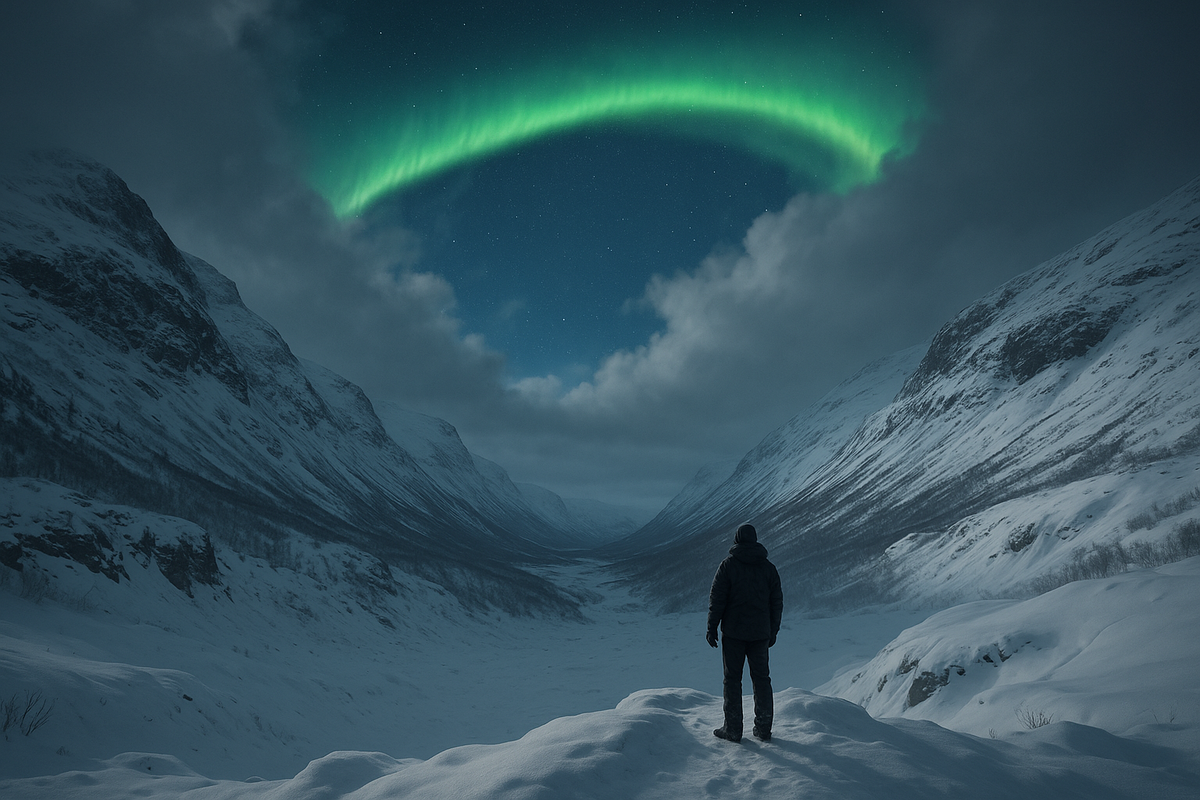
🇸🇪 Sweden: a small area with great luck
Sweden lived in the shadow of its hype-worthy neighbours for a long time, until the whole world learned the word ‘Aviska’.
What is important about this region:
- it lies directly under the auroral oval;
- it is surrounded by mountains and is in a ‘rain shadow’ — the mountains block moist air masses;
- it has one of the lowest levels of precipitation in the Arctic and many clear nights.
That is why in guidebooks and forums you constantly see phrases like ‘blue hole of Abisko’ — a local ‘blue patch’ in the clouds that remains when everything around is covered in clouds.
But there is a nuance in Sweden: this luck is very local. Drive 60–80 km away, and you are already in ordinary Swedish Lapland with normal northern cloud cover. Therefore, Sweden is a genius of precision: choose the right window → get magic; miss the window or stay in the wrong place → you get the usual ‘cloudy north’.
🇳🇴 Norway: an Atlantic beauty with character
Norway is a photographer's dream and, at the same time, a major source of frustration for tourists.
The reason is simple: the ocean is nearby. It brings:
- wet fronts from the Atlantic;
- frequent weather changes (literally ‘an hour of sunshine followed by two hours of rain’);
- a high proportion of cloudy days in winter.
This is especially noticeable in super-popular places:
- Tromsø — located on the coast, with mild temperatures and a very high percentage of cloud cover; in December, the sky here is ‘closed or almost closed’ up to ~80% of the time.
- The Lofoten Islands are visually stunning, but for hunting the aurora in winter, they offer a combination of ‘wet + windy + cloudy’.
- At the same time, Alta is slightly removed from the purely oceanic climate, with drier, more stable air. It is not for nothing that the place is called the ‘city of the northern lights’ and one of the best in terms of climate and darkness.
In short: Norway offers ‘wow’ views and powerful activity, but the weather is a lottery.
Climate & aurora risk by region
Not just Kp: multiplying the probability
To fairly compare the northern lights in Norway and Sweden with Finland, it is important to remember: the chance of seeing the lights = (are there lights at all) × (is the sky clear).
- In northern Finland (Utsjoki, Kilpisjärvi), the aurora is visible on about three out of four nights when the sky is clear.
- In Norway, the aurora can shine above the clouds almost every night in winter, especially in the Tromsø–Alta latitudes, but low cloud cover eats up most of the opportunities.
- In Abisko, statistics from tour operators and local guides suggest ‘two weeks in a row with clear skies’ — obviously, this is marketing, but according to climate data, there really is a higher proportion of clear nights there than in neighbouring areas.
Plus, we are currently experiencing favourable conditions: the peak of solar cycle 25 is expected in 2024–2025, and in 2026, activity is still expected to be high. This means that in the 2025–2026 and even 2026–2027 seasons, there is a better chance of a spectacular show than in ‘quiet’ years — provided you find a window in the clouds.
When to go: month and length of trip
The classic northern answer: September–April, with the peak season from late September to late March. The aurora can happen in October or February — the main thing is that it is dark and cloudless.
To avoid playing a dangerous game of Russian roulette:
- minimum — 3–4 nights in the aurora zone (not a great chance, but better than ‘one night and home’);
- optimum — 5–7 nights: you are almost guaranteed to get at least 1–2 clear windows, even if part of the trip is snowy;
- if you are flying far and it is expensive, 7 nights is the golden mean: ‘not too long, but significantly increases the probability.’
A separate myth is that ‘the aurora is stronger in March/October,’ but there are fewer clouds. In reality, cloud cover varies from day to day, not month to month. It is more important to follow the specific forecast for low and medium cloud cover than to believe that ‘January is always cloudy and February is always clear.’
Tools: what to actually use
Many people only look at the Kp index and pretty pictures with an oval map. In practice:
- you need hourly cloud maps, preferably separately for low clouds;
- local aurora services in Finland, Norway, and Sweden already mix space data and clouds into their forecasts and often send push notifications when the sky clears;
- A good level is when you know how to look at satellite images of clouds and see where the holes are ‘falling’.
Plus, remember: the camera sees more than the eye. Even with light haze and low activity, the camera already captures green when you only see a grey cloud.
First, look at the clouds, then at the Kp. A high Kp under ‘milky’ skies = zero. An average Kp under clear skies = a very real aurora.
Common mistakes when hunting for the aurora
The north is harsh but fair. The mistakes here are made not by the clouds or the sun, but by people.
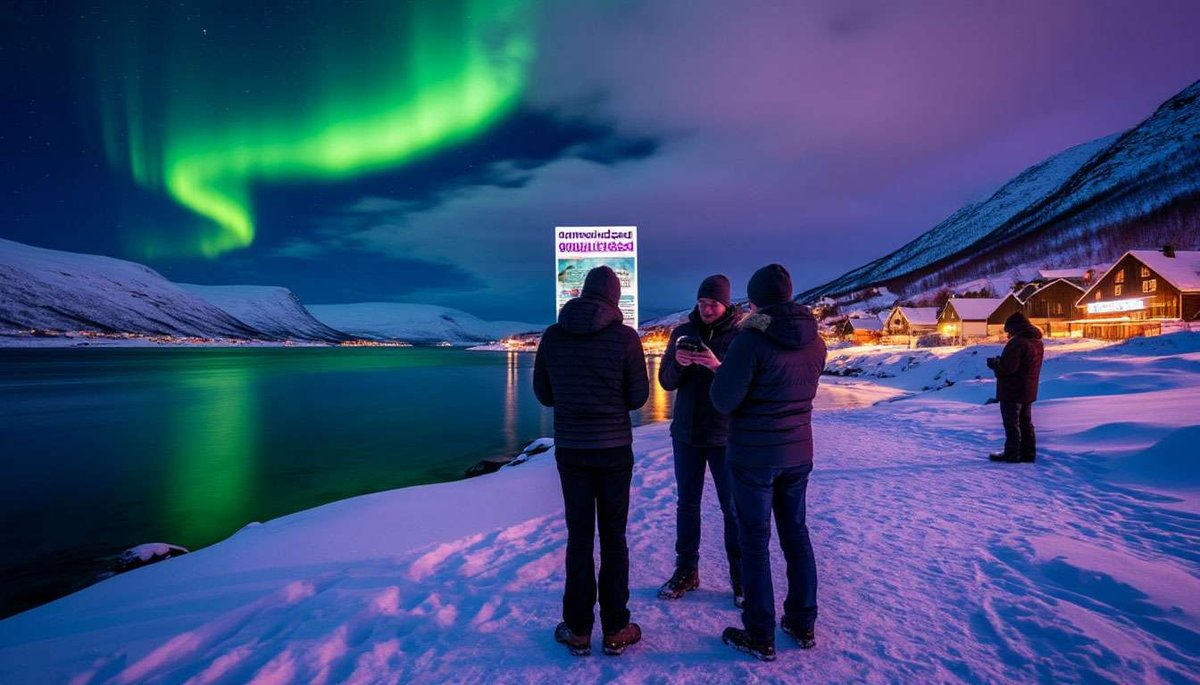
Mistake 1. ‘Tromsø = guaranteed show’
Tromsø is popular because:
- it is a beautiful city;
- it has the sea, fjords, whales;
- there are lots of ‘guaranteed’ tours.
But in terms of climate, it is one of the most cloudy cities in the aurora zone: in December and January, the sky is ‘closed’ most of the time.
If you don't have a car or a tour with a full ‘sky chase’ for 100-150 km around, you can spend the whole weekend under a grey cover, even though the Kp index showed a ‘perfect’ window.
Booking a trip with a “guaranteed aurora or another trip for free” promise without reading the fine print. In most cases this only means a new attempt in the same place – not a real guarantee of clear skies.
Mistake 2. ‘Two nights is enough’
The scenario ‘arrive on Friday evening, be home on Sunday afternoon’ seems economical, but by northern standards, that's one and a half nights of hunting:
- arrival → fatigue → the first night is almost gone;
- one real attempt;
- and that's it.
This is fine if you live in the same country and can easily fly back again. But if this is a dream and an expensive trip, it's better to save up for 4-5 nights or more.
Mistake 3. ‘The main thing is a high Kp.’
Kp is just an index of global geomagnetic activity. At the latitudes of Lapland and northern Norway, even a Kp of 2–3 can produce a beautiful aurora, especially closer to midnight.
But cloud cover doesn't affect Kp at all. Therefore:
- hunters look at Kp after they see a window in the clouds;
- and never cancel a trip just because Kp is ‘only 2’.
Mistake 4. ‘We want green and purple, like on Instagram’
The eye and the camera are two different worlds.
In reality:
- you often see a ‘greyish cloud’ or a slight arc at first;
- a camera with a long exposure already shows a green/purple “explosion”;
- strong, bright, dynamic flashes do not happen ‘every night’, even at the peak of the cycle.
Therefore, an honest approach to the northern lights in Finland and neighbouring countries is not to constantly expect a ‘Marvel movie’, but to enjoy both the soft glow and the subtle arcs. A strong storm is a bonus, not the norm.
Concluding that ‘the north is a disappointment’ after one two-day trip to the wettest place in Norway. That's not a bad thing, it's just how the climate roulette works.
Mistake 5. ‘No plan B’
Sometimes the weather objectively gives you no chance. That's when a substantive plan B comes to the rescue:
- daytime activities: skiing, dog sledding, snowshoeing, sauna;
- cultural programme: museums, local cuisine, Sami culture;
- light therapy and walks — otherwise it's easy to catch the winter blues.
If your trip to see the aurora turns into ‘we sit in a cabin and wait for a window’ — this is a very fragile strategy. The North loves those who know how to enjoy themselves even without a green streak in the sky.
Route scenarios and logistics
Now let's put together some realistic scenarios that take into account the weather, logistics and budget. Here, both the best route for the Northern Lights and common sense will come in handy.
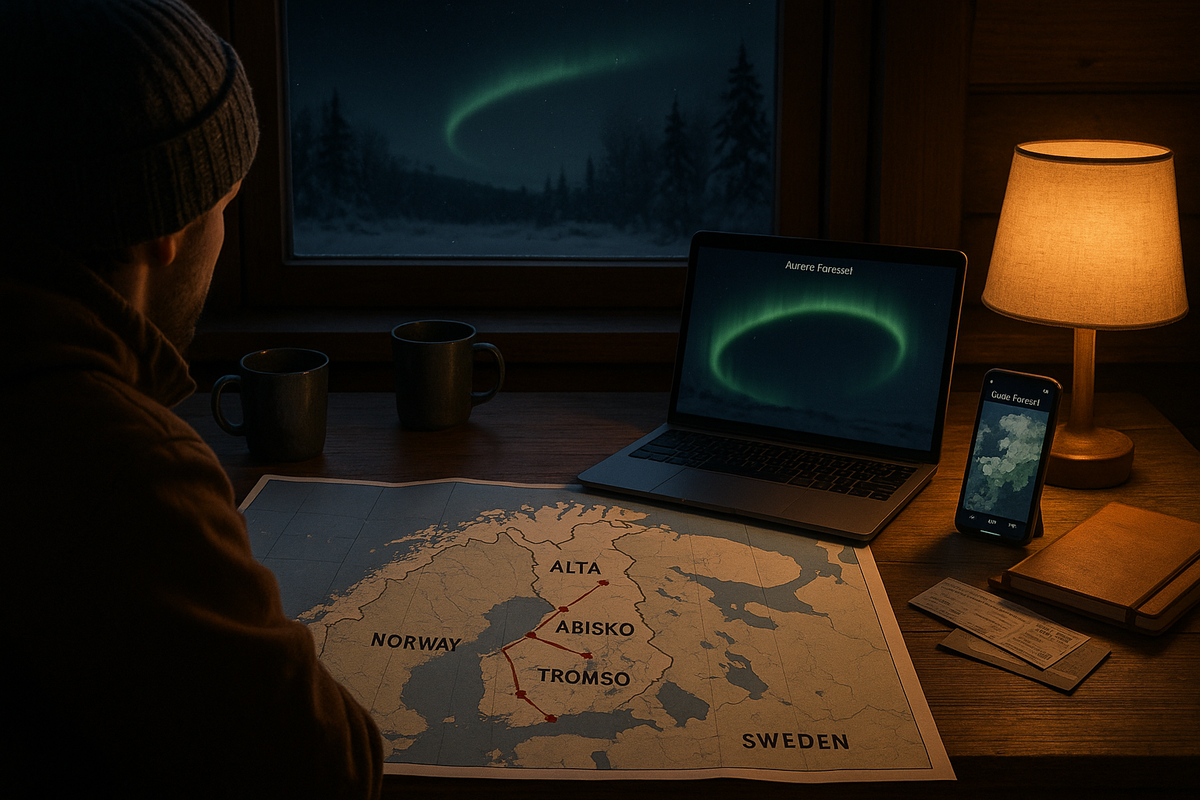
Scenario 1. Base in Finland: dry Lapland + trip to Norway
Suitable if you already live in Finland or are flying into the country as your main hub.
Lapland + Alta route (6–7 nights):
- 3–4 nights in Finnish Lapland (Inari / Utsjoki / Saariselkä):
- – stable weather, high chance of clear nights;
- – fewer people and light pollution;
- – you can combine the aurora with skiing, hiking, and sauna.
- 2–3 nights in Alta (Norway):
- – a different landscape — fjords, sea; – also a fairly stable, dry climate and the name ‘city of the northern lights’.
This scenario is balanced: you have many ‘reliable attempts’ in Finland and the added chance of a Norwegian show if the weather fronts suddenly clear up.
Scenario 2. ‘Aby Skog + Finnish border’ for introverts
If you want peace and quiet, minimal crowds and maximum chances, it makes sense to put together a package:
- flight to Kiruna or Luleå, transfer to Aby Skog;
- 3–4 nights there — betting on the local ‘blue hole’ and microclimate;
- plus 2–3 nights on the Finnish side, closer to Utsjoki/Enontekiö, to experience and where to see the aurora borealis in Scandinavia on the other side of the border.
This is for those who are comfortable with ‘small villages’, are not looking for parties, but want the best chance to see the sky.
Scenario 3. Marketing classic: Lapland and Tromsø route
Many advertising leaflets offer roughly the same thing:
- arrival in Rovaniemi/Kuusamo/Ivalo;
- a couple of nights in Finnish Lapland;
- transfer/flight to Tromsø;
- another couple of nights and flight home.
In terms of weather, it works like this:
- Finland gives you calm, stable attempts;
- Tromsø is a lottery: either you catch a night when the front has passed, or you sit under the clouds and ride through the mountains on a bus, hoping for a break in the clouds.
This is not a bad scenario, but it is important to be honest: Norway is part of the adventure here, not ‘insurance’ against the weather.
- Look at the precipitation and cloud cover map for the region for the winter, not just the photos in the brochure.
- Check what is included if there is no aurora (discount, second trip, other activities).
- Check if there is a daytime programme in case of prolonged inclement weather.
- Compare the price with renting a car + accommodation yourself, sometimes it is cheaper.
Scenario 4. For those who live in Finland
If you are already here, you can catch the northern lights in Finland in stages:
- Discover Rovaniemi and its surroundings — as a gentle start.
- Then go to Utsjoki/Kilpisjärvi, where it is darker and drier.
- And only then add Norway and Sweden for variety.
This way, you will get to know the region and not worry so much about ‘one unsuccessful trip’.
“ We first went to Tromsø for three nights and saw nothing but snow and fog. The following year, we visited Abisko and the Finnish side, and saw the aurora four times in a week. Conclusion: the location and climate are more important than the hype surrounding the city."
The North without the hype
If we remove the marketing and leave only the facts, the picture is as follows:
- Finland offers many stable opportunities: a continental climate, dry Lapland, good infrastructure and the opportunity to combine the aurora with a leisurely life in the north.
- Sweden offers a specific miracle in Abisko and generally good chances throughout Lapland — especially if you are mobile.
- Norway offers the most dramatic landscapes, intense activity and the most unpredictable weather.
The ideal answer to the question ‘where to see the aurora borealis in Scandinavia’ will always be personal:
- introverts will enjoy small villages, a cottage, a sauna and quiet nights somewhere near Inari or Abisko;
- those who love adventure and are not afraid of bad weather will enjoy the Norwegian fjords and the race for daylight;
- and those who have lived here for a long time may well be satisfied with ‘one good trip a year’ and warm memories, rather than chasing the perfect shot.
The Northern Lights are not a Netflix show, but a living process. Sometimes they dance for hours, sometimes they appear for five minutes, sometimes they hide behind the clouds while you drink tea. And there is honesty in that too.
If you want to plan a specific route — according to your budget, number of nights and tolerance for cold weather — feel free to ask questions. The more specific your request, the easier it is to put together a route without unnecessary illusions and with the maximum chance of seeing that very ‘green sky’.
❓ FAQ
If you look purely at the climate, Finnish and Swedish Lapland often win out: it is drier and more stable there. Norway has more cloud cover, especially on the coast, but it works well in dry regions such as Alta. Ideally, you should combine the two: base yourself in a drier location and make 1-2 trips to more ‘show-oriented’ locations.
Three nights is the absolute minimum, when you might just get lucky. Four to five is a more realistic range, when the chances increase significantly. Seven nights give you the feeling that you really gave the north a chance, rather than playing a single lottery ticket
A healthy range is from late September to late March. November–January is darker and more ‘wintery,’ but there may be more snowfall and clouds. In February–March, the weather is often a little calmer, but it all depends on the specific fronts. In 2025–2026, solar activity will be high, so the chances are good throughout the season.
Not necessarily, but mobility greatly increases your chances. A car or minivan tour allows you to travel 30-150 km to where the clouds have broken. If you take a car, winter tyres, experience driving in snow and a willingness to turn back if a heavy snowstorm begins are important.
A city offers comfort: cafes, museums, various activities. A village offers darkness, silence and minimal light pollution. A good compromise is to live in a small town with dark surroundings and travel outside of it to hunt. Or divide your trip: a few nights in the city, a few in a more remote area.
No. To experience the wow effect, all you need is your eyes and normal clothing. A camera or smartphone on a tripod will come in handy for visualising weaker auroras, but the main thing here is not technology, but patience and warm socks.
In inland Lapland, temperatures of -15 to -25 °C are common, sometimes lower. On the coast of Norway, the temperatures are milder, but the damp wind makes it feel colder. The working principle: layers, warm shoes, gloves and a hat, plus the ability to quickly get into a warm room or car.
During the day, it makes sense to check the cloud cover and overall activity a couple of times. In the evening, starting around 7–8 p.m., check detailed cloud maps (low and medium) and local aurora services. Double-check with 2–3 sources, not just one app.
When the moon is faint, it does indeed ‘eat away’ some of the contrast, especially in bright snow. With medium and strong moonlight, the moonlight is no longer critical; rather, it adds volume to the landscape. If you have a choice, it is better to choose phases from new to first quarter — but we have also seen many beautiful storms under a full moon.
The honest answer is no. No one can control the sun or the clouds. The most realistic option is a flexible approach: be prepared to travel to another valley, postpone your trip to another day, or add a second attempt. Any wording such as ‘we guarantee the aurora’ is marketing, not physics.
It's possible, but it's easy to turn your holiday into a marathon of transfers. If you have a week, it's wiser to choose 1-2 countries and 2-3 locations within reasonable logistics. That way, you'll have time to catch the northern lights in Norway and Sweden without hating your suitcase and airports

0 comments
Log in to leave a comment