



👨👩👧 Helsinki, Stockholm, Oslo, Copenhagen: which capital city is more comfortable for children in winter?
🌍 First time in Scandinavia with children
The thought of ‘I want to go to Scandinavia’ is pleasant in itself. But as soon as children enter the equation, everything becomes more complicated: prams, layers of clothing, short daylight hours, budgets and the question of which city to start with. Scandinavia with children in winter is no longer just a beautiful shot from TikTok, but a very practical project.
Helsinki, Stockholm, Oslo and Copenhagen look similar in pictures: water, lights, cosy cafes, neat trams. In reality, each capital has its own character and its own ‘child-friendly’ strengths:
- somewhere, almost everywhere, there are children's areas in museums;
- somewhere parents with prams travel for free on public transport;
- somewhere it is easier to go skiing or sledging just outside the city;
- and somewhere the main magic is in children's museums and soft ‘urban hygge’.
In this article, you will learn which capital is more comfortable for a winter family trip, how the routes differ ‘with a pram’, with a child aged 6-9 and with a teenager, and why you shouldn't try to see all four cities in one week.
🧩 The character of capitals through the eyes of parents
Tourists usually argue in abstract terms: which place is more beautiful, which food is tastier. Parents have a different perspective: which place has fewer tantrums, is easier to navigate with a pram, and has more warm ‘refuges’ in case of wet snow.
Let's take a look at what capitals look like when viewed from under a child's hood.
🇫🇮 Helsinki: a ‘children's town’ with the sea and saunas
In one of the latest family blogs, Helsinki is called a ‘children's town’ — a city where even when it's freezing and the sea is frozen, there's plenty for children to do.
What is important in winter:
- Transport. Children under 7 travel free, and one adult with a child in a pram can travel on HSL transport without a ticket, which makes getting around the city much easier.
- Infrastructure. Trams, buses, ferries — everything is designed for prams, lifts and ramps. Crossings are short, distances are moderate.
- Indoor activities. SEA LIFE Helsinki, aquariums and interactive areas are a lifesaver on particularly windy days; children can easily spend a couple of hours there.
- Outdoor fun. Playgrounds near the Sibelius Monument, sledding on the frozen bays near Café Regatta, if the ice is safe and it is officially allowed.
Helsinki is comfortable if you want a gentle introduction: a little sea, a little snow, a little Christmas atmosphere, lots of parks and a not too aggressive city rhythm.
🇸🇪 Stockholm: a museum paradise and ‘prams everywhere’
One of the major family blogs honestly writes: ‘Stockholm is perhaps the most family-friendly city we have seen.’ And that's no exaggeration.
Why parents love Stockholm so much:
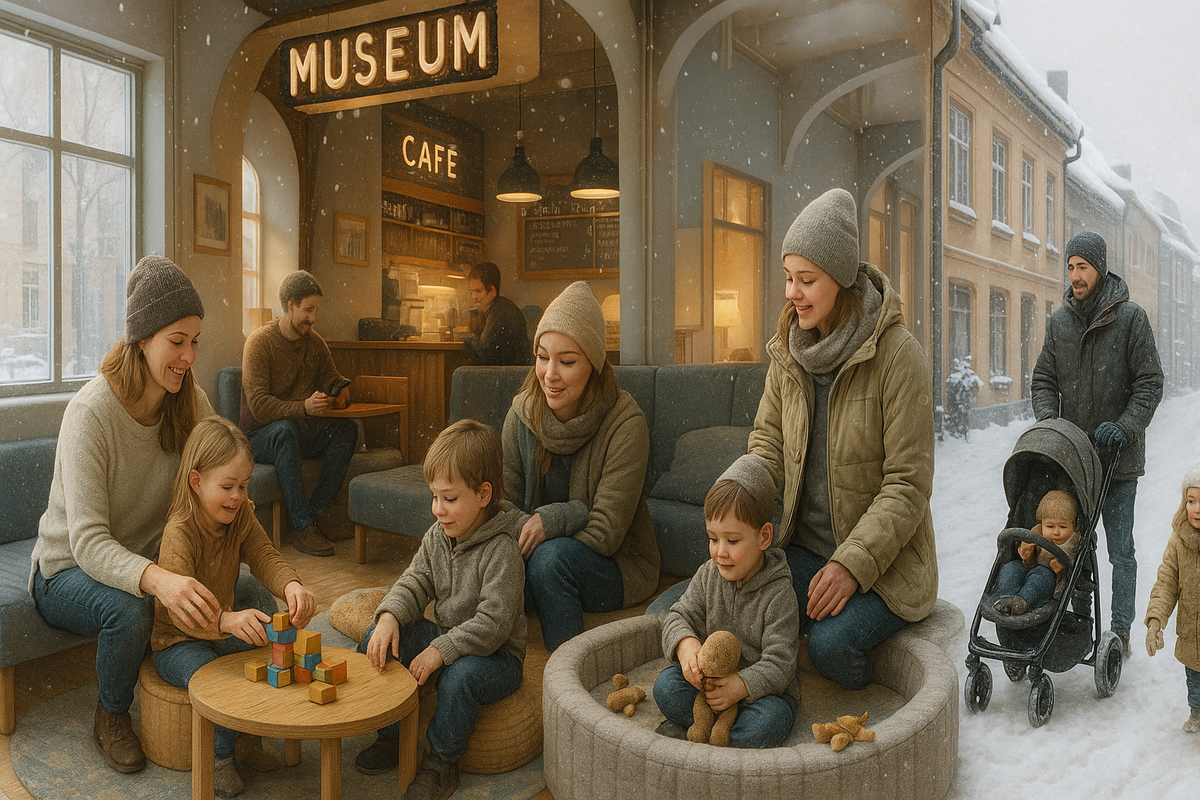
- Children's areas in museums. Junibacken (the world of Astrid Lindgren), the children's area in the Nobel Museum, interactive exhibits in other museums — almost everywhere there is a separate ‘children's’ section where you can touch, play and run around.
- Fika for parents. Fika is a break for coffee and a bun. There are many cafés in the city where it's okay to sit with children without feeling like you're in the way.
- Transport. In Stockholm, children under 7 usually travel free with an adult; plus, on weekends, there are additional discounts for 7-12 year olds. Many buses allow parents with prams to ride for free — a nice bonus for the budget.
- Djurgården Island. A whole ‘children's’ universe: museums, attractions, walks — it's convenient to spend the whole day here without long journeys.
If you want your child to visit museums not because they have to, but on their own initiative, Stockholm is a very strong candidate.
🇳🇴 Oslo: an active city for older children and teenagers
Oslo really comes into its own when children are ready to walk and be amazed by more than just swings.
Based on the results of winter family trips here, people often note:
- Transport and airport. Flytoget from the airport is one of the most pleasant express trains in Europe, and children under 16 travel for free with an adult; in Oslo itself, children under 6 travel around the city for free with an adult.
- Vigeland Park and the Opera House. Large open spaces where you can run, climb, look at sculptures and climb onto the roof of the Opera House for a view of the fjord.
- Holmenkollen. Ski jump + museum + view from the top — impressive even for jaded teenagers. In bad weather, there is a backup plan in the form of museums and indoor parks.
- Overall impression. Lots of greenery, fresh air and people who continue to live outdoors even in winter, simply adding blankets and heaters to café terraces.
Oslo is great for children aged 8+ and teenagers who are already interested in architecture, a slightly more mature cityscape and a ‘real’ winter with the opportunity to hit the slopes.
🇩🇰 Copenhagen: hygge, LEGO and museums without ‘do not touch’ signs
Copenhagen is a case where a winter city looks like a Pinterest board: lights, Nyhavn, bicycles under blankets, sweets and hot chocolate. For families with children, it is not only beautiful but also practical.
What parents who have visited here in winter with toddlers and preschoolers like to mention:
- Nyhavn and the city centre. You can just walk around for a long time, feast your eyes on the colourful houses, pop into cafés and not try to ‘tick off’ all the sights.
- LEGO Store. The brand store with free play areas is a great way to wait out the snow while your child is glued to the building blocks.
- Museums with children's sections. The National Museum of Denmark has a separate children's section where you can touch and climb on everything; the National Gallery has children's workshops on weekends.
- Transport. In the Danish public transport system, an adult with a ticket can carry two children under the age of 12 for free — convenient if you are travelling with the whole family.
Copenhagen is a strong option if you are wondering whether Helsinki or Copenhagen is better with a child and feel more drawn to hygge, food and picture-perfect walks.
🚆 Logistics, weather and budget with children
A winter trip with children to Scandinavia is not only about ‘where is cool’, but also ‘where we won't have to argue with our child every day about whether they are cold and why we have to walk so far’.
Flights and travel from the airport
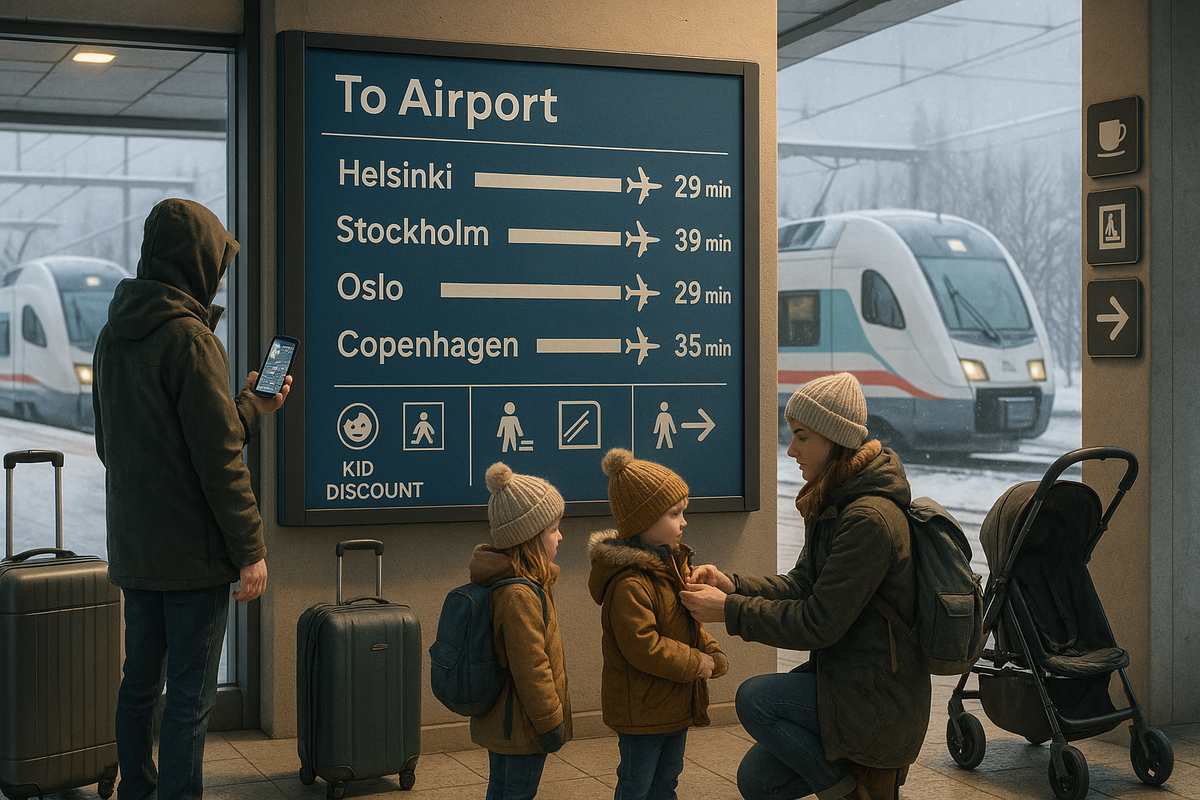
- Helsinki. The airport is connected to the city by trains and buses; on VR trains, children under 7 travel free on suburban routes.
- Stockholm. Arlanda Express always gives children under 7 free travel, and children under 17 travel free with an adult, which greatly reduces the cost of transfers for families.
- Oslo. Flytoget is a fast and beautiful express train where all children under 16 travel free with an adult; further into the city, children under 6 travel free with an adult on the Ruter system.
- Copenhagen. The airport is easily accessible by train or metro; an adult with a ticket can carry two children under 12 free of charge.
Public transport is really convenient in all four capitals: lifts, ramps, low platforms, separate areas for prams.
How the weather feels with a child
The key question in winter is not ‘how many degrees is the forecast’, but ‘how long can the child actually stay outside’.
- Helsinki and Stockholm. Snow and wind, often around -5...0 °C, but with a ‘cool sea’ feeling. It is important to have extra layers and a plan for indoor stops every couple of hours.
- Oslo. The interior of the country is slightly more continental, with lots of snow and ‘real’ winter; but you can quickly go into the forest or up into the mountains.
- Copenhagen. Often around zero, wet snow, rain and wind — not extremely cold, but damp. Museums, cafés and short walks save the day.
The younger the child, the less sense it makes to chase after ‘perfect snow’ and the more important it is to have a dense network of warm spots — aquariums, museums, cafés, indoor playgrounds.
Plan your route as a sequence of ‘street → warm place → street’. One intensive ‘street block’ in winter with a child is 60-90 minutes, not a whole day.
Budget: where it's cheaper to travel with children
In terms of overall cost of living, Oslo and Copenhagen are usually the most expensive; Helsinki and Stockholm are slightly more affordable in terms of accommodation and food.
For families, this translates as follows:
- Accommodation. Family rooms of a reasonable size are easier to find in Helsinki/Stockholm for more reasonable prices; in Copenhagen and Oslo, prices are higher, but you can save money by eating hearty breakfasts and shopping at supermarkets.
- Food. It's good everywhere, but Copenhagen and Oslo are more expensive in terms of cafés and restaurants.
- Transport. Children's discounts significantly reduce the overall cost of travelling around the city — especially when combined with city travel and airport express trains.
If you are on a limited budget, it is wise to choose Helsinki or Stockholm for your first trip, and then, once you understand the format, plan a trip to Copenhagen or Oslo.
🧸 Scenarios by age and interests
To avoid arguing in a vacuum, it's easier to look not at the abstract ‘best city’ but at specific families.

0–4 years: pram, sleep and short outings
With babies, it's crucial to have:
- few transfers;
- space to sleep in the pram;
- warm indoor supplies.
The best places for this age group are:
- Helsinki. A pram on public transport is almost like a magic card: one adult travels for free, there are lifts and low steps everywhere, lots of parks and quiet areas for walking. Aquarium, cafés by the water, short distances.
- Copenhagen. You can live practically in the centre and walk to Nyhavn, the park at Rosenborg and the museums; two children under 12 travel free with an adult, and the children's areas in museums allow parents to relax.
5–9 years: museums, fairy tales and ‘let's do it again’
Here you can already build a full programme for the day.
- Stockholm. Gamla Stan, children's areas in museums, Junibacken, Skansen and walks around the islands — the city is great at keeping children's attention. Parents on blogs regularly call it ‘one of the most family-friendly cities in the world’.
- Helsinki. Sea Life, Suomenlinna, ice rinks and snow games, trams, boats — less museum overload, more variety.
- Copenhagen. LEGO Store, National Museum, gallery with children's workshops, parks — a great set for 2–3 days.
A good scenario: fly to Helsinki, spend 2-3 days there, then take the night ferry to Stockholm for another couple of days. This way, your child gets two impressions of the city instead of just one.
10-15 years old: architecture, stories and ‘almost adults’
Teenagers need different hooks: stories, excitement, a little more freedom.
- Oslo. Holmenkollen, opera, modern architecture, walks along the waterfront and the feeling of a ‘real country of skis and fjords’ appeal to teenagers much more than yet another museum.
- Copenhagen. Urban neighbourhoods, food halls, street culture, bicycles, a slightly more ‘adult’ vibe.
- Stockholm. A balance between history (Gamla Stan, the palace), the modern city and activities.
For very young children, Oslo often offers slightly fewer ‘cute’ activities than Copenhagen or Stockholm, but for an ‘adult + teenager’ pair, it can be the ideal destination.
"For us, ***family-friendly Scandinavian capitals*** are those where children can choose what to do themselves: there is a children's area in the museum, they are not asked to “sit quietly” in cafés, and the park is a 10-minute walk away. So far, in my personal ranking: Stockholm, Copenhagen, Helsinki, and slightly behind — Oslo.‘
⚠️ Common mistakes on family winter trips
The North is particularly honest here: most failures are not due to the weather, but to planning.
Trying to ‘make up’ for every day with maximum activity.
In winter, travelling, getting dressed and ‘taking off and putting on 5 layers’ consume a lot of energy, especially for children. Without daily breaks for quiet games, cartoons and coffee, the trip turns into a marathon of irritation.
Choosing a city based solely on the ‘popularity’ of its name.
A common scenario: flying to Copenhagen because there are more videos about it, even though the family is more suited to the quieter Helsinki or Stockholm. Or, conversely, going to Oslo ‘just for the fjord’ when the children don't like walking in the cold for long periods of time.
Trying to combine three or four capitals in one week with children.
Everything is close together on the map, but for a child, it's not ‘just another capital city,’ but another flight, a new hotel, different transport and, in essence, a mini-move. It's better to take your time and enjoy one city and maybe add a second one by ferry or train than to try to complete a ‘Scandinavian quest.’
Underestimating clothing and footwear.
Even the most family-friendly city ceases to be enjoyable when a child's feet are wet or their jacket is draughty. One good windproof outfit is more important than three fashionable but thin jumpers.
✨ How to choose a capital city and not regret it
Honestly, there is no ‘right’ answer here. There is an option that best suits your rhythm, the age of your children and your budget.
To sum up:
- Helsinki — a gentle start, good infrastructure for prams, the sea and the feeling of a ‘quiet winter capital’.
- Stockholm offers a powerful museum and children's package, a convenient choice for those who love busy but structured days.
- Oslo is all about mountains, fresh air and a slightly more adult vibe, especially with teenagers.
- Copenhagen — a warm, hygge city for those who want to combine walks, food, museums and children's spaces.
If you already live in Finland, it's convenient to start with Helsinki as a base and then try out other options with short trips. If you are flying from far away and only have one winter trip with children to Scandinavia, ask yourself honestly: are you more interested in history, food, nature or peaceful walks — and choose based on that.
And most importantly — don't try to do everything. Let your children leave with the feeling that they want to return to the city, rather than just ticking it off their list ‘we were here’.
If you like, write how many days you have, how old your children are and where you are flying from — we can put together a Scandinavian family itinerary for you and help you decide where to start.
FAQ
If you want a gentle start without overload, choose Helsinki or Stockholm. Helsinki is more compact and quiet, while Stockholm offers a wide range of children's museums. Copenhagen is a logical choice if you love food and hygge, and Oslo is better if mountains and active recreation with older children are more important to you.
Helsinki and Copenhagen are the easiest cities to visit with young children: they are stroller-friendly, have many cosy cafés and indoor activities, and their transport systems are child-friendly. Stockholm is also great, but the programme is often a little more intense due to the museums. Oslo is more suitable when your child is ready to walk more.
Stockholm offers an almost perfect combination: museums with children's areas, Djurgården Island, walks through the old town and canals. Helsinki adds the sea, an aquarium and castle fortresses. Copenhagen, with its LEGO store and children's section at the National Museum, is also great for children aged 6-9.
Temperatures are usually around zero or slightly below, but the wind and humidity add to the ‘feels like’ temperature. The main thing is to wear layers, waterproof shoes and have a sensible daily routine with regular stops in warm places. With this approach, children usually tolerate the weather even better than adults.
Yes, in all four capitals. Public transport is designed to be really convenient for prams and children: low entrances, lifts, separate areas. Plus, generous discounts on tickets for children, including free travel for toddlers when accompanied by an adult, can really help you save money.
Yes, almost everywhere children under a certain age travel free with an adult and have discounts on museums and attractions. In Helsinki, parents with prams travel free on public transport, in Stockholm and Copenhagen children under 7–12 often travel free with an adult, and in Oslo there is free travel on the airport express for children. It is worth checking the exact rules before travelling.
Apartments and aparthotels are well represented in all four cities, but Helsinki and Stockholm are usually slightly cheaper. In Copenhagen and Oslo, family rooms are more expensive, but you can compensate for this by saving on food thanks to kitchens and hearty breakfasts.
Rely on indoor activities: in Helsinki, there is an aquarium, libraries and children's areas; in Stockholm, there is Junibacken and children's museum centres; in Oslo, there are museums and indoor playgrounds; in Copenhagen, there is the National Museum, a gallery and a LEGO store. In each city, it's easy to find 2-3 full ‘warm’ days without getting stuck in the hotel.
At least three full days per city to have time to adapt, visit a couple of key places and leave time for leisurely walks. If you want to add a second capital (for example, Helsinki + Stockholm), it is more convenient to take a week and use a night ferry or train rather than adding extra flights.
Yes, if you do it gently. The most popular duo is Helsinki and Stockholm: the night ferry turns into an adventure rather than a separate flight. You can also combine Copenhagen and Oslo or Stockholm by rail, but with small children it is better not to complicate the route.
Thermal underwear, a windproof jacket, a warm hat, mittens, waterproof shoes and spare gloves. Plus a small backpack with snacks, a thermos, a blanket for the pram, and a favourite toy or book. This is a basic set that will instantly turn any café or museum into a comfortable ‘home’.
Look not only at the sights, but also at the ‘background’: how the playgrounds are arranged, how people behave on public transport, how you feel in supermarkets and libraries, how easy it is to find your way around with children. It's a good sign when your child says they ‘want to come here again’ and you catch yourself thinking that you can already imagine a typical winter Monday here.

0 comments
Log in to leave a comment