



🌌 Glass igloos and the Northern Lights in Finland: how to choose an igloo for a better chance of seeing the lights
In this article, you will learn how to choose a glass igloo in Finland (especially in Lapland) so that your chances of seeing the Northern Lights are actually increased, rather than remaining just a "pretty picture from an advertisement". If you are searching for "glass igloo Finland", "igloo Finland" or "Finland glass igloo northern lights", this is a practical guide with no promises and no fluff.
What to do to make the igloo really work
● ✅ 1) Choose darkness and the horizon, not "the most beautiful photo"
● ✅ 2) Book 2–3 nights; one night is a lottery
● ✅ 3) Check the clouds before bed: they ruin the evening more often than any numbers
● ✅ 4) Prepare Plan A/Plan B: where to go if the igloo is light or the horizon is closed
● ✅ 5) Remove reflections (light, screens) inside the igloo — otherwise the sky will "disappear"
● ✅ 6) Be ready to go outside: the view is almost always better outside
● ✅ 7) Prices and conditions change — quickly double-check the details before booking
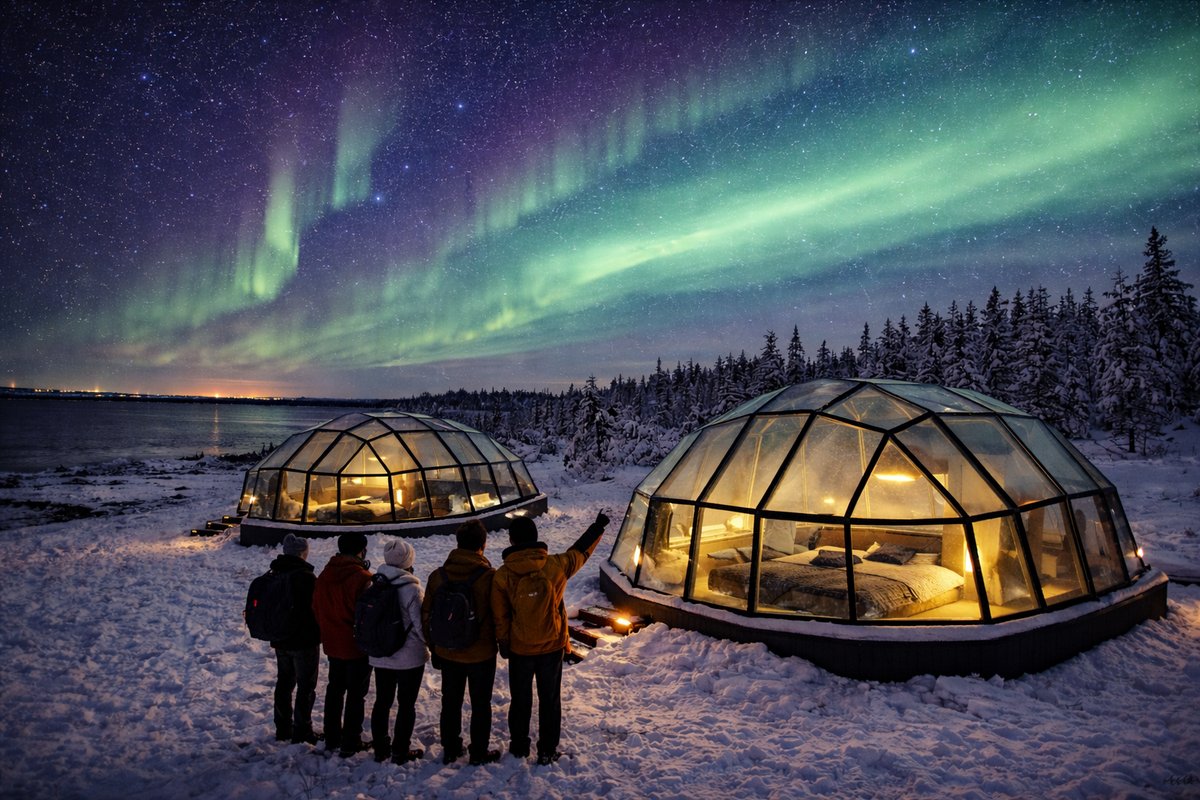
Now, step by step: how to choose a place, not overpay for "glass without a sky" and what to do in the evening when the forecast is really good.
Silence, snow, dark sky — and you're lying under glass, like in a film. This is one of the most powerful "Finnish" experiences. But there's an important detail: the glass roof itself does not make the sky clear and dark.
In this article, you will learn how to think like a practical aurora hunter: first the conditions (darkness and clouds), then the type of accommodation. This is what distinguishes a successful night at "aurora igloo finland" from the disappointment of "we stayed in an igloo, but saw nothing".
Do lasi-iglut guarantee the northern lights in Finland?
No, glass igloos do not guarantee the Northern Lights — they guarantee comfortable waiting. The aurora depends on activity and, most importantly, on clouds, while visibility depends on the darkness around and an open horizon.
The correct way to phrase your expectations is this: an igloo is a way to not miss the moment when the sky "lights up" and a way to wait in warmth. But the chance still depends on the location and the weather.
Where in Finland to choose a glass igloo for the aurora and how to understand that it is dark around
If your goal is specifically to see the northern lights (finland the northern lights), then the logic is simple: the further north and the darker it is, the more "nights with real meaning" you will have. In practice, this almost always leads to Lapland.
But even in Lapland, there are two different scenarios:
● "Dark and wide": there are few lights around and there is an open horizon — even a calm night looks beautiful.
● "There is glass, but no sky": illuminated paths/car parks + a wall of forest around you — it's like being in a beautiful aquarium, but the sky loses its contrast.
Therefore, when choosing an area, think like this:
● if you want the "best chance" — choose areas with real darkness and open spaces;
● if you want "convenience and lots of services" — choose a resort, but be sure to plan a short trip/drive to a dark spot.
As a guide for different regions (specifically in terms of darkness and the horizon), it is useful to read Revontulet Saariselällä ja Inarissa once — it explains the "reliability model" and why Plan B works particularly well with clouds.
It is also important to consider popular "aurora village" formats. If you are considering options such as Northern Lights Village Saariselkä (sometimes searched for as "northern lights village saariselka finland" or "northern lights village finland") or similar queries such as "aurora village ivalo finland", there is one rule: find out how dark it is around and whether there is an open horizon. An "aurora village" can be an excellent base, but it is not a guarantee.
How many nights should you book in an igloo to have a real chance?
The most honest answer: 2 nights is the minimum reasonable, 3 nights is comfortable. One night is a gamble on the clouds and activity coinciding on your particular evening.
Why is this so important for igloos?
● you are paying not only for accommodation, but also for the experience;
● in one night, you psychologically start to "demand results";
● cloud cover can "ruin" the evening even when conditions are good.
If your travel plans are flexible, it is better to stay 2–3 nights in one area than "one night everywhere". Igloos work precisely as an "opportunity to wait for your night".
When to go: season and best time of night for the aurora
It is worth going when the nights are dark enough, otherwise you will be looking at a beautiful but bright sky. For planning by month and expectations, Paras aika nähdä revontulet 2025–2026 is very helpful — it is like a calendar of "when the sky really becomes your ally".
In most "tourist" scenarios, it is convenient to keep the window open from approximately 9 p.m. to 2 a.m. But don't treat it as a schedule. The aurora can flare up for 15-40 minutes and then disappear, so the main skill is not to "go out at the exact time" but to be ready.
If you choose a base for your trip in the Rovaniemi area (and are also looking for "glass igloo finland rovaniemi"), it is useful to read Revontulet Rovaniemellä — it explains very clearly the logic behind the distance from the lights and why the centre almost always loses out to darkness.
How to check "will it happen today": clouds, activity and the moon
The straightforward answer: first the clouds, then the darkness, then the activity, and only then does it make sense to "hope". It's easy to fall into a trap in an igloo: you lie in the warmth and endlessly refresh the maps, but you don't make a decision.
For a specific evening, keep Revontuliennuste Suomessa as a tool — it helps you quickly understand "whether it makes sense to get up and go out".
- Clouds: are the stars visible at your location or at least within 10–30 km?
- Darkness: are there any bright lights nearby that will kill the contrast?
- Moon: if it is bright, the darkness around becomes even more important.
- Activity: evaluate as "sufficient/insufficient" rather than a guarantee.
- Plan B: where should you go/drive to if it is light around the igloo or the forest blocks the horizon?
Key point: you don't need to guess. You need to quickly see if there is a "window" of opportunity and act.
Igloo, glass cabin or cottage: what to choose to "see the sky"?
The straightforward answer: an igloo offers the most comfortable waiting experience, a cottage offers the best control over the location, and a glass cabin is a compromise. But the advantage in terms of "brightness" almost always comes from the darkness around you, not the shape of the roof.
| Format | Plus for shine | Minus | Who is it better for | Budget (usually) |
|---|---|---|---|---|
| Glass igloo / lasi‑iglu | Don't miss the peak: visible right from the inside, comfortable waiting | Reflections, lighting around, trees can "eat" the horizon | Couples, "I want the experience", those who don't want to freeze | tall |
| Glass cabin/house | Often more space and less of an "aquarium" effect | Same risks of glare and horizon | Families, if space and comfort are important | medium/high |
| Cottage/house by the lake | You can choose a spot without lights and with a horizon (maximum control) | You need to go outside and "work" in the evening | For those who have a car and want results | different |
| Hotel in a resort area | Convenient to live in and easy to take a tour/transfer | Lighting almost always gets in the way | Those who value comfort over "the hunt" | Average |
Conclusion: if you want the "Finnish experience under glass," go for an igloo, but choose it based on darkness and horizon. If you want "probability," choose the location and nights, not the type of roof.
How to remove reflections in the glass without spoiling the view
The straightforward answer: reflections are the main enemy of igloos, and they can almost always be solved by turning off the lights and being disciplined with screens. Even a perfect night can look "empty" if you are in a brightly lit interior and looking at your own reflection.
What really helps:
● turn off the overhead light and leave minimal backlighting (or none at all);
● reduce the brightness of phones/laptops;
● do not place a bright lamp inside;
● make "dark mode" a habit before bed.
Another honest detail: in severe frost, glass can "behave" differently (frost/condensation), and sometimes it is easier and more beautiful to go outside for 10 minutes anyway.
Should you leave the igloo and go outside if the sky has 'come alive'?
Yes, often the best view is from outside, even if you live in a glass igloo in Finland. There are fewer reflections outside, you can choose the spot with the best horizon and it is easier to see the faint details with your eyes.
The most effective strategy is this: the igloo is the "radar" and the street is the "screen". When you see something starting, quickly get dressed and go to a dark spot nearby. This is especially important if the forest nearby obscures the low horizon.
How much does a glass igloo in Finland cost: price ranges and what is usually included
The straightforward answer: glass igloos in Lapland are usually more expensive than average accommodation, and the price depends heavily on the season and the popularity of the location. Without exact figures (they change), the budget logic is as follows: an igloo is a "premium experience," and most often you pay for uniqueness and the view.
The price usually includes:
● accommodation and heating;
● basic amenities (toilet/shower — depends on the property);
● sometimes breakfast;
● sometimes an "alarm clock"/notification about the aurora (but consider this a bonus, not a guarantee).
What is almost never included "by default":
● guaranteed aurora;
● perfect weather;
● personalised hunting with cloud transfers.
It is best to check prices and conditions before booking, especially if you are travelling during the peak winter weeks. This is not a disclaimer, it is practicality.
How to get to an igloo in Lapland: airport, transfer, car
The straightforward answer: logistics at igloo hotels vary, and this directly affects your chances of seeing the aurora. If you don't have a car and your accommodation is "in the forest, but with lighting," you may need a transfer or tour to get to the ideal horizon.
Usually, the scenarios are as follows:
● arrival at the northern airport and then transfer to the area;
● train/bus to the nearest base and then transfer;
● car rental — the best option for Plan B in case of clouds, if you are confident driving in winter.
If you don't want to deal with evening logistics, sometimes it's easier to organise one evening with a guided hunt. Selection criteria to avoid buying "promises" are compiled in Revontuliretket Lapissa.
Who is an igloo suitable for: couples, families, solo travellers, budget travellers, expats
Direct answer: igloos are best suited for those who value the "experience" and comfort of anticipation, rather than just the bare probability. But even in this case, darkness and the number of nights are the deciding factors.
Couples.
Imagine the evening: you turn off the lights, lie under the glass, and suddenly a green arc appears in the sky. For couples, this is one of the most powerful "Finnish" scenarios, if the place is really dark and there is a horizon. And yes, it is couples who most often care not only about the result, but also about the atmosphere.
Family.
With children, the igloo works as a "comfortable headquarters": you can wait in the warmth and quickly go out for 10 minutes if the sky starts to clear. But it is important for families not to buy "one night of dreams" but to plan for 2-3 nights, otherwise the stress will be greater than the joy. And check in advance if there is a safe dark spot nearby without roads or ice.
Solo.
For solo travellers, igloos provide peace of mind and the opportunity not to miss the peak. But solo travellers often benefit from mobility: it is useful to have a Plan B and the ability to quickly move to a clear window. If mobility is not an option, it is better to choose a location in the darkest area possible.
Budget.
If your budget is limited, it is wise to make igloo a "one-night experience" and spend the rest of the nights in regular accommodation in a dark place. This often gives you the best balance between money and opportunity. And don't overpay for glass if there are bright lights around: you pay for the picture, but lose contrast.
Expats.
If you live in Finland and can adjust to bright nights, it's easier not to "buy hope" but to catch the right forecast and go where it's clear. In this case, an igloo is more of a nice bonus than a necessary tool.
Mistakes made by guests of glass igloos and how to avoid them
The straightforward answer: most often, people lose not to the "sky" but to their organisation of the evening. Below are the mistakes that are repeated over and over again.
Regular text between inserts: the second mistake often seems "harmless," but it kills visibility. People lie under the glass with the lights on, bright screens, and then say "the sky is empty." In fact, they are looking at a reflection.
Regular text: The third mistake is psychological. One night turns everything into a lottery and stress. People start waiting for the "show" instead of watching the sky.
And two more common minor issues:
● not going outside when the sky comes alive (and you can see better outside);
● not having a backup spot with a horizon (the forest around the igloo may block the low arc).
A night under glass that you will truly remember
A glass igloo in Finland is not a "purchase of light", but a purchase of the right experience: you are close to the sky and don't miss the moment when it turns on. But for this to become a reality, you choose not "glass", but darkness, the horizon and the number of nights.
The strongest scenario is simple: you figure out in advance where it's darkest, turn off the lights inside, check the clouds, and if it starts, go outside for 10 minutes. On nights like this, even a calm arc turns into a feeling of "it was real."
If you have already lived in an igloo in Finland, share what was more important: the location, the number of nights, or the opportunity to go outside to a dark spot. These are exactly the details that help others avoid mistakes.
FAQ
No, glass igloos do not guarantee Northern Lights, as visibility depends on solar activity and cloud cover. The igloo offers a comfortable observation spot and the chance to catch a brief peak. If the surrounding area is bright or the sky is cloudy, the glass does not help. Choose a dark location and plan multiple nights for the best chance.
The best chances are usually in Lapland, where nights are darker and there is less light pollution. It is important that the accommodation has an open horizon and minimal surrounding lights. An igloo located in a bright area may obscure faint auroras, so consider both the location and environment carefully.
Windows are usually best kept open from around 9 PM to 2 AM, though peaks may be brief. Rather than guessing a single time, check the sky multiple times during the evening. The igloo allows sky observation without stepping into the freezing cold, but the best viewing often requires going outside.
Clouds are the most common reason: a strong aurora forecast cannot penetrate dense cloud cover. Reflections, interior lights, and bright screens can also interfere. Check cloud cover and turn off all interior lights.
A bright moon reduces the contrast of faint auroras. Inside the igloo, this effect is noticeable, especially with surrounding lights. Strong auroras are still visible in moonlight, but details may be faint. Darkness and minimal light pollution are critical for optimal viewing.
Sometimes the view from bed is possible, especially for bright auroras in dark surroundings. Usually, the best view is outside: fewer reflections, wider perspective, and easier to see faint patterns near the horizon. The igloo works as a “detector,” alerting you to the start of auroras, while the best visuals are outside.
Prices vary by season, location, and size. Generally, it is more expensive than standard accommodations as it is a premium experience. Some include breakfast or additional services but do not guarantee aurora visibility. Plan your budget carefully and compare offerings, not just photos.
Yes, if the surrounding area is very dark and there is a nearby location with an open horizon. Without a car, contingency plans are harder, so it is advisable to book 2–3 nights to avoid relying on a single evening. Sometimes a single night with an organized tour solves the logistical challenges.
It can be excellent if the surroundings are dark and the horizon is open, but it is not an automatic guarantee. Paths and parking areas may reduce contrast. The best approach is to check in advance where you can quickly access a dark spot for 5–10 minutes for optimal viewing.
Night mode on phones amplifies faint light and may render the green tint brighter. Eyes need time to adjust to darkness, and bright screens interfere with this. Turn off lights and allow 5–10 minutes for your eyes to adapt. Outside, the difference between eyes and phone is usually smaller.
Consider three key factors: surrounding darkness, open horizon, and number of nights. Even the most beautiful dome fails if there are nearby lights or dense forest. A good sign is the ability to quickly reach a nearby dark spot. Always check cloud cover on the evening — it is the most important “switch” for success.

0 comments
Log in to leave a comment