



📅 Best time to see the Northern Lights in Finland 2025–2026: month and time guide
In this article, you will learn when it is best to see the Northern Lights in Finland in the 2025–2026 season: which months are most likely to produce results, what time of day it makes sense to go out, and why Lapland, Oulu and the south of the country have different rules.
What to do right now if you are planning a trip
✅ Season: usually late August/September to April (the main condition is darkness)
✅ Best night-time window: most often 9 p.m. to 2 a.m., but peaks are shorter (15–40 minutes)
✅ How many nights to plan for: at least 2, preferably 3 — this way you will survive a cloudy night
✅ Where the chances are higher: in Lapland (Lapland northern lights), the chances are usually higher even on "normal" nights
✅ How to increase your chances without magic: choose a month + region, then check the clouds before going out
🔎 For a specific evening, Revontuliennuste Suomessa will come in handy, and for a general overview of the country — Revontulet Suomessa 2025–2026
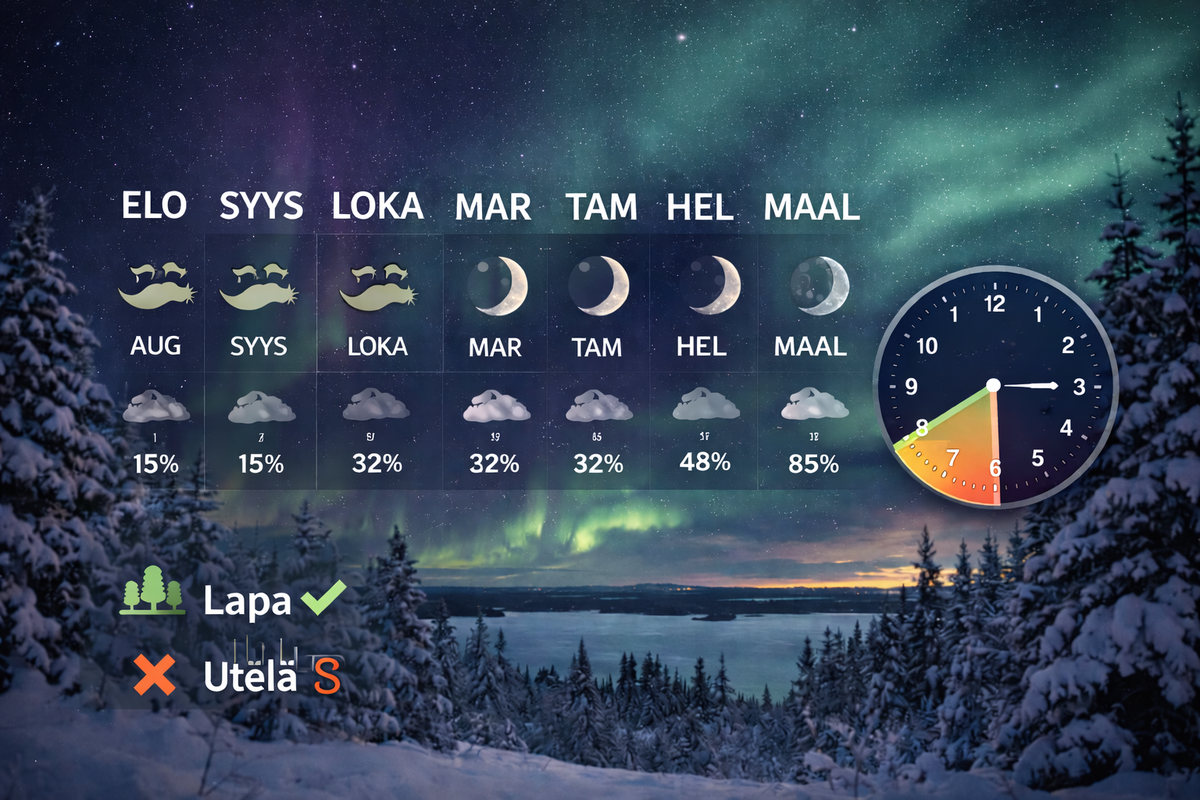
Now, choose a month so that you don't arrive during the "season" but without darkness or a plan.
In Finland, the aurora is not a "scheduled holiday" but a natural phenomenon that loves discipline: darkness, clear skies and a little patience. But the advantage of the country is obvious: it's easy to get away from the city lights here, and if you choose the right month + region, your chances become not "mythical" but quite realistic.
If you've ever Googled something like "best time to see northern lights in Finland" or "best time to visit Finland for northern lights," you don't need a poetic answer, but calendar logic. That's what you'll find below.
When does the northern lights season start and end in Finland?
Usually, the Northern Lights season in Finland begins when the nights become dark enough: most often this is **late August–September** in the north and closer to autumn in the south. The season usually ends **in April**, when the nights quickly become lighter. In summer, the "white nights" and polar day make observations almost impossible — even if there is activity in space.
The practical conclusion is simple: if you are planning a trip for the sake of the "Finland aurora borealis", focus on the period from September to March as the most convenient in terms of darkness, and consider August/April as the "edge of the season" (sometimes excellent, sometimes too light).
Which months are considered the best for the Northern Lights in Finland and why?
September–October and February–March are most often considered the best months: during these periods, it is usually dark enough, and the trip is easier in terms of logistics than during the "peak winter". These are not guarantees, but statistically favourable months: you get a dark sky and a better chance of catching a clear window on at least one of the nights.
Winter (December–January) offers very long nights and the "Lapland atmosphere," but it is often more expensive and colder. Spring (March–early April) is popular with many for its combination of snow, daylight and darkness at night: it is more comfortable to walk during the day, but it is still possible to catch the aurora at night.
At what time of night are the Northern Lights most often seen in Finland?
Most often, people see the aurora between approximately 9 p.m. and 2 a.m., but this window can shift: sometimes it starts earlier, sometimes it peaks in the middle of the night. The most common mistake is to go out "for 10 minutes" and leave: the aurora can be short and come suddenly.
In practical terms, this means planning for 2–3 hours of flexibility rather than a specific time. And decide in advance where you will stand: if you are in the city, even a good display can be "lost" due to the light.
- Choose the 9 p.m. to 2 a.m. window as your main range.
- Allow 20 to 40 minutes for waiting on a clear night (peaks are short).
- Avoid lights: even 5 minutes in the dark improves visibility.
And important for tourists: if you are travelling for the "aurora lights finland", it is better to have a plan for two evenings than to try to guess one "perfect" night by the clock.
Autumn, winter or spring in Finland: which is best for seeing the lights?
If you choose the season based on your feelings, autumn has milder temperatures and often lower prices, winter is the most "fairytale-like" with long nights, and spring offers a balance of daytime comfort and still fairly dark evenings. In terms of the chances of seeing the lights, all three seasons can be good, but comfort and budget vary significantly.
In autumn, it is more pleasant to wait outside, but there is often more dampness and "variable cloudiness". In winter, the nights are longer, but the cold and wind are stronger (especially in open areas). In spring, it is often easier to combine an active day (skiing/walking) with quiet hunting at night, and the snow adds "light from below" — it is beautiful, but requires an even darker place because of reflections.
How many nights should you plan to see the Northern Lights in Finland?
The minimum that really works is **two nights**, but the most practical plan is **three nights**. The reason is simple: one night is often spent waiting for clouds to clear, the second is spent waiting for a window of activity, and the third gives you a reserve. In Lapland, sometimes one lucky night is enough, but relying on this is like buying a ticket for a single flight in winter: you may get lucky, or you may not.
If the goal is to "see and relax," 2-3 nights are usually better than "one night + an expensive tour + waiting." If the goal is to "catch the wow show" for photos and emotions, plan for 4-5 nights or more — that way you'll catch both clear weather and strong activity.
Lapland, Oulu or the south: where does the "best time" differ and why?
The best time depends on latitude and light: the further north you go, the earlier it gets dark in autumn and the longer the night darkness lasts in spring. Therefore, the season in Lapland feels longer and "works" more often: even with moderate activity, the aurora can be noticeable. In the south (including Helsinki), the conditions need to coincide more precisely: stronger activity, darker location, clearer sky.
If you are travelling on a short holiday and want the best chance, the regional logic is as follows: Lapland is a "bet on probability", Oulu and north of central Finland is a "compromise", and the south is a "try on a rare night". That is why searches such as "helsinki northern lights" attract a lot of attention, but in reality require patience and luck.
Northern Lights calendar in Finland 2025–2026 by month: August–April
This is not a "show schedule" but a practical calendar: what usually happens with darkness, weather, prices and viewing conditions. Use it as a filter: select a month, then select a region and set aside 2–3 nights.
| Month | Darkness | Weather/clouds | Prices/people | Who it suits |
|---|---|---|---|---|
| August | It gets dark in the north, but it's the "end of the season" | Often changeable, it's important to catch clear windows | Usually calmer than in winter | For those who want to combine summer with a chance for sunshine |
| September | It's already quite dark (especially in Lapland) | Autumn: clouds are frequent, but so are clear skies | Usually cheaper than peak winter | Photographers, couples, those who dislike the cold |
| October | Dark for a long time | Colder, but sometimes clearer than in early autumn | Demand is growing, but not yet at its peak | Good balance of opportunity, comfort and price |
| November | Long dark nights | Weather can be "damp", depending on the year | Often more affordable than December | For those who want darkness without New Year's prices |
| December | Very dark, "winter wonderland" atmosphere | Cold, cloud cover is the main risk | Often more expensive (holidays) | Families and those travelling for winter activities |
| January | Maximum darkness and long nights | The coldest period, equipment is important | After the holidays, it may be quieter | For those who are ready to brave the cold for the Lapland experience |
| February | It's dark enough, but the days are noticeably more pleasant | Often a more "stable winter", but depends on the week | High demand (holidays/resorts) | Best compromise between "winter + comfort" |
| March | It is still dark at night, but there is plenty of light during the day | It is often convenient to combine an active day with hunting at night | Sometimes more profitable than February | For families, couples, those who want to "ski and sightsee" |
| April | End of season: darkness is rapidly decreasing | Can be great at the beginning of the month, but not always | Often quieter in terms of prices | For those who want a "last chance" and fewer people |
The calendar is convenient because it immediately shows the trade-offs: December is beautiful and festive, but expensive; March is comfortable, but already lighter; September is mild, but capricious in terms of clouds. Don't choose the "best month on the internet," but the best one for your circumstances.
Which months to choose for your travel style: family, couple, solo, budget?
If you need a quick choice: for a "first attempt", **February–March** (more comfortable during the day, still quite dark at night) or **September–October** (less frost, good chance in Lapland) will most often work best. And then we'll tailor it to your scenario.
Imagine four situations:
● A family wants a "winter wonderland" and an active day (skiing, sledging, villages): they often choose December–March, but plan for 3 nights so that one is sure to be clear.
● A couple wants a beautiful atmosphere and photos without extreme cold: September–October or March are usually calmer.
● A solo traveller wants the best chance: they choose Lapland and a minimum of 3-4 nights during the season when it is convenient to travel on clear days.
● Budget travel is usually during the "off-peak weeks": September, October, November or part of March are often cheaper than December and the holidays.
If your dream is a glass dome, "glass igloo Finland" or "igloo Lapland Finland", remember: it looks most beautiful in winter, but the price and demand will be higher, which means you will have to book earlier.
The moon, snow and light pollution: why the perfect month does not guarantee a glow
Even if you choose an excellent month, two factors can ruin the experience: bright moonlight and city lights. Bright moonlight makes the faint glow less contrasting, and the surrounding lights literally "eat away" at the details, especially in the south and in resort villages.
Snow adds beauty (the sky and ground look "clean"), but it also reflects light from street lamps and buildings. Therefore, in winter, the rule of "getting away from the light" becomes even more important: sometimes it only takes 10-20 minutes by car for the picture to change radically.
Practical conclusion: the best month is only revealed where there is a dark sky. And if you are aiming for the aurora borealis Suomi as a "wow moment", choose a place with real darkness, not just a beautiful hotel next to the lights.
How much does a trip to see the Northern Lights cost depending on the season, and when should you book?
Not only distance but also the calendar determines the budget: December–February is often more expensive due to high demand, while autumn and part of spring may be more affordable. The most practical way to avoid overpaying is to fix not a "specific night" but a range of dates for 3 nights and see where the best accommodation is available on those days.
Usually (very roughly, according to the market), the following ranges are set:
● Aurora tour: approximately €80–200 per person (the format, region and season greatly affect the price).
● Night in a glass dome/igloo: often €250–600+ per night (higher during peak season).
● Independent hunting: sometimes this is "€0 + transport", but in winter you may need a taxi/car rental if you want to get away from the lights.
And an important note: prices and availability change quickly, especially during holidays. So the rule is simple: if you are travelling in December–February, check and book in advance, while in autumn and March it is usually easier to find options closer to your trip (but this also depends on the resort).
Where to go to see the Northern Lights in Finland: Lapland, Rovaniemi, Saariselkä, Helsinki
If the goal is to "see it with a high probability," Lapland is the most popular choice: it is darker there and there is less light pollution, so even a "normal" night can be productive. If the goal is to combine the city with the chance to see the aurora, then look north of the central regions, but keep in mind that there are usually fewer successful nights there.
For point-by-point planning, it is useful to refer to geo-pages: for example, if you are planning a trip through Rovaniemi, look for Revontulet Rovaniemellä, and if you want the "classic north" and more darkness, look for Revontulet Saariselällä ja Inarissa. In accommodation areas that are often searched for as "northern lights village saariselkä" or "northern lights village saariselka finland", the convenience is that it is usually closer to darkness — but clouds and a place without direct streetlights are still important.
Southern Finland and Helsinki are a story of rare luck: searches for "helsinki finland northern lights" and "aurora borealis helsinki" are popular, but this is not a "holiday plan" but rather "trying it on an exceptional night". If you are in Helsinki and don't want to travel far, set your expectations in advance: there is a chance, but it is significantly lower than in the north.
What mistakes when choosing dates most often spoil the "best season" in Finland?
The most common mistake is to set aside one night and tie everything else to it. The second mistake is choosing dates without thinking about darkness: people come during the "season" but too early in autumn or too late in spring, when it is light at night. The third is booking accommodation "in a beautiful place" and then standing under the streetlights and wondering why the aurora looks so faint.
Another mistake is "skewed expectations". People think that if it's the "Finnish northern lights" or "Lapland aurora borealis", then the lights must be visible every night. In practice, even in the best locations, there are quiet nights — and that's normal.
How to put together the perfect 2–3 night plan for the northern lights in Finland?
The most effective formula sounds boring, but it almost always works: **choose a month → choose a region → plan for 2-3 nights → leave some flexibility for clouds**. Don't try to "schedule" a night of auroras in advance — decide on a base and duration, and choose a specific evening closer to the time.
If you want "maximum excitement" without unnecessary fuss: go to Lapland, choose a period with good darkness, book three nights and keep one backup scenario in case of clouds (travel or tour). If your dream is a glass dome, include it as part of the plan, but not as a "guarantee": for more information about expectations and choosing a location, see Lasi‑iglut ja revontulet Suomessa.
If you already have dates, a city and a format (family/solo/couple) — write to me and I will help you "put together" the optimal 2-3 nights so that you don't depend on a single weather forecast.
❓ FAQ
Most people choose the period from September to March, as darkness is more consistent and it’s easier to plan 2–3 nights. Autumn is more comfortable in terms of temperature, winter offers the strongest atmosphere, and spring combines active daytime hours with dark nights. If your goal is to maximize your chances, it’s more logical to choose a northern region and stay several nights rather than just one. However, cloud cover ultimately determines which evenings work.
It’s generally wise to keep a viewing window open from about 9:00 PM to 2:00 AM, though peaks can occur earlier or later. The key is not trying to guess an “exact time” but allowing a few hours of flexibility. Sometimes auroras last only 15–40 minutes, which is why short outings often fail. It’s better to choose a dark location in advance and be prepared to wait.
Both September and February can be good, but they offer different experiences. September is more comfortable, though autumn cloudiness can interfere; February is usually more “wintery” and pleasant during the day, but demand and prices are higher. If you must choose just one month, consider your budget and tolerance for cold. In any case, plan for 2–3 nights.
December offers a strong winter atmosphere and very long dark hours, but it is often colder and more expensive. March is comfortable because there is more daylight for activities while nights are still dark enough for auroras, especially with clear skies. For a trip focused on relaxed viewing and walking around, March is often more pleasant. December is better for a “fairytale and holiday” vibe.
In southern areas this is a rare coincidence: strong solar activity, clear skies, and a very dark location outside the city are all required. Therefore, the “best time” here is not a specific month, but a rare, powerful night during the dark season. If you’re planning a trip specifically for auroras, the south should not be your main destination. But for a casual attempt, it is possible.
For families, a 3-night plan works best: it avoids tying success to a single night and allows flexibility with weather. It’s also important to keep attempts short — 20–40 minutes in the right place is often more effective than long waits with tired children. The farther north you go, the easier darkness logistics become. And don’t forget warm clothing.
In most cases, autumn and parts of spring are more affordable than the winter peak, especially December–February. Winter demand is higher due to holidays and peak travel season, which raises accommodation and travel prices. That said, “cheaper or more expensive” ultimately depends on the destination and the specific week. If budget is critical, choose flexible dates and 2–3 nights outside peak season.
In autumn, you can get beautiful reflections on water and milder temperatures, but the weather is more variable. In spring, snow adds a “clean” look to photos but also reflects light — making it important to get far from cities and artificial lighting. For photography, the season matters less than having a dark location and clear skies. This is why flexibility at night is especially valuable for photographers.
Yes, but then it’s important to choose a base where darkness is accessible without long travel, or to arrange transportation or guided excursions. Popular northern resorts often make it easier to reach dark areas than cities do. For the best chances, it helps to have at least some way to reach a dark spot with a short drive. Without a car, staying 2–3 nights is especially important so you’re not dependent on a single evening.
A full moon does not “block” auroras, but it makes weaker displays less contrasty, especially in illuminated areas. On bright moonlit nights, finding a truly dark location becomes even more important. If your trip is already planned, don’t worry — strong auroras are visible even with moonlight. Just don’t expect fine details in well-lit places.

0 comments
Log in to leave a comment