



🌌 Revontulet Kilpisjärvellä: Suomen parhaat mahdollisuudet?
In this article, you will learn why Kilpisjärvi is often called one of the best places in Finland for the Northern Lights, how to choose a spot with an open horizon, how to survive "hardcore conditions" (wind, frost, distances) and how to plan for 2–3 nights so you don't have to rely on luck alone.
If you want the best chance in Kilpisjärvi
● ✅ Why this place is great: very dark sky + often open horizon (tundra/lakes/slopes)
● 🧭 Tactics: Plan A + Plan B (two points) and be ready to move if the clouds "move on"
● 🕒 When to watch: keep the window open from 9 p.m. to 2 a.m., but don't expect "all evening" — peaks last 15–40 minutes
● 🕒 How many nights: 2–3 nights — the best compromise between chance/fatigue/money
● ❄️ Safety is more important than romance: the wind and frost are more intense here than in "resort Lapland".
● To decide whether to go out today or sleep in, use bold italics Revontuliennuste Suomessa
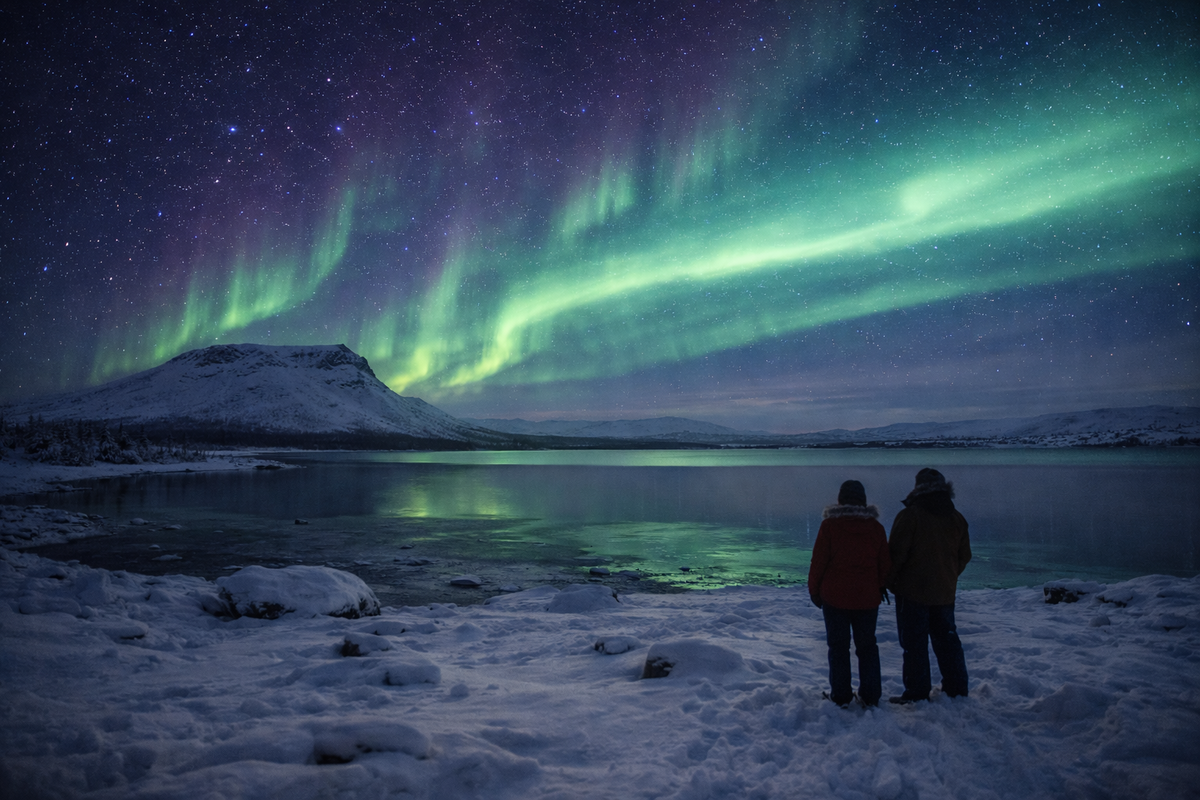
And now, step by step: why Kilpisjärvi is so good, where exactly to stay, and how not to lose out to the weather.
Kilpisjärvi is Lapland at its most extreme: it's far away, often windy, and there's a lot of dark sky around. This is why it is loved by those who dream of the Lapland aurora borealis without city lights and tourist glare. But let's be honest: this is not an "easy hunt," but a place where preparation matters more than any beautiful maps.
If you've come for the Finnish Lapland northern lights and want not just a chance, but a real taste of the north, Kilpisjärvi will give you that. But only if you respect the weather and have a Plan A/Plan B ready in advance.
Why is Kilpisjärvi considered one of the best places in Finland for the Northern Lights?
The short answer is because darkness and an open horizon often coincide here — two factors that make even a moderate display noticeable. Kilpisjärvi has less light pollution than most "convenient" bases and more spaces where the sky is visible in a wide sector.
The second reason is the "geography of experience": when there are minimal lights around, you see the sky more deeply, and your eyes adapt to the darkness more quickly. This is why the effect that people expect when they search for "visit finland northern lights" is more likely to occur here.
When is the best time to go to Kilpisjärvi for the Northern Lights: season and months
The best season is the dark part of the year, when the nights are long enough and there is a chance of clear skies. In practice, this is usually autumn, winter and early spring, while summer is almost unsuitable due to the light nights in the north.
If you are choosing your dates in advance, don't focus on the "most popular month", but on how many nights you can plan for and how important daytime comfort is to you. For calendar logic by month, keep in mind the bold italics Paras aika nähdä revontulet 2025–2026 — this is useful so that you don't arrive "in season" but without real darkness and reserve at night.
At what time of night are the northern lights most often seen in Kilpisjärvi?
The most common time is in the evening and the first half of the night, and it is convenient for tourists to keep the range of 21:00–02:00 as the "main" one. But this is not a schedule: the aurora can appear suddenly and disappear in 20 minutes.
The practical meaning of this is: don't plan to "go out for 10 minutes". Plan your evening so that you can stand quietly in the dark for 20-40 minutes, move if necessary, and return to the warmth without heroics.
What level of activity is "sufficient" for Kilpisjärvi, and why are clouds still more important than numbers?
In Kilpisjärvi, moderate activity is often enough to see a noticeable glow, because the darkness and the horizon enhance the visual effect. But any indicator becomes useless if the sky is overcast: clouds are the main switch.
The most honest test on site is the stars. If the stars are visible and it is dark around you, the chances are good even on a "normal" night. If the sky is uniformly grey and there are no stars, you either move or save your energy.
Where is the best place to see the Northern Lights in Kilpisjärvi: which spots work best?
The best spots are those where you get an open sector of the sky and a minimum of direct light. In Kilpisjärvi, three types of places are most often the best: shore/open space, height/slope, and open tundra/plateau.
Important: do not try to find a "secret coordinate". In Kilpisjärvi, the secret is not the point, but the conditions of the point: the horizon, darkness, safe access in winter, and the ability to return quickly.
| Type of place | Why it works | Who it suits | Risks/nuances |
|---|---|---|---|
| Open lake shore | Long horizon, fewer trees in the frame | Couples, photographers, "I want a rainbow on the horizon" | Wind and cold are stronger; slippery |
| Low altitude/slope | Wider view of the sky, sometimes less local haze | For those who want a "bird's eye view" without travelling far | Wind; warm clothing required |
| Open tundra/plateau | Maximum darkness and space | "Hardcore" and those who are ready for the conditions | Safety and orientation are paramount |
If you want an "easy win", choose a shore or an open area with safe access. If you want "maximum wow" — height/space, but then safety and wind become the main factors.
Plan A and Plan B in Kilpisjärvi: how to make a plan based on clouds and wind
Plan A/Plan B is needed here not for beauty, but for results. Kilpisjärvi is remote: losing one night because of clouds is more disappointing than in a place where you can "just try again tomorrow" without logistics.
Working plan:
● Plan A — a nearby, safe spot with a horizon.
● Plan B — another spot, preferably in a different direction, so that you can really get away from the cloud front.
In Kilpisjärvi, the distances may be short in kilometres, but they feel longer because of the winter roads and wind. Therefore, Plan B should not be based on emotions. It should be realistic: arrive, look, return.
How to get to Kilpisjärvi: options, time and what to consider in winter
Kilpisjärvi is one of the most remote tourist destinations in Finland, and that's part of its appeal: fewer lights, more sky. People usually get there by car or combine a flight to Lapland with onward ground transportation.
The most common choices are:
● car (maximum freedom for Plan A/B),
● transfers/buses during the season (convenient, but you are dependent on timetables),
● a combination of "fly to Lapland → continue by car/bus".
In winter, it is important to check road conditions and wind forecasts before setting off. In northern areas, wind and snowstorms can make the journey much more tiring than it appears on the map.
How much does a trip to Kilpisjärvi cost: accommodation, food, tours, transport
Kilpisjärvi often feels more expensive, not because everything is luxurious, but because you are paying for remoteness: there is less choice and logistics are more complicated. Exact prices vary depending on the season, so I am giving approximate ranges and advise you to check before you travel.
Usually, you should budget for:
● accommodation: a wide range of types (hotel/apartment/cottage), more expensive in peak winter;
● food: as in Lapland, it is significantly more expensive than in large cities in Finland;
● tour/trip to see the Northern Lights (if you take one): often around €80-200 per person, but it depends on the format and duration.
If you are choosing between "more expensive, but 3 nights" and "cheaper, but 1 night", the former is almost always more profitable: an extra night is more likely to bring results than the "perfect bet" on one evening.
What to bring with you for observation in Kilpisjärvi: clothing, equipment, safety
Kilpisjärvi is a place where "slightly cold" turns into "why can't I move my fingers" faster because of the wind. Therefore, not only warm layers are important here, but also protection from the wind.
- Wind protection: a windproof jacket/trousers are more important than "another jumper".
- Warm hands and feet: mittens + spare gloves, warm socks, normal footwear.
- Headlamp: to walk safely in the dark without blinding yourself.
- Power bank: the cold quickly drains batteries.
- Return plan: parking and a quick way back are more important than a "beautiful spot in the field".
If you are going further from the road, think like a local: it is better to stay closer, but safely and with a good horizon, than to heroically go "into absolute darkness" and then struggle with the wind and orientation.
How to photograph the Northern Lights in Kilpisjärvi: what really works without unnecessary magic
Three things give the best results: a dark spot, a stable position, and minimal fuss with settings. In Kilpisjärvi, the wind can shake your hands and tripod, so "perfect settings" often lose out to the simple: get steady and take at least a few good shots.
If you are shooting on your phone, don't be surprised that it "sees" the greenery more brightly. This is normal: night mode amplifies low light. Your task is to get away from the lights, let your eyes adjust, and not stare at the bright screen all the time.
If you're shooting with a camera, the basic logic is this: wide angle, focus on infinity, then adjust the exposure/ISO according to the brightness. But the main thing is not to turn the evening into a "battle with the menu": first see, then shoot.
Scenarios: family, couple, solo, budget, expats — who is Kilpisjärvi suitable for and how not to "break down"
Kilpisjärvi is perfect for those who are ready for the idea of "far away and beautiful". But the approach to the night should be different.
Family: wins if the hunt is short and close to a warm return. Wind and frost make a 2-hour stand difficult, so plan for 20-40 minutes of trying, then a break.
Couple: Kilpisjärvi offers that very "silence and sky", but don't overload yourself with expectations. Plan A/B and two evenings is the gold standard.
Solo: You are flexible and can react faster to clouds. But safety comes first: don't go far without a clear route and communication.
Budget: Kilpisjärvi is rarely the "cheapest option," but it often delivers on sky quality. If your budget is limited, it's better to optimise your nights and logistics than to pay for unnecessary "extras."
Expats: if you are already in Finland and are catching the best nights "according to the forecast", Kilpisjärvi is a strong bet for sky quality. The main thing is to plan your trip with plenty of time and check the road conditions.
Mistakes tourists make in Kilpisjärvi that can ruin even a perfect night
The most common mistake is to overestimate yourself and underestimate the wind. The second is to choose a "romantic spot" without a safe return route. The third is to bet everything on one night.
And here's another pitfall: standing next to your car and constantly turning on the lights/screen, and then wondering why your eyes can't see anything. Give the darkness 5-10 minutes, and you'll start to notice more — especially in places like this.
When Kilpisjärvi is the best choice, and when it is wiser to choose another base in Lapland
Kilpisjärvi is the best choice if you want the darkest sky possible and are prepared for remoteness. But if "resort simplicity" and quick solutions without a long journey are more important to you, it is sometimes more practical to base yourself closer to infrastructure.
As a "reliable but simpler" alternative, many choose Revontulet Saariselällä ja Inarissa: there is also a lot of darkness and horizons there, but the logistics are often easier. For an overview of the country and other regions, use Revontulet Suomessa 2025–2026 as a guide.
Kilpisjärvi rewards the prepared
Kilpisjärvi is a place where the Northern Lights look "as they should" because the sky is really dark. But it is also a place where nature quickly reminds you that the wind, frost and distances are real.
If you want to get the most out of your trip, do three things: plan for 2–3 nights, have a Plan A/B, and dress for the wind. Everything else is just pleasant details.
If you already have experience in Kilpisjärvi (or are just planning a trip), tell us what you chose: the shore, the heights or the tundra. Such details help other tourists not to lose a night.
❓ FAQ
Kilpisjärvi offers very dark skies and an open horizon, making auroras more visible even on moderate nights. There is minimal light pollution, so weak auroras don’t get “washed out.” Weather still plays a major role, especially clouds and wind, but the location itself is ideal.
The most reliable viewing window is usually between 9:00 PM and 2:00 AM, but there is no fixed peak hour. Auroras often appear for 15–40 minutes and then fade. Calm waiting in darkness and multiple attempts work better than short, rushed checks. On clear nights, patience almost always pays off.
Cloud cover matters more. Even strong aurora activity is useless if the sky is overcast. Activity forecasts only matter once the sky is clear and dark. First find a clear window — only then check activity levels. In remote areas like Kilpisjärvi, this is crucial since every night counts.
Plan A and Plan B prevent losing the night to clouds. Even a short relocation can move you into clearer skies, but Plan B must be in a different direction, not just nearby. This increases the chance of escaping cloud systems — especially important in remote locations where nights are limited.
Cold feels stronger due to wind, so a windproof outer layer is essential. Hands and feet freeze first — warm boots and quality mittens are critical. Standing still for long periods increases discomfort, so layered clothing and a thermos help a lot. Always choose a safe spot with a quick return option.
Yes, if you know dark spots close to your accommodation and have some transport access. Without a car, flexibility is limited and Plan B is harder to execute. That’s why staying 2–3 nights is especially important. One night in a remote area is always a gamble.
In night mode, phones amplify faint light and may show green tones more clearly. This is normal and doesn’t mean you missed the aurora. Move away from lights and allow 5–10 minutes for eye adaptation. In very dark places like Kilpisjärvi, the difference between phone and eye is usually smaller.
Ideally 2–3 nights. Two nights already reduce the risk of cloudy conditions, while three nights add real reliability. In remote areas, one night depends too much on weather. An extra night is almost always more effective than hoping for luck.
Lakeshores often provide a clean horizon and wide aurora arcs, while higher ground offers broader views and a feeling of open sky. However, higher spots are usually colder and windier. Choose a place where you can stand safely and comfortably for 20–40 minutes — comfort directly affects your chances.
A tour makes sense if you don’t have a car or prefer logistics handled for you. Tours don’t guarantee auroras but improve efficiency, especially if guides can change locations due to clouds. Prices and formats vary by season, so check current conditions before booking.

0 comments
Log in to leave a comment