



🌌 Revontulet Levillä ja Ylläksellä: Northern Lights — best places and plan
In this article, you will learn how to actually catch the Northern Lights in Levi and Ylläs: where it is darkest near the resorts, how to quickly get away from the village lights, and why a "short 15–40 minute trip" often makes for a successful evening even without ideal numbers.
A quick plan that works in Levi and Ylläs
● ✅ Model for success: accommodation at the resort + a short trip/walk into the darkness (do not stand under streetlights)
● 🚗 Time to move: usually 15–40 minutes is enough for the sky to become noticeably darker
● 🌌 Where is best: open horizon (lake/field/field slope) + minimum direct light in the frame
● 🕒 When to look: keep the window open from 9 p.m. to 2 a.m. (peaks are short, 15–40 minutes)
● 🌥️ The main thing is clouds: if the stars are not visible, the chances drop sharply, even with a "good forecast"
● 🔔 To check "today", use Revontuliennuste Suomessa
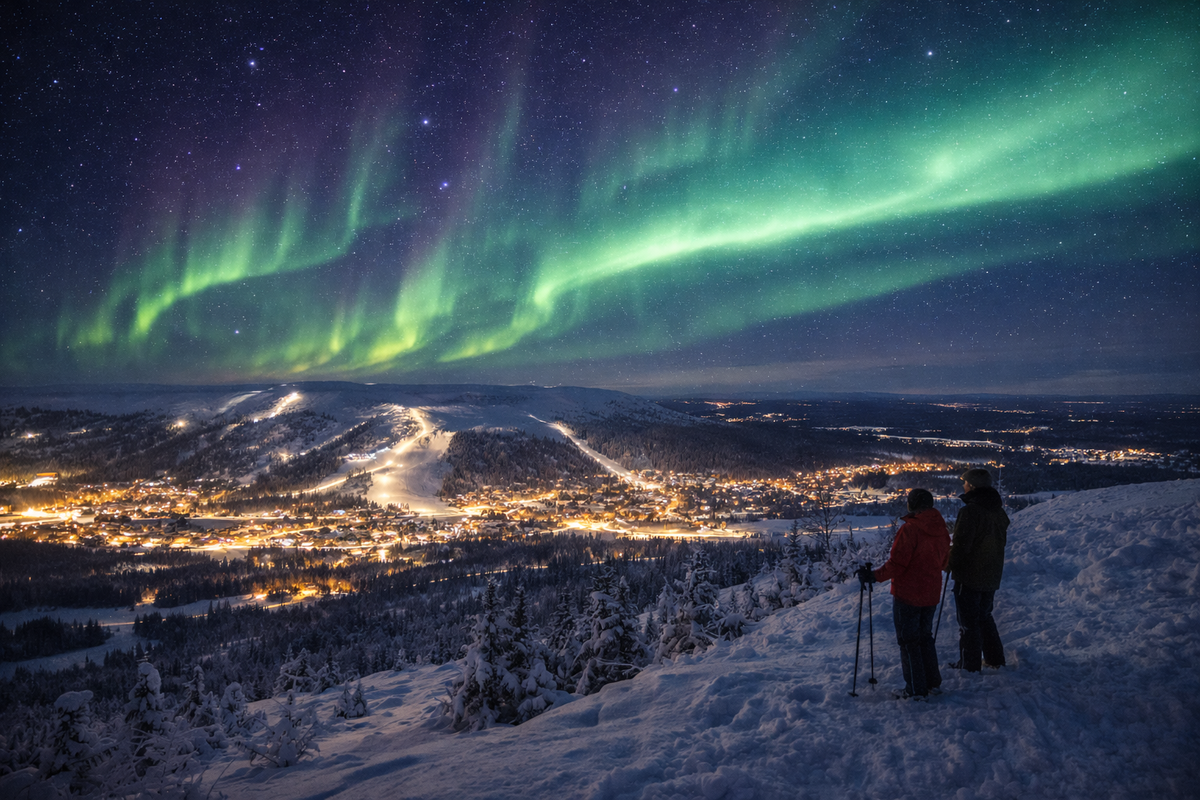
Now, let's look at the difference between Levi and Ylläs, the best spots, and a relaxed evening routine.
Levi and Ylläs are two very convenient scenarios for the Lapland northern lights: you live in the resort infrastructure (heat, restaurants, transport), but literally within a short drive, you have the real darkness of Lapland. The problem is different: many tourists stay in the brightest part of the village — and then are convinced that "the glow is weak" or "it's all a hoax".
The truth is simpler: the aurora is often there, but it is obscured by light. And that is why in Levi/Ylläs, those who have made a small plan in advance win: where to go for 20 minutes if the sky is clear.
When is the best time to see the Northern Lights in Levi and Ylläs during the season?
In Lapland, the northern lights season begins when the nights become truly dark. This is usually from around the end of August/September to April, but it is most comfortable to plan your trip for the months with consistent darkness.
If you are choosing your travel dates (rather than "going today"), refer to Paras aika nähdä revontulet 2025–2026: it explains the logic behind each month and why 2–3 nights are almost always better than "one perfect night".
For Levi and Ylläs, it is important to remember that winter is beautiful and "magical," but the resort area is also more noticeable due to the reflection of light from the snow. This is not a bad thing — it just means that a dark spot becomes even more important.
At what time of night are the Northern Lights most often visible in Levi and Ylläs?
The most practical window is 9 p.m. to 2 a.m. Not as a schedule, but as a range in which it is worth being ready to go out or drive into the darkness.
The typical pattern is as follows: half an hour of "nothing", then a quiet arc appears, and after 10 minutes it may intensify — and after 20 minutes disappear again. Therefore, the most common mistake at resorts is "went out for 10 minutes, got cold, left". For Levi/Ylläs, the tactic of short but correct attempts works better: 20-40 minutes in the dark, then back to warm up.
Levi vs Ylläs: where is it easier to get away from the lights and catch the open horizon?
Both resorts can be great for the Finnish Lapland northern lights, but they feel different. Levi is often more "bright and active" (more light and movement), while Ylläs is often "calmer and more spacious," especially if you are in the right village and not standing under the streetlights.
| Item | Levi | Ylläs |
|---|---|---|
| Light pollution in the village | Often stronger (lots of lights) | Often weaker, but depends on the area |
| How quickly it gets dark | Usually 15–40 minutes by car | Often 15–40 minutes as well, sometimes closer |
| Open horizon | Choose spots near water/fields/away from lights | More "space" nearby, convenient for the horizon |
| Best strategy | Resort for living + trip to a dark spot | Same, plus it's often easier to find quiet places |
The conclusion is simple: at both resorts, the Northern Lights are more often "made" not by choosing a room, but by choosing two dark spots that you are willing to drive or walk to.
How far do you need to get away from the lights at Levi and Ylläs for the sky to come alive?
If you are standing next to a lamppost, you are losing before you even start. This is especially noticeable in Levi: the light is active, with many reflections from the snow. Therefore, the guideline is as follows:
● If you are in the brightest area of the village, you will almost always need to drive somewhere (usually 15–40 minutes).
● if you live a little further away, sometimes a short walk to a darker place is enough, but only if there is no strong lighting around;
● The best indicator on the spot is the stars: if you can see a scattering of stars, you are in the right darkness; if the sky is "grey milk" and there is light around, the chances are slim.
Important: "dark" does not mean "black sky". In Lapland in winter, snow and atmospheric haze can make the sky appear brighter. But it is the lights in the frame that most often kill the details of the glow.
Where is the best place to see the Northern Lights on Levi: which locations work most often?
To avoid turning this article into a list of "secret coordinates," I'll give you something that's really useful: types of spots that almost always work on Levi, provided the sky is clear.
- Lake/open shore — provides a horizon and fewer trees in the frame.
- Open field/clearing — minimal light pollution and a wide view.
- A higher point (not necessarily the top) — sometimes helps you see further and avoid local fog.
Practical logic for Levi: the village is a beautiful place to live and ski, but it's almost always better to go outside to see the aurora. That's how you get those "aurora lapland" photos that everyone is chasing after.
Where is the best place to see the Northern Lights in Ylläs: which to choose between the villages and the surrounding area?
Ylläs is convenient because there is a lot of space nearby, and in some areas you can already feel the "right darkness". But the rule is still the same: look for an open horizon and a minimum of direct light.
Typical viewing spots around Ylläs:
● open areas by the water (if accessible and safe in winter),
● fields and aavas (spacious open areas),
● slopes/high ground with a view (but without bright lights nearby).
In practice, Ylläs often wins out because you are more likely to find a quiet spot where no one is shining a torch in your face. For families and those who don't like "nightlife", this is a big plus.
How to know if it's worth going out "today": clouds are more important than Kp
Almost all failures at Levi/Ylläs are due to clouds. People see a beautiful picture of activity, put on their down jackets — and stand under a grey roof because they didn't look at the most important thing.
To decide whether to go or not, you only need one honest test: are the stars visible? If yes, let's go ahead and try. If no, and the clouds are thick, let's save our energy, because even strong activity cannot break through continuous cloud cover.
If you want to figure this out with confidence, keep Revontuliennuste Suomessa as your "evening guide" — that's where you'll find the logic of the maps and the order of verification without unnecessary numbers.
Plan A and Plan B at Levi/Ylläs: two locations in different directions save more evenings than you might think
At resorts, it's easy to fall into the trap of "we have one beautiful spot". But clouds in Lapland have a life of their own: if it's cloudy in the west, you can win by going east, and vice versa.
How to put together Plan A/Plan B in 10 minutes:
● Plan A — the nearest dark place with an open horizon (lake/field/height).
● Plan B — another direction with a 20–40 minute buffer so that you can really "escape" from the cloud front, rather than just moving to the neighbouring car park.
Can you see the Northern Lights directly from the ski slopes of Levi or Ylläs?
Sometimes, yes, especially if the aurora is bright. But two things often get in the way: the lighting on the slopes and the fact that you are still in an area with a lot of light and people.
If you want to "see it quickly without leaving," choose the darkest area possible, where the light does not dazzle your eyes and does not enter your field of vision. But to be honest, the slopes are a nice bonus, and going to a dark spot more often gives you a stable result.
How to get to Levi and Ylläs and why does logistics affect your chances of seeing the aurora?
These resorts are chosen for their convenience: most often, tourists fly to the northern airport and then take a transfer or bus; some travellers combine train and bus (especially for Ylläs via the station in the north).
Why is this important for the aurora? Because your chances depend not only on the sky, but also on whether you can quickly get to a dark place. If you don't have a car and your hotel is in a bright area, you are limited. If you have a transfer/car/tour, you can easily escape the light and clouds.
If your trip base is Rovaniemi (e.g., arrival or stopover), it is useful to have a separate city plan: Revontulet Rovaniemellä. This saves a lot of time in the early days.
How many nights should you plan for Levi/Ylläs to see the aurora with a high probability?
The minimum that really works is 2 nights, optimally 3. The reason is simple: one night may be cloudy, the second may be quiet in terms of activity, and the third often "seals the deal" for success.
This is especially true for those who travel on the request "levi finland northern lights": expectations are high, and it is better to relieve the tension in advance with the number of attempts.
Northern Lights tours from Levi and Ylläs: when are they really useful?
You need a tour not "because there is no aurora without it," but because it solves two practical problems: the logistics of darkness and finding a clear window if you don't want to drive yourself.
A tour is especially useful if:
● you only have one free evening;
● you don't have a car and don't want to depend on taxis;
● you are not sure where to go and how quickly to change location due to clouds.
If you are considering a "Finland aurora tour" or "Lapland northern lights tour", keep in mind that a good tour does not promise guarantees, but it does make your evening more effective. We discuss detailed selection criteria in Revontuliretket Lapissa.
How much does "aurora hunting" cost in Levi and Ylläs: an honest budget
Exact prices depend on the season, week and format, so I'll give you a rough idea of the price range — and I advise you to check before you travel, especially for peak winter dates.
It usually works out like this:
● independently: €0 + transport (car rental/taxi/transfer) — and this is often the best option if you are already mobile;
● organised trip/tour: often around €80–200 per person (depending on the duration and services included);
● photo formats and "premium": may be higher, but do not always give you a better chance — sometimes you just pay for comfort.
More important than money in this matter is time: it is better to invest in another night than to wait for the "perfect" one.
Glass igloos near Levi/Ylläs: are they a "guarantee" or just nice accommodation?
The search terms "glass igloo finland", "igloo finland" and "igloo lapland finland" are popular for a reason: the idea of seeing the aurora borealis from a warm bed sounds perfect.
But the reality is that a glass roof does not eliminate clouds, the moon and light pollution. Therefore, an igloo is a great experience if:
● it is really dark around you,
● you have 2–3 nights,
● you are willing to go outside when the sky is clear (it is almost always better to see from outside).
If you want to choose accommodation "on a chance", check out this separate article: Lasi‑iglut ja revontulet Suomessa — it's all about what really affects the probability.
Evening routine in Levi/Ylläs: what to do so you don't go home feeling like "we did everything wrong"
The Northern Lights love simple actions, not complicated expectations. That's why a routine works great at resorts: dinner → check the clouds → a short trip into the darkness → wait → decide whether to "wait/go to Plan B".
- Check the clouds and clear windows 30–60 minutes before attempting.
- Choose Plan A and Plan B (in different directions) so you don't lose out to the front.
- Once in place, give your eyes 5–10 minutes to adjust to the darkness (do not stare at the screen).
- If the sky is clear, wait 20–40 minutes: peaks are often short and come in waves.
- If clouds have covered the sky, moving 20–40 minutes is usually more effective than waiting.
And one small detail that matters more than you might think: don't stand next to a light source. The glow may be above you, but you won't see it because of the light behind you.
Scenarios for different people: family, couple, solo, budget, expats
Family.
Make your hunting trips short: 20–40 minutes in the dark, then back to warm up. Comfort is more important for children than "staying up until two in the morning". At Levi/Ylläs, family success is about finding the right spot and a clear window, not heroism.
Couples.
The best strategy is to relax: a thermos, warm layers, a quiet spot with an open horizon. If the glow is weak, you still get a beautiful Lapland night. And that's how the "wow" moment most often happens.
Solo.
You gain flexibility: it's easier to move around and easier to wait. But think about safety: winter is dark, cold and slippery, and short stops on the road are dangerous. It's better to choose places with normal parking.
Budget.
Save money not on nights, but on "unnecessary fuss". Two or three nights are almost always cheaper than one evening with high expectations. And choose accommodation so that the walk in the dark is short — this also saves money.
Expats.
If you already live in Finland and make trips "according to the forecast," Levi/Ylläs are good because the infrastructure is nearby, and darkness is also nearby. It is easier for you to leave when it is clear than for a tourist with a strict schedule.
Mistakes in Levi/Ylläs that make the aurora "invisible" even on a good night
The most common mistake is to look at the sky from a bright area of the resort and then be disappointed. The second is not having a Plan B. The third is expecting "fireworks" when in fact there is a quiet arc on the horizon.
And one more thing: sit in a car with the lights/screen on and try to see the faint glow right away. Your eyes love darkness — give them a chance.
A night to remember at Levi/Ylläs
When everything comes together, Levi and Ylläs offer pure magic: the snow glows softly, the sky becomes three-dimensional, and even a calm green arc looks like an event. And almost always, it is not those who waited for the "perfect Kp" who win on this night, but those who did three simple things: got away from the light, checked the clouds, and prepared a backup plan.
If you want to get the full picture across the country and understand where your base fits in best, use Revontulet Suomessa 2025–2026 as your main reference point — it's a "map" of the entire cluster.
❓ FAQ
In Levi, it usually makes sense to plan aurora watching during the dark season and keep a viewing window open roughly between 9:00 PM and 2:00 AM. However, the key factor is not the exact time but clear skies and darkness. Within the village, auroras often appear weaker due to artificial lighting, so the best approach is a short trip to a darker area during clear weather around Levi.
Sometimes yes, if the auroras are strong and you find a spot on the slopes without direct lighting. More often, however, lights from the Ylläs ski area and resort reduce contrast and hide details. For more reliable results, a dark location with an open horizon works better. A slope can be a nice bonus, but it’s not the most dependable option.
In the Levi and Ylläs area, a 15–40 minute drive is usually enough to noticeably darken the sky, depending on direction and exact location. Sometimes even less is needed if your accommodation is already away from bright areas. The main thing is to keep streetlights and illuminated parking lots out of view. Snow reflects light strongly, which makes true darkness even more important.
Most of the time, clouds matter more — you simply can’t see the sky through thick cloud cover. Aurora activity only matters when stars are visible and the sky is clear. At resorts like Levi, people often focus on numbers and forget actual visibility. First you need a clear window in the sky; everything else comes second.
Auroras often come in waves, and their visual peak can be short. Clouds can also move in quickly and block part of the sky even when the general forecast looks fine. That’s why it’s better to be ready to wait 20–40 minutes on a clear night and always have a Plan B. In the Levi–Ylläs region, this strategy works especially well thanks to short driving distances.
Short visits to a dark location work much better than standing outside for hours in freezing temperatures. Plan a 20–40 minute session and think ahead about a warm break. If you have a car or transport in Levi, you can quickly “move the darkness” and improve your chances. The most important thing is not to put everything on a single night.
In the Levi and Ylläs area, prices are typically around €80–200 per person, depending on season, duration, and tour format. A tour doesn’t guarantee auroras, but it can improve your chances thanks to logistics and access to dark spots. If you don’t have a car or only have one free evening, this can be a reasonable option. Always check current terms before booking.
Glass igloos make waiting comfortable, but they don’t remove clouds or nearby light pollution. If the sky is clear and the surroundings are dark, chances improve noticeably, including around Levi. Still, the best views often come from being outside in a dark place with an open horizon. Ideally, plan 2–3 nights and be ready to step outside when conditions are right.
Phones amplify faint light in night mode and can show green tones where the eye sees only a subtle glow. This is normal and doesn’t mean you “missed it.” Move away from lights in the Ylläs area and give your eyes 5–10 minutes to adapt — you’ll start noticing more. The brighter the surrounding light, the smaller the difference.
Plan B is almost always more important, since clouds can quickly cover a single location. Two alternative spots in different directions give you flexibility and can save the entire evening. In Levi and Ylläs, this is easy thanks to short driving distances. Spending 10 minutes on planning is better than losing the whole night.

0 comments
Log in to leave a comment