



🌌 Revontulet Oulussa, Kuusamossa ja Rukalla: northern lights without "deep Lapland" — when is it realistic?
In this article, you will learn how realistic it is to see the Northern Lights in Finland without travelling to Lapland, the northernmost region of the country: what to expect in the Oulu area, the advantages of Kuusamo and the Ruka resort, what level of activity is usually required, and how to overcome the main obstacles — clouds and city lights. For an overview of the country, keep Revontulet Suomessa 2025–2026< handy.
Working tactics for Oulu–Kuusamo–Ruka
● ✅ Realism: you can see them, but on average less often than in northern Lapland
● 🌌 Main condition: dark horizon + clear sky (get away from the lights, look for a "starry" spot)
● 🚗 Distance: often a 15–30 minute drive from the city/town is enough for the sky to become noticeably darker
● 🕒 Time: keep the window open from 9 p.m. to 2 a.m. and plan for a 20–40 minute wait on a clear night
● 🌥️ Tactics: Plan A + Plan B (in different directions) to get away from the clouds on the same evening
● 🔔 To decide "today/not today", Revontuliennuste Suomessa is useful
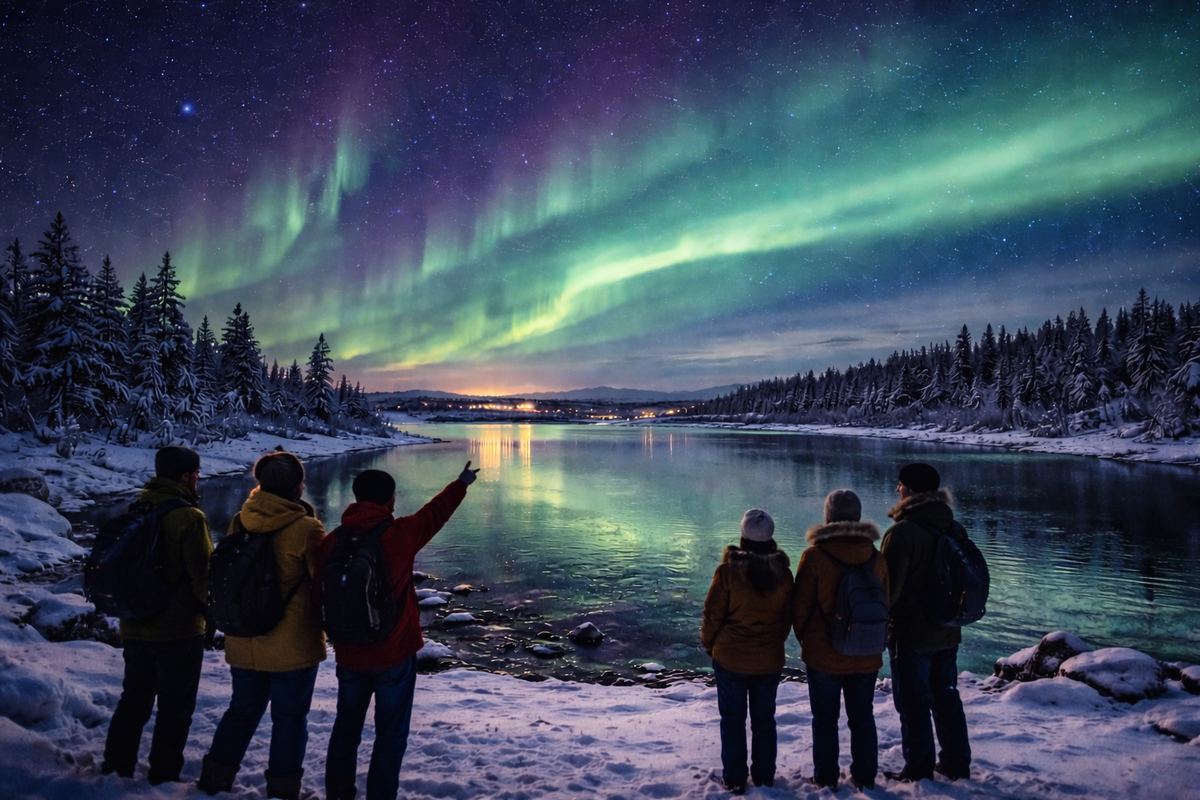
Now for the details: where exactly to look for darkness, which places work best, and how to plan an evening without "standing under a lamppost and leaving."
Oulu, Kuusamo and Ruka are the perfect compromise for those who don't have the time or budget for Lapland, but still want to experience the "aurora lights Finland". It's important to be honest here: you're playing a more difficult lottery than in the north, so it's not "luck" that wins, but the right strategy.
The most common reason for disappointment on this route is not the absence of the lights, but the wrong viewing conditions: people watch from a lit-up place, at a cloudy sky or for "10 minutes". Let's make sure you don't repeat this.
How realistic is it to see the Northern Lights in Oulu, Kuusamo and Ruka?
It is possible, but with varying degrees of difficulty. In the Oulu area, there is a chance, but it depends more on the activity and darkness of the location — city lights quickly "eat up" the weaker forms. Kuusamo and Ruka are usually easier because there are more dark areas around and it is easier to find an open horizon.
The main idea is that these are not "places without auroras," but places where you need a little more discipline — to get away from the light and be ready to make quick decisions about the clouds.
What Kp is usually needed for auroras in Oulu, Kuusamo and Ruka?
The Kp guideline is useful for understanding realism, but it does not replace the sky above your head. On average, the further south you are and the more light there is around you, the higher the activity needs to be for the aurora to be visible. For Kuusamo/Ruka, the "threshold" is usually lower than for Oulu because it is darker in the right spots.
Below is a practical reference table. This is not a promise, but a "scale of expectations" so that you do not make plans for a night that is known to be weak.
| Zone | When "realistic" (usually) | What is most often seen | What bothers you the most |
|---|---|---|---|
| Oulu (outside the city) | more often at Kp ~3–4+ on a clear night | arc/glow closer to the horizon, sometimes a "curtain" | glow + clouds |
| Kuusamo / Ruka | often at Kp ~2–3+ (depending on location and darkness) | arc and movements above the horizon, sometimes higher | clouds, "resort" lights |
| For comparison: further north in Lapland | often already at Kp ~1–2+ with clear skies | more nights "make sense" | clouds (almost always No. 1) |
If you are reading this table and thinking, "So it's hardly worth going to Oulu," that's not the case. It is worth it if you have darkness and a clear window. Just be sure to have realistic expectations.
Clouds and light matter more than "ideal indicators".
The main mistake observers in Oulu-Ruka make is looking at the numbers and ignoring the sky. The Northern Lights are a visual phenomenon: if you can't see the stars, then most likely you are just looking at clouds, and no "ideal" values will help you.
The second part is light. Even a small amount of light makes a faint glow invisible. Therefore, the rule of this article is simple: first darkness and clouds, then everything else.
Where to see the Northern Lights near Oulu: how to choose a dark horizon
The best approach for Oulu is to think not "where in the city" but "where to go quickly". You need an open northern/northeastern sector of the sky and a minimum of lights in the frame.
What works most often:
● open fields/clearings outside the city lights;
● coastal areas where the horizon is wide (if there is no bright lighting nearby);
● any "empty" places where lights do not enter the field of view.
What to avoid:
● car parks with floodlights and lighting;
● places that "seem dark" but are near a road, billboards, or streetlights;
● attempts to look from the centre: this only works with very bright light, and you want a stable tactic.
If you want "like in Lapland" but closer, Oulu is all about discipline: go out into the darkness and let your eyes adjust.
Where to see the Northern Lights in Kuusamo and Ruka: lakes, hills, away from the resort lights
Kuusamo and Ruka are easier because there are many dark spaces around them, but the resort has its own typical enemy: resort lights. In the busiest area, the aurora often looks "pale", although it can be strong.
The types of locations that work best are:
● lake shore or open area by the water (if safe);
● open fields/meadows (wide view of the sky);
● a small hill/slope with a view (often a good horizon, but it can be windier).
If you have come to Ruka for a skiing holiday, treat the aurora as an evening mission: 15-30 minutes to the right spot and you are already in a different "league" of visibility.
The 15–30 minute rule: how far to drive from the lights to get a better sky
For Oulu, Kuusamo and Ruka, the same practical principle often applies: a short drive is better than a long wait. In many cases, just 15–30 minutes away from bright areas will give you a noticeably darker sky.
This is not a magic number, but a guideline: you "drop out" of the light pollution and begin to see faint shapes. Sometimes you need more (if the light stretches far), sometimes less (if you are already not in the centre), but the logic remains: move away from light sources so that they do not fall into your field of vision.
If you want to see how this looks in a "northern version," compare the approaches with Revontulet Rovaniemellä: there, the rule of moving away from the light is the same, but there are usually more nights when it "makes sense."
Time 21:00–02:00 and why the peak can last 20 minutes
The 21:00–02:00 window is convenient as a "main range," but don't make it a schedule. The aurora often comes in waves: you may have 30 minutes of silence, then 15–40 minutes of active "curtains," and then silence again.
So instead of "going out at exactly 11:00 p.m.", do this:
● choose 1–2 attempts per evening;
● give yourself 20-40 minutes at each point if the sky is clear;
● if clouds cover the sky, move on instead of "staying until the bitter end".
This approach is especially important in Oulu and Ruka, because "rare good nights" should be used as effectively as possible.
2-minute check before going out: clouds → darkness → activity
To avoid getting stuck in endless map updates, you need a short sequence of actions. It works the same in Oulu and Ruka.
The scheme is simple: first, look for a clear window (clouds), then choose a dark spot (light), and only then look at the activity indicators as "sufficient/insufficient". This relieves stress and turns the evening into a "go/no go" decision rather than eternal hope.
- Clouds: is there a clear window in the next 1–3 hours?
- Darkness: can you leave/depart so that the lights do not get in the frame?
- Activity: is it sufficient "for this latitude" (reference from the table above)?
- Plan B: is there a backup location in another direction in case of clouds?
How to get there: Oulu, Kuusamo, Ruka — where time is lost
Logistics are part of the success here. If you live in the city and want to "get away for the night", you need quick options: a car, a short transfer, clear points of reference.
The overall picture is as follows:
● Oulu is convenient as a base, but for the best views, you often need to leave the city.
● Kuusamo/Ruka are convenient as a resort scenario: activities during the day, hunting at night, but it is important to get away from the resort lights.
● It is still possible without a car, but you are more dependent on how close there is a dark spot or tour.
If you choose "where it's easier to see", many people opt for the resort option further north: Revontulet Levillä ja Ylläksellä — there is a similar logic of short trips, but on average more nights with a chance of seeing the aurora.
How much does "aurora hunting" in Oulu-Ruka cost: an honest budget
The biggest expense here is not the "aurora", but your mobility and the number of nights. In terms of money, it usually works out like this: independent hunting can be almost free if you have transport, while a tour is paid, but sometimes saves you an evening and your nerves.
Guidelines for setting a realistic budget:
● independent trip: "€0 + transport" (car rental/taxi/fuel);
● tour (if you take one): often in the range of €80-200 per person in the northern regions (the format and season have a strong influence);
● accommodation at the resort: depends on the season, and can be significantly more expensive during peak weeks.
If you have a choice between "one evening" or "two evenings", it is often more profitable to invest in the second night — this really increases your chances.
Plan A + Plan B for one evening: a plan that saves you when it's cloudy
Plan A/Plan B is your main tool when you are not in the "northernmost" Lapland. It allows you not to lose the evening because of a single cloud front.
It works like this:
● Plan A — the nearest dark spot with an open horizon.
● Plan B — a spot in a different direction with a time reserve (usually 15–30 minutes of travel, sometimes more).
If you need an "even more reliable" version of this approach, the next step is Revontulet Saariselällä ja Inarissa: Plan A/Plan B works particularly well there because of the darkness and open spaces.
Scenarios: family, couple, solo, budget, expats
Family.
Comfort is more important to you than heroism. Make short attempts: 20–40 minutes in the dark, then warm up and repeat later when the sky is clear. For children, a "successful short trip" is better than an hour of waiting in the cold.
Couple.
A warm, calm scenario works best: a dark spot, a thermos, a minimum of lights around. Even if the glow is quiet, the experience will be beautiful because you are not standing in the light and you are not nervous.
Solo.
You gain flexibility: it's easy to move around and wait for the right moment. But think about safety — choose places with normal parking and quick access, especially in winter.
Budget.
The smartest budget is not to "save on everything" but not to lose out in one night. Two nights and easy mobility often yield better results than "one night + maximum expectations."
Expats.
If you live in Finland and can travel depending on the weather, Oulu–Ruka is a good option for quick clear windows. Your advantage is flexibility in terms of dates, which means your chances are significantly higher than those of a "one-night" tourist.
Tourist mistakes in Oulu and Ruka that resulted in "nothing happening"
First, an important point in plain text: most failures here are failures of place and time, not "no aurora". You were either standing in the light, looking at the clouds, or left too early.
Between mistakes, a simple practice is important: if you have been looking at a bright screen, give your eyes 5–10 minutes to adjust — otherwise you will physically see less.
And here's another common pitfall: leaving after 10 minutes. In these regions, patience often pays off — 20–40 minutes on a clear night gives you a chance to catch a short peak.
A night without Lapland can also be "wow"
Oulu, Kuusamo and Ruka are not "bad places", but places where you buy a chance with strategy. When you stand in the dark, see the stars and have a backup route to the clouds, the northern lights can be very beautiful even without the "northernmost route".
If you want to increase your chances for the future, add two things to the formula: more nights and a more northern base. But if you only have these regions, they work if you act wisely.
If you want, write down your base (Oulu / Ruka / Kuusamo), how many evenings you have and whether you have a car — I will suggest a "minimum Plan A/Plan B" for your format.
❓ FAQ
Yes, it’s possible, but rarely in the city center. Light pollution makes faint auroras nearly invisible, so the best option is a short drive to a dark location away from street and building lights. The chances improve on a clear night when stars are visible, and giving your eyes time to adjust to the darkness helps significantly.
Many focus on the Kp-index, but it’s not a guarantee. Clear skies and darkness matter more than activity numbers. On successful nights, auroras may appear even when the forecast isn’t ideal. Always check visibility and sky conditions first, then consider geomagnetic activity.
Open horizons with minimal direct light work best. Lakeshores and open fields often give better sky views than illuminated slopes or resort centers. Staying in the middle of lights can make faint auroras hard to notice. Combining resort accommodation with a separate dark viewing spot is usually the winning strategy.
Cloud cover is the most common reason — auroras are invisible through dense clouds. Standing in lit areas or failing to adapt your eyes also reduces visibility. Weak auroras may appear near the horizon rather than overhead. In these cases, finding a dark location and waiting 20–40 minutes often makes the difference.
Auroras often appear between 9 PM and 2 AM, but exact timing varies. Short peaks can disappear quickly, so multiple attempts during the evening are more effective than focusing on one precise moment. On clear nights, 20–40 minutes of patient observation usually yields better results than a quick step outside.
Typically, a 15–30 minute drive is enough to escape strong lighting and see more aurora details. Exact distance depends on direction and nearby light sources. Stars are a good indicator — if they’re clearly visible, you’ve likely reached the right darkness. If nearby lights still appear in the frame, move a little further.
Warm boots, windproof layers, insulated gloves, and a thermos are essential for comfort during 20–40 minutes of standing outdoors. A power bank is useful as phone batteries drain faster in cold. Always choose safe spots and plan a clear route back.
Night mode enhances faint light, so phones may show auroras brighter than what the eye sees. This is normal. Choose a dark location, keep the camera steady, and allow your eyes to adjust for 5–10 minutes before judging visibility. Low-light photos capture memories rather than perfect ad-like shots — this is expected.
Yes, but you’re more dependent on nearby dark spots and local transportation. Without a car, it’s crucial to plan multiple evenings to avoid losing opportunities due to clouds. One organized tour can help — it doesn’t guarantee auroras, but usually improves logistics and location choice.
Prices vary by season and type, usually around €80–200 per person in northern Finland. Tours don’t guarantee clear skies but provide transportation and access to dark locations. Before booking, check if the tour can change location in case of clouds and confirm current conditions.
Yes, bright moonlight reduces contrast, especially for faint auroras near lights. Strong auroras remain visible, but details may be less clear. On moonlit nights, choosing the darkest possible location becomes even more critical.
At least two nights are significantly better than one; three nights allow more flexibility to catch clear skies and peak activity. In less remote areas of Finland, planning multiple nights is essential. If you have only one night, maximize efficiency: find a dark location and prepare a Plan B in case of clouds.

0 comments
Log in to leave a comment