



🌌 Revontulet Saariselällä ja Inarissa: where to see the Northern Lights and how not to miss them
In this article, you will learn why Saariselkä and Inari are often called "almost foolproof" destinations for the Northern Lights: how to choose a spot with a dark horizon, how to play against the clouds using Plan A/Plan B, and what to do if you live in an "aurora village" (e.g., Northern Lights Village Saariselkä).
What to do to actually see the aurora
● ✅ Why it's "reliable": there is a lot of dark sky and open horizons (lakes, fells, tundra)
● 🚗 Strategy against clouds: keep a reserve for a 10–30 km trip to clearer skies
● 🕒 Time window: most often between 9 p.m. and 2 a.m. (peaks are short, 15–40 minutes)
● 🌙 Moon and lights: a dark spot makes the glow more noticeable even on a "normal" night
● 🛌 Plan for the nights: 2 nights minimum, 3 if you want to significantly reduce the risk of the "cloud lottery"
● 🔔 To decide "today/no today," Revontuliennuste Suomessa will come in handy, and a general guide for the country is Revontulet Suomessa 2025–2026
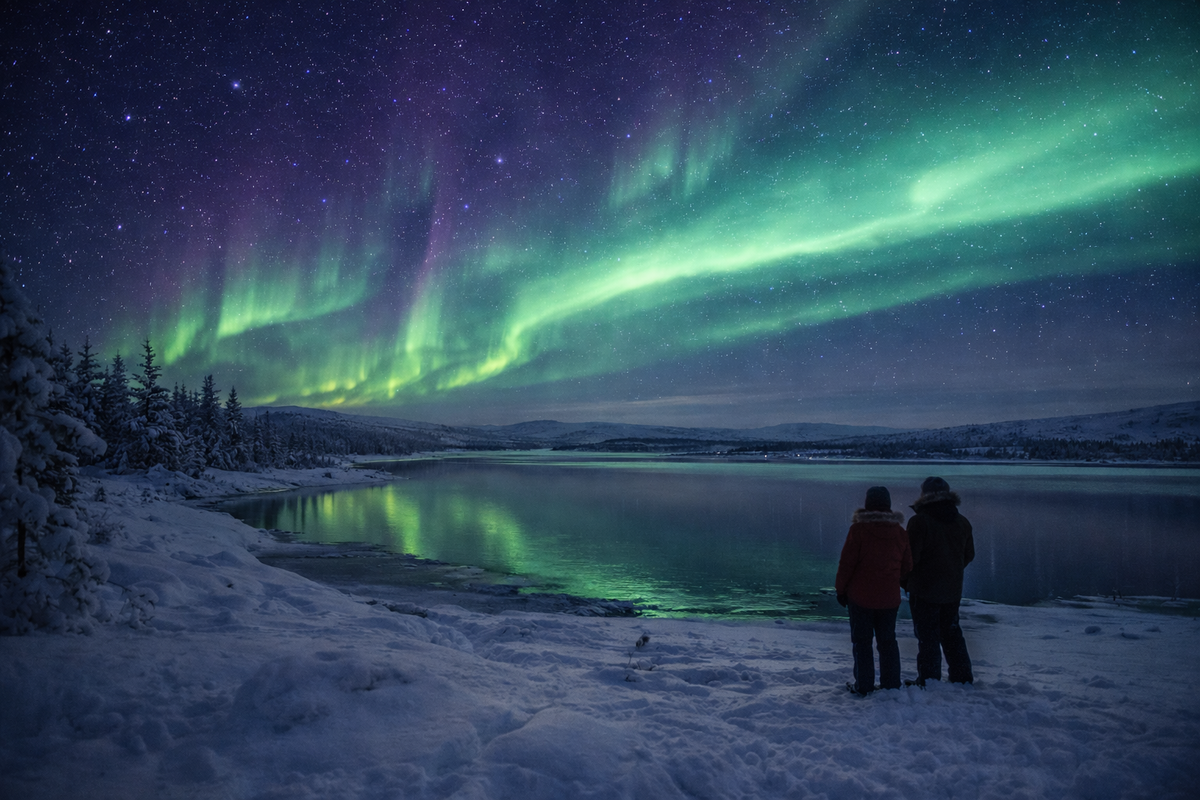
Next up are specific spots in Saariselkä and Inari and a simple evening plan that works even in unpredictable weather.
Saariselkä and Inari are not "places where the aurora is guaranteed to appear," but places where it makes the most sense to try to see it on most nights. There is less urban light pollution here, more open spaces, and you are not surrounded by streetlights and tall buildings like in the city.
But there is a catch: precisely because the region seems "ironclad," tourists relax. And then they get the classic story: "the forecast was good, but we didn't see it." Almost always, the reason is not in space, but in three simple things: clouds, light, and the wrong spot.
Why are Saariselkä and Inari considered the "most reliable" choices for the Northern Lights in Finland?
Because three practical advantages coincide here that are more important than any beautiful promises:
- Darkness is the norm, not the exception.
- Open horizons (lakes, fells, hills) where the sky is visible "wide".
- Flexibility in terms of location: it is often possible to travel 10–30 km and find a clearer area without turning the evening into an expedition.
If you google "Finland aurora borealis" or "Lapland and northern lights," Saariselkä/Inari is exactly that format: you come to Lapland, where the chances remain high even without ideal activity, if the sky is clear and you are standing in the dark.
When is the Northern Lights season in Saariselkä and Inari, and which months are easiest to plan for?
The season in Lapland usually begins when the nights become truly dark and lasts until spring, when the nights become too light again. In practice, the most convenient period for planning is autumn, winter and early spring.
Key takeaway: choose your dates based on darkness and the number of nights you can afford, not on the "most popular month on the internet". If you choose to travel during specific months, the calendar logic in Paras aika nähdä revontulet 2025–2026 is very helpful — so that you don't arrive "in season" but without the necessary darkness or without a reserve of nights.
When is the best time to go out and see the aurora in Saariselkä and Inari?
Most often, the working window is from evening until late at night, and the practical range for tourists is 9 p.m. to 2 a.m. But this is not a schedule. The aurora comes in "waves": sometimes 20 minutes, sometimes an hour, sometimes a calm arc on the horizon that lasts a long time.
Therefore, don't plan to "go out at 11 p.m. for 10 minutes," but rather:
● be prepared for several short attempts throughout the evening,
● you are in a dark place,
● you have a backup plan in case of clouds.
What level of activity is "sufficient" for Saariselkä/Inari and why are clouds more important than numbers?
In this region, the Northern Lights can be visible even on a moderate night — precisely because of the latitude and darkness. But for you as an observer, this means one simple thing: if the sky is overcast, you've lost, regardless of the numbers.
In Saariselkä and Inari, the most useful skill is not to argue with the indices, but to quickly answer the question: "Is there a window of clear sky above us, and can we drive there?" Therefore, the first thing on your checklist should be the cloud forecast.
If you want to be in control, remember this honest test: if the stars are visible, there is a chance. If the sky is uniformly grey and there are no stars, the chance is much lower, and it is better to either move on or not waste your energy.
How to read the clouds in Lapland: Plan A/Plan B, which really saves the evening
Plan A/Plan B in Saariselkä/Inari works especially well because distances "within an evening" are really useful. Often, 10–30 km is enough to see a different picture in the clouds.
The logic is simple:
● Plan A is the nearest dark spot with an open horizon (lake/aava/hill).
● Plan B is a point in a different direction so that you can get away from the cloud front, rather than just "changing parking spots".
A very important detail: Plan B is not "just in case", it is part of the strategy. If you came for the aurora, one backup route often gives more results than any "perfect night" on paper.
Where is the best place to see the Northern Lights in Saariselkä: which spots work most often?
Saariselkä is convenient because there is a lot of darkness around, but inside the tourist area there are still streetlights, illuminated paths and light from hotels. Therefore, it is wisest to choose spots where:
● there is no direct light in your field of vision,
● there is an open sector of the sky,
● it is safe to drive up and stop in winter.
Practical categories of spots that work most often:
● elevated areas/fields (to see a wide section of the sky),
● dark areas near water (if it is safe and there is a clear view),
● open areas/spaces where the forest does not block the horizon.
If you are planning to stay in one spot for your entire holiday, choose a place where you can stand comfortably for 30-60 minutes without freezing in the wind, and where you will not obstruct traffic or put yourself at risk on the road.
Where is the best place to see the Northern Lights in Inari: what to choose by the lake and why the horizon is important
Inari often wins out precisely because of its "space": the large lake and open shores provide a horizon that is very helpful for calm auroras. Even when the aurora is not "above your head," it can lie beautifully in an arc above the horizon — and it is precisely these nights that people often miss if they stand among trees or near bright lights.
The working logic for Inari:
● look for an open shore/open space,
● avoid points with direct lighting,
● keep a reserve for relocation if clouds come from the lake (or vice versa, if they leave).
Safety is especially important in winter: do not try to "cut across to the lake" through unclear areas, do not walk on the ice without understanding the local conditions, choose approaches and places where it is really safe to stand and return.
Saariselkä vs Inari: what to choose if you have 2-3 nights and want the best chance?
Both destinations are great, but the "feel" and logistics are different. Below is a brief comparison to help you choose your base and not have any doubts.
| Criterion | Saariselkä | Inari |
|---|---|---|
| Infrastructure | Resort facilities, convenient for "living and trying" | Quieter, more of a "northern" feel |
| Darkness nearby | Very close, but it is important to get away from the streetlights | Often even darker "in feeling" |
| Horizon | You need to choose points (heights/open areas) | The lake provides a wide open horizon |
| Who will find it easier | Those who want "everything nearby" and short trips | Those who love peace and quiet and are ready for calm logistics |
If you have 2–3 nights and want to reduce the risk, choose a base where it is easiest for you to do two things: get away from the light and move through the clouds.
Northern Lights Village Saariselkä and other "aurora villages": how not to fall into the trap of "beautiful, but bright"
Many people come here because they want that very format: cottages in the forest, glass roofs, "step out onto the porch and see". In a search, this usually sounds like "northern lights village saariselkä", "northern lights village saariselka finland" or even broader — "northern lights village finland". Near Ivalo, there are similar searches such as "aurora village ivalo finland".
An important clarification: such places can indeed be an excellent base, but they are not a guarantee. Why?
● there is often lighting on paths and car parks near the accommodation,
● glass amplifies reflections,
● if the horizon is blocked by trees, you simply won't notice the calm glow.
The right strategy is simple: living in "aurora village" is convenient, but on a clear night, it is still worth going to the darkest spot nearby (sometimes a 5-10 minute walk is enough, sometimes a short drive).
If you choose an igloo for the sake of the glow and want to do it wisely, there is a separate logic of choice and expectations in Lasi‑iglut ja revontulet Suomessa.
How to get to Saariselkä and Inari: Ivalo, transfers, cars and what is important in winter
The most common point of arrival in this area is Ivalo: from there, you can travel on to Saariselkä or Inari by transfer, bus or car. Lapland in winter is not a place for "let's just wing it": the roads are good, but the weather and darkness require a calm pace and a sensible plan.
Practical options:
● a car gives you maximum freedom for Plan A/Plan B and "moving to clear skies";
● a transfer/bus is convenient for basic travel, but in the evening you are limited by how easy it is to get out in the dark;
● a tour solves the issue of evening logistics if you don't have a car and want to "seize the opportunity" effectively.
Schedules and frequency of flights vary by season, so it's worth checking before you travel — not to be paranoid, just as part of your preparation.
How much does hunting for the Northern Lights in Saariselkä/Inari cost: honest budget and ranges
Prices depend on the season, week and format (resort/cottage/igloo), so I'll give you a rough idea of the ranges and remind you to check before you travel.
Typically, the costs are as follows:
● independent travel: "€0 + transport" (car rental/taxi/fuel) — this is often the best option if you are mobile;
● tour: often in the range of €80–200 per person (this is typical for Lapland, but the format has a significant impact);
● "glass" accommodation options: often significantly more expensive than regular options, and the price increases during peak weeks.
The main thing: in this case, money cannot replace clear skies. It is better to have a backup plan for cloudy nights than to pay extra for the "most beautiful" format and end up standing under a grey roof.
Evening routine in Saariselkä/Inari: how to act so that the evening does not turn into "updated the forecast and did not go".
Saariselkä and Inari are great because you can make your evening plan very simple. You don't need complicated calculations: you need a plan of action.
- Check the clouds and find the nearest clear window (1–3 hours ahead).
- Choose Plan A and Plan B (in different directions) and allow 10–30 km for travel.
- Avoid lights at the spot: give your eyes 5–10 minutes to adjust.
- If the sky is clear, wait 20–40 minutes: peaks are often short and come in waves.
- If clouds have "eaten" the sky, travelling is usually more effective than waiting.
Then it all depends on the number of nights. If you only have one attempt, you are at the mercy of the weather. If you have two or three nights, you can turn it into a relaxed, stress-free hunt.
Plan for 2-3 nights in Saariselkä/Inari: a simple scenario that most often works
If you want to reduce the risk, plan a series of attempts rather than "one magical night".
Night 1: short reconnaissance, understanding the lighting around the accommodation, test Plan A.
Night 2: main trip to the darkest spot possible, patience for 20-40 minutes, readiness to move.
Night 3 (if available): insurance against clouds and a chance to catch brighter activity.
The best part is that in Saariselkä/Inari, it feels like a "reasonable holiday" rather than an obstacle course: darkness is close by, and the trips are short.
Scenarios: family, couple, solo, budget, expats — how to tailor Saariselkä/Inari to your needs
Imagine an evening with a family with children: you don't need "a night until 3 a.m.", you need short attempts in the right darkness. Go out for 20-40 minutes, come back to warm up, and repeat later if the sky is clear.
Imagine a couple who want a quiet "northern" evening. Saariselkä/Inari are ideal: less city noise, more sky. The main thing is to get away from the light and not put all the meaning of the trip on one night attempt.
Imagine a solo traveller: you gain flexibility and can easily move across the clouds. But think about safety and proper parking, because "stopping anywhere" in winter is a bad idea.
Imagine a budget traveller: the best investment is not an "expensive format" but an extra night and the opportunity to get to a dark spot. And one more thing: don't waste the evening on doubts — follow your checklist.
Imagine expats who "catch" the right evenings according to the forecast: Saariselkä/Inari are good because even a moderate night can be beautiful if you are in the dark and have an open horizon.
Mistakes tourists make in Saariselkä/Inari that most often make the aurora "invisible"
Here, people most often make mistakes not in choosing the region, but in the details.
First, here is some general advice to remember: even in "reliable Lapland," the aurora does not like three things — light, clouds, and haste. If you stand under a streetlight and wait for 10 minutes, you are almost guaranteed to see less than you could have.
This mistake is usually followed by a second one: not having a backup plan for clouds.
And three more "little things" that really spoil the result:
● a bright phone screen before looking at the sky (your eyes won't adjust);
● waiting for "fireworks" when the glow may be a calm arc on the horizon;
● trying to "cut through" to a beautiful place without understanding whether it is safe there in winter.
Is it worth taking a tour to Saariselkä/Inari and when does it really help?
A tour makes sense if you don't have much time, don't have a car, or don't want to deal with evening logistics. A good tour doesn't promise a "100% guarantee" but does three practical things: it takes you into the darkness, helps you get away from the clouds, and saves you time looking for a spot.
If you are considering tours, keep your selection criteria in a separate article, Revontuliretket Lapissa, where it is easier to compare formats and questions to ask before booking (so you don't end up just riding around in the dark).
How to make your night in Saariselkä/Inari "the one"
The most beautiful moment in these places usually comes not when you are "in control" but when you have prepared the conditions correctly. A dark horizon, a clear window, calm anticipation and a willingness to move — this is the "secret" of Saariselkä/Inari.
And another honest tip: if you come for one night and encounter thick cloud cover, it's not a "bad place", it's just the weather. So the best way to reduce your anxiety is to add nights and have a backup plan.
FAQ
In the Saariselkä area, the best viewing window is usually between 9:00 PM and 2:00 AM. There is no exact peak hour — auroras often appear in short waves. The key factors are clear skies, darkness, and a visible horizon. On clear nights, waiting 20–40 minutes in one dark spot is often more effective than short, repeated checks.
Cloud cover matters more than activity levels. Even strong aurora activity is invisible behind clouds. Activity indicators only matter when the sky is clear and dark. In the Inari region, open horizons near the lake often improve visibility once a clear window appears.
Clouds can cover one location while skies are clear elsewhere. Around Saariselkä and Inari, moving 10–30 km in another direction can dramatically improve conditions. Plan B should be in a different direction, not just nearby. This simple strategy often saves the entire night.
Yes. A bright moon reduces contrast, especially for weaker auroras and near artificial lights. Strong auroras are still visible, but details may fade. On moonlit nights, it’s essential to move to the darkest possible location. In Saariselkä, this often requires only a short walk or drive.
Sometimes, but it’s not guaranteed, even at places like Northern Lights Village Saariselkä. Yard lights, paths, and trees often block the horizon. The best option is a nearby dark spot with no direct lighting, where you can stay for 15–30 minutes during clear conditions.
Safety depends on conditions. Avoid going onto ice unless you are sure it is safe. Choose shoreline viewing spots with clear visibility, stable footing, and easy access back. Cold and wind increase heat loss, so proper winter clothing is essential.
Yes, but flexibility is limited. Success depends on how close dark areas are to your accommodation. Without a car, staying 2–3 nights is especially important to avoid relying on a single clear evening. One organized tour can help if transport options are limited.
In the Saariselkä and Inari area, tours typically cost €80–200 per person, depending on season and format. Tours do not guarantee auroras but can improve your chances through logistics and cloud avoidance. Always check how flexible the operator is with changing locations.
Phones amplify faint light in night mode, revealing green tones that the human eye may barely detect. This is normal. Move away from lights and allow 5–10 minutes for dark adaptation — visibility improves significantly. The brighter the surroundings, the bigger the difference.
Two nights are much better than one; three nights significantly reduce the risk of cloudy conditions. While latitude and darkness help in Saariselkä and Inari, weather is still unpredictable. The best strategy is 2–3 nights plus a Plan A and Plan B.

0 comments
Log in to leave a comment