



🌌 Revontuliennuste Suomessa: Northern Lights forecast and how to track them (Kp, clouds, maps)
In this article, you will learn how to quickly and without unnecessary maths read the northern lights forecast in Finland (Lapland, Oulu, south/Helsinki): in what order to check the maps, why cloud cover is more important than a "beautiful Kp", and how to make a "go/no go" decision in a couple of minutes — right today.
2-minute check before going out
✅ 1) Clouds: look for a "window" with cloud cover of about 0-30% and look at the movement 1-3 hours ahead
✅ 2) Aurora/space weather: Kp is a guideline, but not a guarantee; based on experience: Lapland is often 0–2, Oulu ~2–4, south (Helsinki) is more often 5–7
✅ 3) Darkness: proximity to a full moon and light pollution can "kill" even a good forecast; travelling 10–30 km from the city often solves the problem
✅ 4) Plan A + Plan B: two locations and 15–45 minutes to travel between them if clouds cover your spot
🕒 When to watch: most often the window is most active between 21:00 and 02:00 (may shift)
💶 How much to budget: independent hunting is usually €0 + transport; tours are often in the range of €80–200 per person (depending on the region and format)
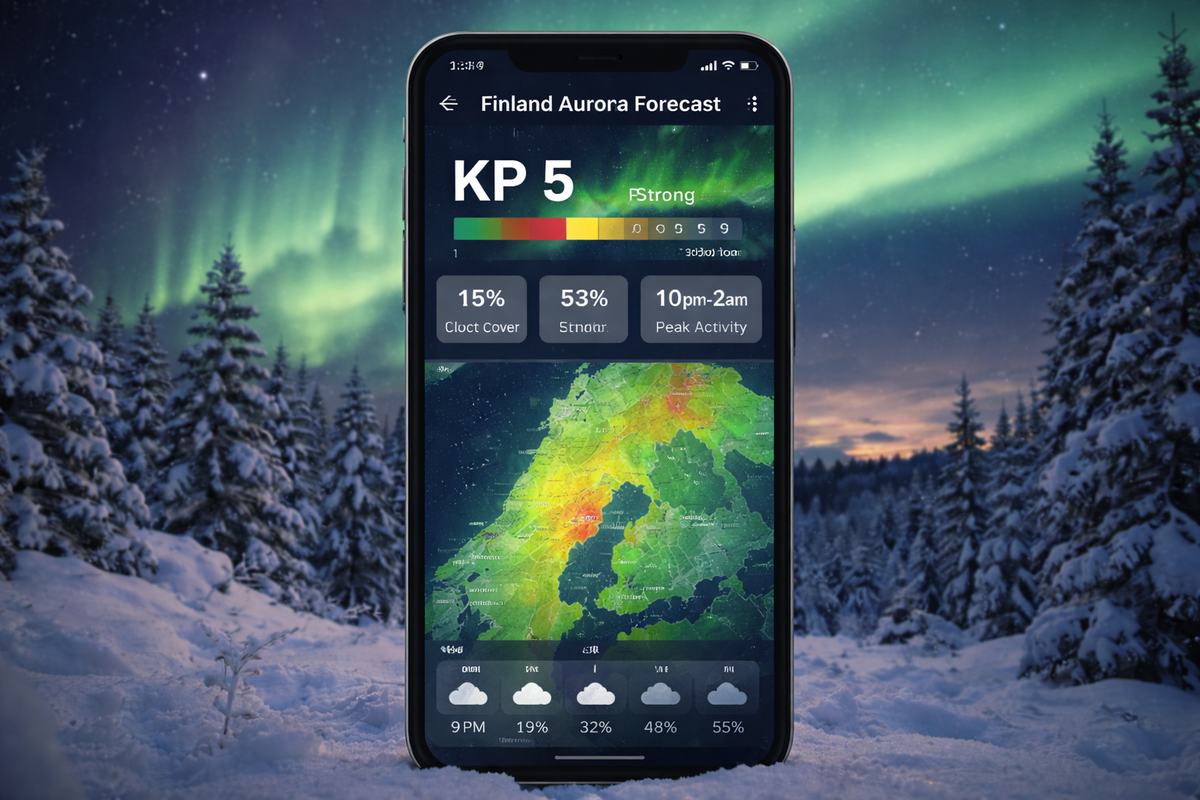
Imagine an evening in Finland: the air is dry, snow crunches under your boots, a lone streetlamp glows somewhere in the distance — and that single lamp can “eat” half the sky’s beauty. On nights like that, it feels like the Northern Lights are a matter of luck. In practice, it’s almost always a matter of checking the right things.
The most common reason for disappointment sounds the same in Lapland and near Helsinki: “The map looked great, but on location — nothing.” Usually “nothing” means one of three things: clouds, too much light, the wrong time window. That’s why we build this article around a simple algorithm you can repeat every evening.
WHY DOES THE AURORA FORECAST IN FINLAND “JUMP AROUND”, AND WHAT ACTUALLY DECIDES IT?
The aurora forecast changes quickly because it’s made up of two moving parts: space activity and the weather above your head. In reality, what most often ruins the night isn’t “weak Kp”, but ordinary cloud cover or light pollution from a town.
Second point: maps often show a “probability/zone”, not a promise of a show. So the right approach is not to hunt for a perfect number, but to assemble three совпадения (three things lining up): activity + darkness + clear sky.
And one honest detail: in Finland, a “good night” may last 15–40 minutes, not the whole evening. People who expected “two hours of green waves” often miss the short window because they went inside to warm up.
HOW TO CHECK THE REVONTULIENNUSTE IN FINLAND IN 2 MINUTES BEFORE GOING OUT?
If you have only 2 minutes, work in a fixed order: clouds → darkness → activity. This is the most reliable way to avoid driving out for a “magnificent Kp” into a solid grey ceiling.
The idea is simple: first find a place where you actually have a chance to see the sky, then make sure it’s dark enough, and only at the end estimate how strong the activity needs to be specifically in your region.
- Clouds: where it’s clearer right now and where the “window” is shifting (look 1–3 hours ahead).
- Darkness: how far you are from streetlights/cities, and how bright the moon is tonight.
- Activity: Kp/aurora indicators — is it enough for your region (Lapland ≠ south).
- Plan A + Plan B: two locations and a 15–45 minute buffer to relocate if clouds cover you.
From here, the main thing is not to overcomplicate it: if cloud cover is 80–100% and you can’t see stars, no “perfect forecast” will save you. If clouds are broken into “patches”, there is a chance — especially if you’re willing to drive 20–30 minutes in the direction of clearer sky.
WHAT IS THE KP INDEX, AND WHY DOES A TOURIST IN FINLAND NEED IT?
The Kp index is a rough scale of geomagnetic activity used to estimate how “wide” the auroral zone might spread. But for a tourist in Finland, Kp is not a “yes/no” button — it’s a hint about how many chances you have in your place, assuming the sky is clear.
Two important caveats. First, the same Kp feels different at different latitudes: in Lapland even a “modest night” can produce beautiful aurora, while in the south you need a rare alignment. Second, aurora can look very different: sometimes it’s a “band on the horizon”, sometimes fast pillars overhead. Kp is more associated with the “second option”, but it doesn’t guarantee it.
If you google in English like “finland aurora borealis” or “aurora lights finland”, the algorithm is the same: the sky must be visible, it must be dark, and only then does it make sense to argue about numbers.
WHAT KP DO YOU NEED IN FINLAND: LAPLAND VS OULU VS THE SOUTH AND HELSINKI?
A common practical way to think about it: in Lapland low values are often enough, around Oulu you already need a “medium” level, and in southern Finland (including Helsinki) you most often need strong activity and perfect darkness. This is not a formula — it’s a useful guideline that helps you avoid wasting a night.
Below is a convenient “regional cheat sheet”. Treat it as a starting point: the real result depends heavily on clouds, the moon, and how far you got from city lights.
| Region | What’s often “enough” | What must align |
|---|---|---|
| Lapland (Rovaniemi–Levi–Saariselkä–Inari) | about Kp 0–2 (sometimes 3+ is brighter) | clear sky, darkness, open horizon |
| North/central (Oulu area, Kuusamo/Ruka) | about Kp 2–4 | get away from city lights + track clouds |
| Southern Finland (Helsinki and surroundings) | most often Kp 5–7 and higher | a truly dark place + clear sky + a lucky “window” |
The practical logic is this: in Lapland you’re hunting for “sky quality”, while in the south you’re hunting for a “rare everything-lines-up moment”. That’s why tourists who plan lapland northern lights as a travel goal usually get the biggest boost from choosing the right place and darkness — not from waiting for “space magic”.
HOW TO READ A CLOUD MAP FOR AURORA: WHAT TO CHECK FIRST?
First, don’t look for “perfectly clear sky”, look for a window where there are fewer clouds and it’s moving toward you. Even 30–50% cloud cover can work if clouds are broken, you have a view of the northern horizon, and patience to wait 20–40 minutes.
Look at three things:
- current cloud cover above you,
- front movement (where the clear zone is “driving”),
- cloud height (low uniform layers are usually worse for observing).
If you’re in Lapland, the biggest “cheat” is having a plan for two directions: for example, if it’s closing in from the west, you drive east (or vice versa). Around places like Rovaniemi or Saariselkä, this often decides the night.
And don’t forget the simple check without any maps: if you can’t see stars and the sky is evenly grey, the chance is minimal. If stars “break through in patches”, there’s a chance — especially in the northern regions.
WHY THE MOON AND LIGHT POLLUTION CAN RUIN A “GOOD” FORECAST?
Even with excellent activity, aurora can look like “nothing” if it’s too bright around you: bright moon, streetlights, shop windows, a highway, an illuminated parking lot. For your eyes it means one thing: weak green tones get lost in the background.
A working rule: if you want not just a “barely visible haze” but a beautiful structure, get away from light. Often 10–30 km from a city center or 5–15 minutes from a Lapland resort village is enough — but it depends on terrain and where the nearest hotel spotlight is aimed.
If you’re staying in a glass dome or searching for glass igloo Finland / igloo Finland, remember: glass doesn’t cancel light pollution. A good “igloo night” is when it’s dark around you and you’re ready to step outside for 15–20 minutes, rather than waiting for magic from bed.
WHAT TIME IS AURORA MOST OFTEN VISIBLE IN FINLAND, AND HOW MANY NIGHTS SHOULD YOU PLAN?
Most often the activity “fires” in the evening and at night; a typical window is roughly 21:00–02:00, but it can shift easily. So the best plan is not “go out exactly at 22:00”, but keep 2–3 hours of flexibility and watch the clouds.
If you’re coming for aurora, plan at least 2 nights, preferably 3. This is the cheapest way to improve your odds: even if one night is cloudy, the second might be clear and the activity sufficient.
For a short trip, this formula works: not one perfect night, but two ordinary ones. And yes, this is especially critical if you plan holidays to lapland northern lights and want to “see at least something” without stress.
WHICH MAPS AND APPS ACTUALLY HELP TRACK AURORA IN FINLAND?
Usually three types of tools are enough: a cloud map, an aurora probability/oval map, and a light pollution map. Everything else is a “nice add-on” that won’t save you if you check in the wrong order.
If you choose an app, look not for “the prettiest” one, but for one where:
- you can see cloud cover and its movement,
- there’s a simple activity scale (no matter what it’s called),
- you can set alerts by a threshold.
The key is not to set the threshold to “maximum”, otherwise alerts will come once a season. Better set a “medium” threshold for your region and still do a quick cloud check every time.
HOW TO SET ALERTS SO YOU DON’T MISS A GOOD NIGHT “TODAY”?
The most workable setup is two layers of alerts: “activity is up” and “there’s a clear window”. Then you won’t be woken up by a “super-Kp” hidden under clouds, and you won’t miss a quiet but clear Lapland night.
In practice it looks like this: the activity alert gives you a “ping”, and you check the cloud map manually in 30 seconds. If you live in the south, it makes sense to set a higher threshold, but still remember: one strong peak can be short.
One more nuance: alerts are great when you’re already in the region and ready to go out. For tourists this is especially convenient in places like Saariselkä/Inari, where you can quickly drive into darkness.
PLAN A AND PLAN B: HOW TO CHOOSE A VIEWING SPOT AND WHEN TO MOVE?
The best spot isn’t “the most beautiful”, it’s the one where you have an open horizon and as little light around you as possible. For the first outing, it’s enough to pick Plan A (main spot) and Plan B (backup in another direction), so you’re not dependent on one patch of sky.
Plan A criteria:
- dark (no direct streetlights in the frame),
- a view to the north (or a wide sector of sky),
- safe access/parking in winter.
When should you move? If clouds above you are dense and the map shows a clear zone 20–40 minutes away — it’s usually better to go. If clouds are “broken chunks”, it’s often better to wait 20–30 minutes on the spot.
And yes, in Finland “driving for the sky” is a normal strategy. Especially in Lapland: if you’re willing to shift 30–60 km, you often beat those who stand in one place all evening.
WHAT TO DO IF YOU’RE TRAVELING: CAR, TRAIN, OR TOUR — AND THE FORECAST CHANGES?
If you’re driving, you’re in a better position: you can literally “catch” a clear corridor and make it within the activity window. But it’s important not to burn out: choose one zone and work within a 30–60 minute radius of it, rather than zig-zagging across the entire map.
If you’re on a train, treat aurora as a bonus. For “hunting”, a train is rarely ideal because of reflections and the fact you don’t control stops. But the plan “night train + hunting on location” is often very effective (and psychologically calmer).
If you take a tour, the main plus is logistics and experience. Usually you pay not for a “guarantee”, but for being quickly driven to where it’s darker and clearer. If you care about the phrasing “finland northern lights tour”, choose tours that have an honest Plan B in case of clouds.
SCENARIOS: TOURIST, EXPAT, LOCAL, AND FAMILY — HOW NOT TO LOSE A NIGHT IN FINLAND?
Short answer: everyone needs the same algorithm, but different constraints (time, transport, kids, fatigue). So below are four situations where people most often make mistakes, and how to make it simpler.
Scenario 1: Tourist in Rovaniemi for 1–2 evenings.
Set the goal “see at least something”, not “get a National Geographic cover”. Leave the center, keep the 21:00–02:00 window, and decide based on clouds. If you want it without driving — consider a rovaniemi northern lights tour as a way not to spend the evening on logistics. Once per trip is fine.
Scenario 2: Family in Saariselkä / Inari (kids, schedule).
Best is short attempts of 20–40 minutes, but in the right place. If you’re staying near a complex like Northern Lights Village Saariselkä (sometimes searched as northern lights village saariselka finland), check how dark it is around it: sometimes it’s enough to walk a bit farther from lit paths, sometimes a short drive to a “black” spot is better.
Scenario 3: Expat in Helsinki and surroundings.
Don’t try “every evening”. Check the forecast only on nights where high activity and clear skies align, and pick a dark spot outside the city in advance. For this scenario a separate article Northern Lights in Helsinki and Southern Finland is useful — more about realistic expectations.
Scenario 4: Local (or someone staying in Lapland for longer).
Your super-skill is patience and routine. Do the 2-minute check each evening, keep expectations moderate, and have a “quick drive” option 20–30 minutes away. Over the long run you’ll see more than a tourist chasing “perfect Kp” once.
COMMON MISTAKES WHEN CHECKING THE AURORA FORECAST IN FINLAND — AND HOW TO AVOID THEM
The first thing to remember: most failures are explained not by space, but by organization. People either check in the wrong order, stand under a streetlamp, or leave 10 minutes before it starts.
Other common mistakes:
- Waiting too little. You arrive, stand for 10 minutes — and leave. Sometimes the window arrives after 20–40 minutes.
- Wrong location. A “pretty bridge/waterfront” is often brightly lit. Look for darkness, not a postcard.
- Framing instead of seeing. The camera sees differently, but if you only watch the screen you adapt worse to the dark.
- No plan. Without Plan B you depend on one piece of sky.
- Expecting “fireworks”. Sometimes aurora is a calm green arc on the horizon. That’s still luck — especially in the south.
If you want to increase your odds as a “trip project”, it’s useful to look at Northern Lights in Rovaniemi (if you’re in Rovaniemi) or a housing piece Glass igloos and Northern Lights in Finland (if the goal is “glass igloo + aurora”).
ONE HABIT THAT NOTICEABLY INCREASES YOUR CHANCE TO SEE AURORA
Make one thing a ritual: every evening — a 2-minute check in order and a short decision “go / don’t go”. It removes stress and avoids the main trap — endless map refreshing without action.
The second habit is thinking not in “one point”, but in “an area”. In Finland, very often the winner is the person who’s ready to drive 20–40 minutes to where the sky is clearer. Especially in Lapland, where darkness and space make it easy to change plans quickly.
And third: if you’re traveling for aurora, don’t put everything on one night. Two ordinary attempts are better than one “perfect” one — calmer, more honest, and in practice more productive.
If you have your own working trick (how you catch clear windows, where you look, how you plan Plan B) — write it in the comments. Other people’s short lifehacks in this topic genuinely save evenings.
❓ FAQ
Because the activity forecast and the cloud forecast are different things, and cloud cover changes faster than “pretty aurora maps”. Even if activity is excellent, thick clouds simply block the sky. Check cloud movement 1–3 hours ahead and keep a Plan B in another direction. In the north, a short 20–40 minute relocation often decides the night.
Check three things in order: clouds, darkness (moon and light pollution), then activity. It’s crucial to get away from city lights — even small glow “eats” weak forms. If it’s cloudy over your area but there’s a clear window nearby, it’s better to drive there immediately. Make the decision close to departure, because conditions change quickly.
In southern latitudes aurora is rarer, so you usually need strong activity and a match with clear skies. Plus you need a truly dark spot away from city glow, otherwise you’ll see only a faint haze or nothing at all. If conditions don’t align, it’s better not to torture yourself with waiting. If they do align, the attempt can pleasantly surprise you.
Yes, strongly: with a bright moon, weak aurora details become almost invisible. This is especially noticeable in any light pollution. Strong aurora can still be visible, but it will look less contrasty. So on “moonlit” nights, the darkness of the location becomes even more important.
Most often the “working” window is in the evening and the first half of the night, but specific peaks can be short. It makes sense to keep 2–3 hours of flexibility and not leave after 10 minutes if the sky is clear. Sometimes it starts suddenly and doesn’t last long. It’s better to plan a calm outing and short attempts than to wait “all evening”
Sometimes it’s enough to walk/drive just a little if it’s already dark and there are no bright lamps in your field of view. But if there’s a lot of lighting nearby (paths, parking, signs), even a short 10–20 minute drive can noticeably improve the view. The goal is an open dark horizon without direct light. The decision depends on the exact place and weather.
Often yes, if it’s truly dark around you and you have an open horizon, but it still depends on clouds and activity. The most common fail is standing near lit areas and not letting your eyes adapt. If the sky is clear, try going out for 15–20 minutes to the darkest nearby spot. A tour isn’t “magic”, it’s logistics if you need to drive to clearer skies.
A camera with long exposure amplifies faint light, so sometimes it shows green where your eyes see only a greyish haze. That’s normal and doesn’t mean you “missed the show”. If you want to see better with your eyes, go to a darker place and give your vision 10 minutes to adapt. As activity increases, the difference becomes smaller.
A tour is useful if you have little time, no car, or don’t want to drive chasing clear skies. It doesn’t guarantee aurora, but it improves your odds through better spot choice and route flexibility. If the forecast is good, a tour can help you “not miss” the right location and avoid spending the evening searching. Before booking, it’s still smart to check clouds and darkness.
Look for points with minimal light pollution and an open horizon — usually that means leaving built-up areas and getting away from major roads and streetlights. In brightly lit city centers the chance of seeing anything noticeable is extremely low, even with strong activity. If the forecast is unusually strong and the sky is clear, the right place can make the attempt successful. The key is not to expect “Lapland in the city”.
Because high latitude, darkness, and open horizons make even weak activity more noticeable. In such places you win with “sky quality”, not the number in the app. But clouds can still ruin everything, so the rule “clouds first” still applies. And always consider safety: wind and extreme cold can be serious.

0 comments
Log in to leave a comment