



🌌 Revontulijuna in Finland: can you see the Northern Lights from the night train to Lapland?
In this article, you will learn whether the "revontulijuna" (night train to Lapland) is a good way to see the Northern Lights in Finland: when it is realistic, why it is often just a bonus, how to eliminate reflections in the window, and how to make a plan that works even when the sky is unpredictable.
✅ Realistic expectations: you can see the aurora from the train, but more often than not it's a bonus rather than a "guaranteed method".
🌥️ The main factor: clouds and sky visibility, not just "pretty numbers".
🪟 Train window: the chances are higher if the carriage is dark and the window does not glare (set your phone to minimum brightness).
🎯 Best plan: night train to Lapland + 1–2 evenings of hunting already on site (there you control the spot and the darkness)
⏱️ Travel time: usually a night journey of ~10–12 hours (depending on the flight and season)
🔗 For evening decisions, Revontuliennuste Suomessa will come in handy, and the general "main" guide to the country is Revontulet Suomessa 2025–2026
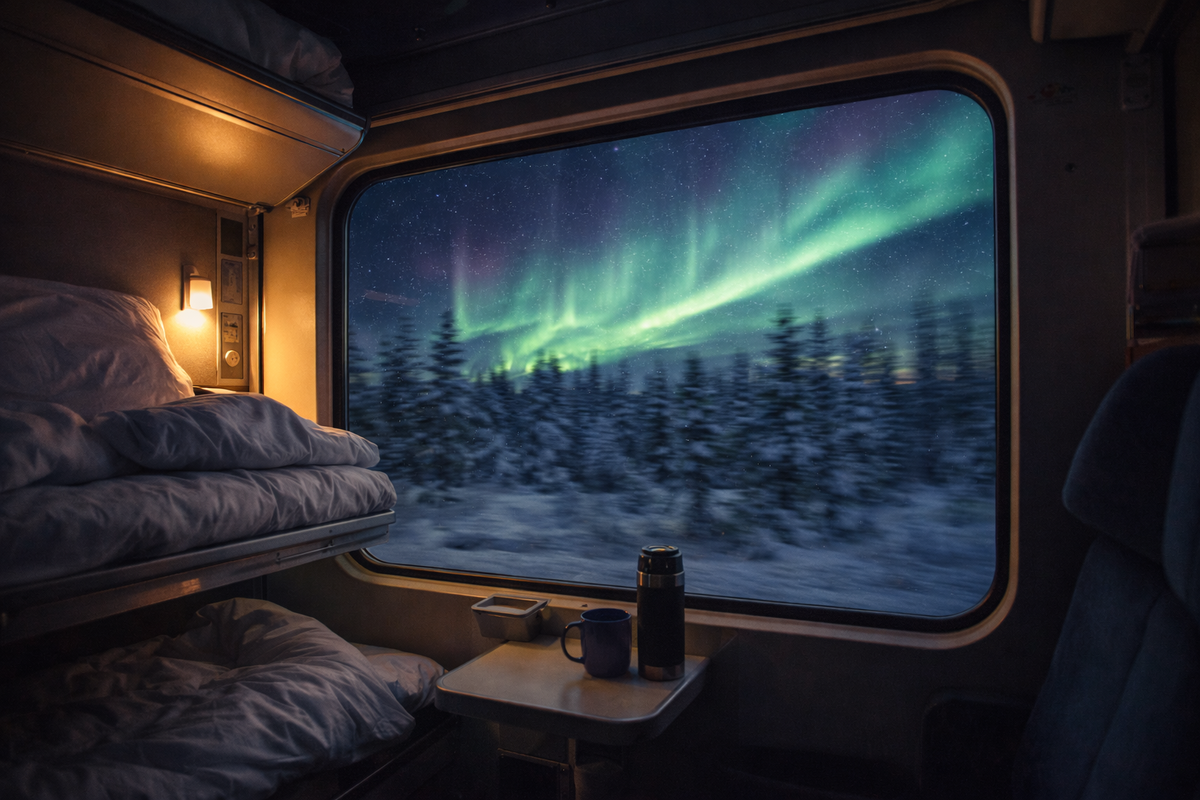
Next, I will show you when a "train attempt" makes sense and how not to be disappointed in your expectations.
A night train in Finland is the perfect image for the imagination: a dark forest outside the window, rare lights, and somewhere out there — a green arc in the sky. That is why the search term "revontulijuna" is gaining popularity among tourists who are looking for "Finland and northern lights" and want to combine travel with the chance to see the aurora.
But it is important to understand the reality in advance: a train is a moving location with glass, light inside, and a route that you cannot control. Therefore, "you can see it" and "you can't bet on it" are two equally true statements.
Is it possible to see the Northern Lights from a night train in Finland?
Yes, you can see it — especially closer to the north, if the sky is clear and the activity is noticeable. But the key point is that trains rarely provide the conditions that make the aurora truly beautiful (a dark spot, an open horizon, no glare).
If you want an honest conclusion: consider the aurora from the window as a pleasant surprise, not as a goal worth sacrificing your plans for. Then revontulijuna works perfectly psychologically: you won't be disappointed, and you'll still have a chance.
What is revontulijuna and why is it not a "guaranteed life hack"?
Revontulijuna is the popular name for the idea of "taking a night train to Lapland to catch the northern lights." It sounds logical: the further north you go, the better your chances, and you're travelling at night anyway.
The problem is in the details. On the train, you almost always encounter reflections, interior lighting, trees along the way, short windows of visibility, and the fact that you cannot "turn towards the clear sky." Therefore, statistically speaking, it is better to use the train as a means of transport to the right region rather than hunting from the carriage.
What conditions must coincide for the aurora to be visible from the train: clouds, darkness, activity
The short answer: if you can't see the stars, the chance is almost zero, even with strong activity. This is especially critical for a train because you can't choose a spot without clouds and have to wait for a "window" while moving.
To see the aurora from the window, three things must coincide:
● there is a section of clear sky above the route (or broken clouds that "make holes");
● it is dark inside the carriage, and the window does not glare;
● there is enough activity for the aurora to be visible even through the glass and against the background of movement.
Practical conclusion: the first thing that determines the success of a train trip is not "numbers" but ordinary weather. If the night is completely cloudy, the revontulijuna simply turns into a comfortable night journey (which is also useful).
On which section of the night route "to Lapland" is the chance of seeing the aurora higher?
The further north you go, the darker it usually is and the less light pollution there is — and the more often the aurora is visible. Therefore, the chances generally increase closer to the northern regions, rather than "immediately after departure".
But there is a nuance: it is in the northern part of the route that the landscape often becomes "forested" rather than "open". This means that even on a good night, you may only be able to see fragments of the sky. If you are lucky enough to find a section with a more open view (away from dense forest and bright lights), your chances increase.
That is why many people ultimately choose not to "hunt on the go," but to use the train as a way to sleep and get to a place where the Northern Lights can be viewed comfortably.
Comparison: the Northern Lights from a train, a tour, and independent hunting — what really works?
If the goal is not "luck/bad luck" but maximum chance, it is important to choose a strategy. The train is the weakest observation tool but a strong logistics tool.
| Method | Chance | Comfort | Main advantage | Main disadvantage |
|---|---|---|---|---|
| View from the train | Low/medium (as a bonus) | High (you're already travelling) | Zero additional logistics | Glare, forest, no control point |
| Independent hunting on site | Medium/high (for 2–3 nights) | Medium (transport/point required) | Darkness and horizon control | Dependence on weather and travel |
| Tour | Medium/high (if travelling for clear skies) | High (logistics on the organiser) | Can take you away from clouds/light | Price, and still no "guarantee" |
The best combination for most travellers sounds boring, but it wins most often: a night train for transport + 1–2 evenings of hunting in the dark already at the destination.
How to choose a place on the train for observation: a sitting car, a compartment or a sleeping car?
If we're just talking about the chance to see the aurora, the best option is one where you can ensure darkness inside and not have to deal with reflections. So in reality, it's not about "which carriage is prettier", but "where is it easier to turn off the lights and close the curtains".
The general rule is this:
● in a sleeping car/compartment, it is easier to create darkness and comfortably "check the window" in short bursts;
● in a seating carriage, the light from the saloon and other people's screens often get in the way;
● in practice, it is not the class of carriage that matters, but the ability to make it darker around the window.
If you are travelling with friends or family, a compartment usually has the added advantage of avoiding conflict: some people are sleeping, while others are looking out of the window for 10 minutes.
How to remove reflections in the window: quick tricks that really help
The short answer: there is often glare, but you don't see it because of reflections and light inside. Therefore, dealing with reflections is the main technical skill of revontulijuna.
The working techniques are simple:
● reduce the brightness of your phone and turn off white screens nearby;
● do not sit opposite a lamp (if possible) and do not illuminate your face;
● look from the darkest corner and closer to the glass to reduce the reflection of the interior;
● use dark clothing/a scarf as a "curtain" around your head and the window (yes, it looks funny — but it works);
● wipe the window area with a microfibre cloth if there are obvious smudges.
And one more thing: if you really want to "see with your eyes," give your eyes 5-10 minutes to adjust to the darkness. This is especially important if you have been looking at a bright screen beforehand.
When to look out the window on a night train: how not to miss the short "window"?
The aurora in Finland often comes in "waves": sometimes it lasts 10-20 minutes, sometimes an hour. On the train, this is even more noticeable because you are constantly changing the background: sometimes it's a forest, sometimes lights, sometimes an open area.
Therefore, it is better not to sit "waiting all night," but to act in cycles:
- choose 5-10 minutes to check the window,
- if the sky is visible and there is a hint of light, stay there,
- if the window is bad (light/forest/glare) — go back to rest and try again later.
This approach saves energy and makes the trip really comfortable. And comfort is important in this context: a tired person often misses the moment precisely because they are "fed up with it all".
How to capture the Northern Lights from a moving train on your phone or camera?
Honest answer: spectacular photos from a moving train are rare because movement does not favour long exposures. But it is possible to "capture the glow" (and sometimes even a nice shot) if you adjust the settings.
If you are shooting on your phone, choose night mode, but don't expect perfect sharpness: the train is moving, and the frame can easily become blurred. With a camera, the strategy of "shorter exposure, higher ISO" usually helps to freeze the movement at least partially.
The most important thing is not to try to take a photo "as if from a stationary shot on a tripod". On a train, a simple "souvenir" shot almost always wins, and it is better to plan a beautiful shot on the spot, in a dark spot and without glass.
What to do upon arrival: the best plan is "night train + 1-2 evenings of hunting on site"
If you use revontulijuna for logistics, the strongest scenario looks like this: you arrive, get some sleep, and in the evening you go out hunting where you can control the darkness and get away from the clouds. This greatly increases your chances compared to "watching all night from the window".
A typical plan on site:
● choose a base with quick access to darkness (even 10–20 minutes by car can make or break the evening);
● have a backup location (Plan A/Plan B) in case the clouds move;
● allow for at least one extra evening so that you are not dependent on a single night.
If your base is in the Rovaniemi area, it is very convenient to have a list of dark spots and distances in advance: Revontulet Rovaniemellä.
And if you don't have a car, no problem: it's easier to take a tour for one evening so you don't waste time on logistics and searching for darkness in an unfamiliar place.
Scenarios for different people: 1-night tourist, family, budget traveller, expat
Revontulijuna has four typical scenarios, and in each one, the "right" plan will be slightly different.
Imagine a tourist who only has one evening in Lapland. In this case, the train is a great way to save time, but it's better to bet on a short trip into the darkness in the evening rather than a window seat. If you have very little time, the logic of "arrive — eat — tour/trip — sleep" works better than a sleepless night on the train for the sake of chance.
Imagine a family with children. The main thing here is not to turn the glow into torture: the train is used for sleeping, and the "hunt" is done in short attempts on the spot. An option where the child can sleep and the adult can check the sky for 15 minutes without stress is very helpful.
Imagine a budget traveller. Trains are often cheaper than planes during the season, but the most expensive risk is "one night and clouds". Therefore, budget does not mean "one attempt", but "two nights and flexibility": even if you save on the tour, it is better to have a reserve in the evenings.
Imagine an expat who has long wanted to see the aurora borealis in Finland and chooses a romantic format. Then revontulijuna is a good experience in itself, but the most beautiful result still comes more often in a dark spot on the spot, rather than behind glass.
How much time and money to budget: ticket, compartment, transfer, tour
In terms of time, the logic is simple: a night train saves you one day of travel, but it does not replace an evening of hunting. Realistically, plan for at least one night on site (preferably two) to give yourself a chance in normal weather.
I give budget guidelines in ranges because the season, day of the week and type of accommodation affect the price more than you might think:
● seats are usually significantly cheaper, but less comfortable and darker;
● sleeping accommodation/compartments are often more expensive, but you get a good night's sleep and have better control over the light;
● a tour to see the aurora usually adds a separate expense, but sometimes saves you an evening and your nerves.
Important: schedules and prices change, so check the current booking conditions before travelling. This is a case where it is better to spend 3 minutes checking than to make plans based on "last year's logic".
Tourist mistakes with revontulijuna: why "the aurora was there, but I didn't see it"
The most common mistake is to expect something from the train that it cannot give: a stable dark spot and an open horizon. The second is a bright interior and reflections: people look out the window and see their own faces, and then are convinced that "there was nothing."
Three other mistakes occur constantly:
● tying success to a single night without a backup plan;
● trying to take the "photo of your dreams" from a moving carriage and getting upset because it's blurry;
● standing at a lit stop and thinking that this is "the very darkness of Lapland".
If you perceive revontulijuna as part of the journey rather than a "guaranteed method," there will be significantly fewer disappointments.
How to turn revontulijuna into a successful hunt: a short plan before the trip
The strongest approach is to decide in advance that the train has one task: to take you to the region and save your energy. The hunt begins when you can choose a spot and get away from the light.
Before the trip, you only need to make three decisions: where you will hunt in the evening upon arrival, what your backup plan is in case of clouds, and whether you are ready to spend one evening "accompanied" (if you don't have a car or have little time). The combination of "forecast → dark spot → flexibility" is ideal for this, and if you need an organised option, Revontuliretki Lapissa will come in handy in the future.
And if your goal is not just to "see" but to have a beautiful experience (including a "glass igloo Finland"), check in advance how dark it is around and whether it is possible to go outside to a good spot: Lasi‑iglut ja revontulet Suomessa.
❓ FAQ
Yes, sometimes it’s possible, especially when the sky is clear and auroral activity is present farther north. However, conditions on a train are much harder to control: window reflections, interior lighting, and forests along the route interfere. That’s why it’s better to treat this as a bonus rather than a “guaranteed” plan. The most reliable option is to use the train simply as transportation to the right area.
On a real trip, clouds usually decide everything, because you won’t see anything through thick cloud cover. Kp and other indicators matter only if the sky is visible. On a train this is felt even more strongly: you can’t just “drive around” clouds. So the logic is simple: first sky visibility, then activity.
The most important step is to darken the area around the window and turn off bright screens. Reflections are often stronger than the aurora itself, especially when the display is weak. If you manage to reduce reflections, you may start noticing thin arcs or faint movement. That significantly increases the chance of seeing the aurora “live.”
Usually the best time is late evening and the first half of the night, but displays are often brief. On a train, it’s not worth staying awake all night — it’s better to check the window at intervals to avoid exhaustion. If the night is clear, repeating checks several times makes sense. On cloudy nights, it’s better to sleep and hunt for auroras once you arrive.
A phone can capture auroras as a “memory photo,” but sharpness often suffers due to movement. Night mode helps, but it requires stillness, which a train can’t provide. If the aurora is bright, the chances of a usable photo are higher. Still, for truly good images, it’s much better to photograph from a dark, stationary location.
In most cases, a private or sleeper cabin is more comfortable because you can darken the area around the window. Seat cars usually have more lighting and screens, which increase reflections. That said, even in a cabin, everything depends on light discipline. If comfort and stress-free window checks are your goal, a cabin is often the better choice.
For families, it’s best to treat auroras during the trip as a pleasant bonus rather than the main goal. A night train is valuable because children can sleep and adults don’t lose a daytime travel day. The best plan is: arrival — rest — short evening attempts at a dark location on site. This saves nerves and increases the chances of seeing something.
The budget depends on ticket type, season, and whether you add a tour or transport to a dark location. Seats are usually cheaper, while cabins and sleeper berths cost more but provide comfort and sleep. If you don’t have a car and time is limited, a guided tour can be a reasonable extra expense. It’s wise to check current prices and schedules before traveling, as they vary by season.
If you want to combine logistics with opportunity, the train is an excellent means of transport — but not an ideal viewing platform. It saves a day and takes you to a place with darker skies. For actual aurora hunting, it’s better to plan your evening once you arrive. In that sense, the train is part of a good strategy, not a gamble.
Because faint glows are easily lost among reflections, carriage lighting, and bright screens. Many people also expect “columns overhead,” while in reality the aurora may appear as a thin arc or subtle movement. If you reduce reflections and let your eyes adapt to darkness, the chances of noticing it increase. And if luck puts you on an open stretch of the route, the impression can be completely different.

0 comments
Log in to leave a comment