



🌌 Revontuliretket Lapissa: how to choose a Northern Lights tour (honestly and objectively)
In this article, you will learn when a Northern Lights tour in Lapland really increases your chances, what formats are available (minibus, snowmobile, on foot), how to distinguish between a "clear sky hunt" and a "walk for the sake of it", and what questions to ask before paying. This is especially useful if you are looking for a "Finland aurora tour", "Lapland northern lights tour" or "Rovaniemi northern lights tour" and want to avoid disappointment.
Quick tour selection for 1 evening
✅ You should take the tour if you have 1 evening / no car / want a Plan B in case of clouds
🚌 The most "practical" format: minibus hunt (you can leave if there are no clouds)
⏱️ Typical duration: 2–4 hours (sometimes longer), usually starting after 7–9 p.m.
💶 Typical budget: €80–200 per person (depending on location, season, format)
⚠️ "Guaranteed glow" = marketing: an honest organiser will talk about the probability and plan in case of clouds
● 🧊 Darkness + patience for 20–40 minutes (short bursts of light)
● 🔔 Before going on a tour, check Revontuliennuste Suomessa — it will save your evening
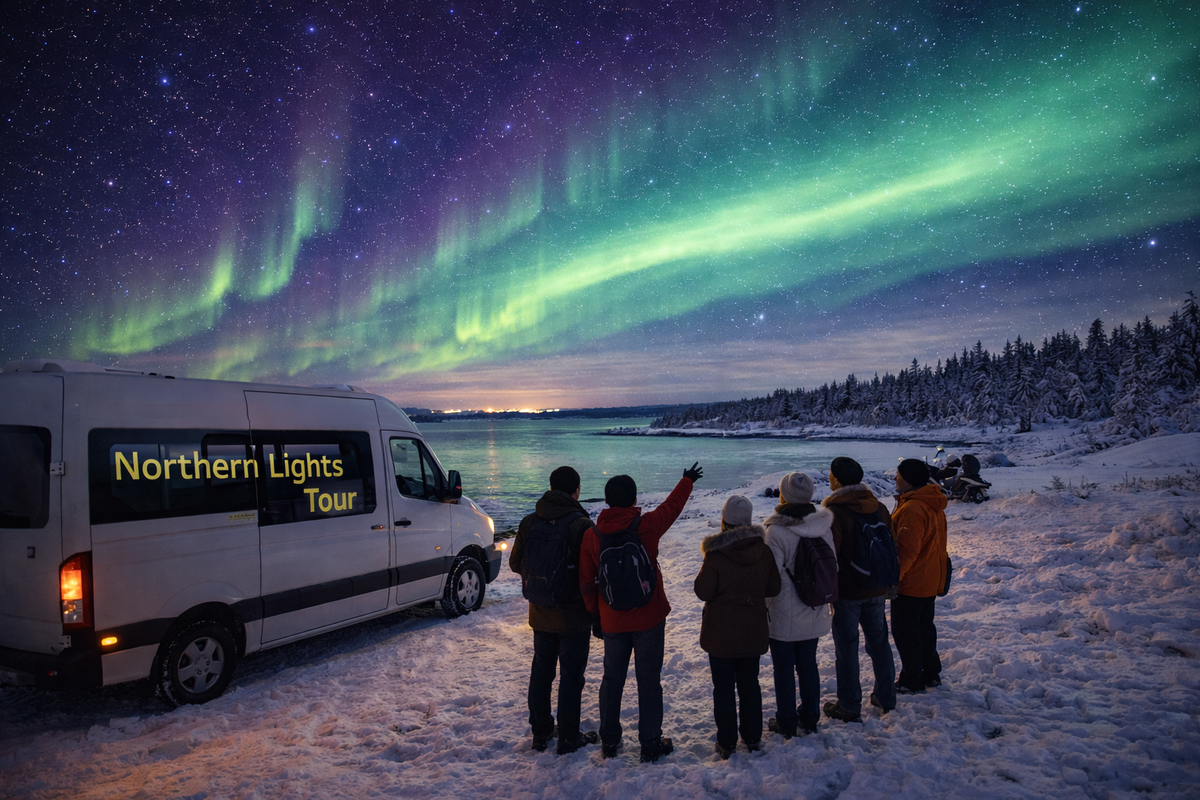
Now, step by step: what kinds of tours are there, how to choose, what to ask, and how to prepare to see more.
An evening in Lapland often looks like this: a dark forest, frosty air, snow crunching underfoot — and silence, in which you want to "catch" the green arc in the sky. That's why tours with keywords like "northern lights tours lapland finland" or "finland northern lights tour" sell so well: they promise simple logistics and a sense of "we did everything right".
But the truth is that tours vary greatly. The same "northern lights tour from Rovaniemi" can be either a competent hunt with trips through the clouds or a beautiful night walk to a bonfire — pleasant, but not increasing your chances. The difference is in strategy and honesty.
In this article, you will learn how to choose a tour that matches your budget and expectations.
Is it worth taking a northern lights tour in Lapland or is it better to search for them on your own?
If you have a car, experience driving on winter roads, and a desire to figure out the locations yourself, independent hunting often gives you maximum control. You can drive away from the lights, choose the horizon, adjust to the clouds, and stay as long as you need.
But a tour often wins in three situations:
- you only have one evening and want to make the most of it;
- you don't have a car and don't want to depend on taxis/schedules;
- you want someone else to do the thinking for you: where to go, where it's darker, where it's clearer.
The most honest expectation: a tour does not "create" the aurora, it reduces errors (light, poor horizon, wrong spot, lack of a Plan B). This is what increases your chances.
What kinds of Northern Lights tours are there in Lapland and how do they differ?
The formats are easy to confuse because the descriptions all sound similar: "hunting", "best places", "photos". In reality, the differences are very practical: can you get away from the clouds, how much time will you actually spend under the sky, and how much control does the guide have?
| Format | Suitable for | Main advantage | Main disadvantage | Usually budget-friendly |
|---|---|---|---|---|
| Minibus "Okhota" | 1 evening, no car, want Plan B | You can get away from the clouds and lights | Depends on the honesty and experience of the guide | ~80–200 € / person |
| Snowmobile/safari | Want adventure + a chance to see | Emotions and distance from the lights | You can't "drive around" the clouds so flexibly | often more expensive than a minibus |
| On foot/snowshoes | If you want peace and quiet, don't chase kilometres | Atmosphere, simplicity, often safe | If it's cloudy, you're still close by | often medium range |
| Private tour | Family/couple, maximum comfort and flexibility | Individual logic, may involve a longer wait | Price | often significantly higher |
The table provides a simple conclusion: if your goal is to see the Northern Lights, rather than just "go for a ride," a minibus hunt or private tour is usually the best option, as they offer maximum flexibility.
When a tour really increases your chances of seeing the aurora: honest maths of the evening
The tour increases your chances not because the guide has "magical places", but because he:
● takes you away from the light (and you stop looking at the "grey sky above the streetlight");
● chooses a spot with an open horizon (important if the aurora is weak and low);
● makes the move if necessary (this is Plan B, which tourists without a car often cannot do).
In other words, the tour works as an "anti-mistake". If you already know how to do all this and have a car, the added value is less. If not, the added value can be decisive.
How long does a Northern Lights tour last and what time does it usually start?
Most often, tours last 2-4 hours: this is enough to get away from the light, stand under the sky, make one trip and return. There are longer formats — especially if it is a private or photo tour, where you wait for the "window" longer.
The logic behind the start time is simple: the tour begins when it is dark enough. During the dark season, this is usually in the evening, often after 7–9 p.m. (depending on the situation and location). And very importantly, the aurora does not have to start immediately. Peaks are short, so "standing in the dark for 20–40 minutes" is a normal part of the process.
How much does a Northern Lights tour in Finland cost and what is usually included?
The most common price range in Lapland is €80–200 per person. It can be lower, but these are usually short/group tours; higher prices include private tours, photo accompaniment, and combined activities.
What is usually included:
● transport to and from the viewing point;
● basic "leader" (guide);
● sometimes a hot drink/snack;
● sometimes help with photos (not always high quality — depends on the format).
What is often not included, and that's normal:
● a "glow guarantee" (such an honest service does not exist);
● professional portfolio-level photo shoot (unless stated separately);
● perfect weather.
Prices and conditions vary by season, so check the current details before booking: this is not paranoia, it is normal caution, especially during the peak winter weeks.
How do you choose a tour that really "hunts" for clear skies, rather than just taking you to the nearest forest?
This is the most important section, because this is where the difference between excitement and disappointment lies.
A good "hunting" tour can usually be recognised by the following signs:
● the description includes the logic of "looking for a clear window / getting away from the clouds" and not just "bonfires and stories";
● there is a reasonable plan for distance: they do not promise "we will go far" as an end in itself, but they also do not pretend that there are no clouds;
● you understand what will happen if it is cloudy (see the next section).
A bad (or simply "not about chance") tour often looks like this: one point, one stop, one scenario — and if the sky is overcast, the evening turns into an excursion. This is not a crime, it is simply a different product.
What questions should you ask before booking a tour so that you don't buy a "guarantee" instead of reality?
If you ask these questions, you will almost always understand how honest and experienced the organiser is:
- What do you do if the forecast is cloudy over your first destination?
- Are you prepared to change locations based on cloud cover during the evening? How far?
- How much time will we actually spend "under the sky" rather than on the road?
- What is the size of the group?
- What is included in terms of clothing/thermal equipment (if anything)?
- If we only have one evening, what format would you recommend and why?
A good organiser responds calmly and specifically. A bad one starts talking about "our secret places" and "we always see it". In the northern sky, "always" doesn't work.
How can you recognise "100% Northern Lights" marketing and avoid falling for it?
If you see phrases like "guaranteed," "100%," or "you will definitely see it," take it as a red flag. The aurora depends on activity and clouds, and clouds do not follow tour schedules.
Honest wording sounds different: "we increase the chance," "we look for clear skies," "if it's cloudy, we change the plan." This is the approach you need.
And a normal continuation of the thought in plain text: even the most honest tour may not show radiance if the night is cloudy. The question is not "why wasn't there any", but whether you did everything reasonably.
How does Plan B work when it's cloudy: what does a good tour do on a cloudy night?
Plan B is not a "second place just in case" option, but a real tactic:
● see where there are clear "windows" in the clouds;
● move to the side where the sky is clearer;
● choose a spot where there is a horizon and minimal light.
Ideally, you understand that a tour is not "tied" to one beautiful place. It is tied to an idea: to find the sky.
What to take on a tour: clothing, phone, camera and small items that determine comfort
Even the best tour won't save you if you're freezing after 12 minutes and want to go back. The Northern Lights often come in "waves," and patience is part of the success.
Take at least:
● warm layers and wind protection (especially in open areas);
● mittens/gloves and warm shoes (hands and feet give out first);
● a power bank (batteries drain faster in the cold);
● a thermos (if not included in the tour, it's worth its weight in gold);
● a soft-light headlamp (so as not to blind yourself or others).
- Clothes for standing, not walking: you will be waiting.
- Set your phone screen to minimum brightness — otherwise your eyes will have trouble seeing the sky.
- Power bank and cable — your battery will die faster than you expect.
- Check whether thermal overalls/footwear are included (if not, bring your own).
- Ask if you can stay longer if the "right moment" has arrived.
Tours from Rovaniemi, Levi/Ylläs and Saariselkä/Inari: where is the logistics easier?
If you are choosing a base and at the same time looking at "aurora borealis tour rovaniemi" or "rovaniemi northern lights tour", it is useful to understand the differences.
Rovaniemi is good because it is a large base: there are many tours and many options. But that's exactly why the quality varies so much — there are excellent "hunts" and purely tourist evening formats. If you are planning to use Rovaniemi as your base, the separate geo-page Revontulet Rovaniemellä helps you understand how far to go from the lights and what a successful evening looks like.
Levi and Ylläs are resort destinations: days on the slopes, nights hunting. A "quick 15-40 minute trip" into the darkness often works well there, and tours can be very practical in terms of logistics. If you are considering these resorts, Revontulet Levillä ja Ylläksellä will come in handy — it covers dark spots and typical evening scenarios.
Saariselkä and Inari often feel more "reliable" in terms of darkness and horizon — which is why you sometimes need fewer tours there if you have a car and are ready to hunt on your own. But if you don't have a car or want to maximise one evening, a tour can still provide a Plan B in case of clouds.
What to do if you live in a glass igloo or "aurora village": do you need a tour or is it enough to just go outside?
A glass dome and a "northern lights cabin" offer comfort while you wait, but no guarantee. Often there are illuminated paths and trees nearby that block the horizon, and you may simply not notice the gentle glow.
An honest tactic:
● if the night is clear and it is dark around you, sometimes it is enough to go to the nearest dark spot and wait 20-40 minutes;
● if clouds are "cutting" the sky with patches, a tour/transfer can help you get to a clear window;
● If you only have one evening, a tour can sometimes save you time and stress.
If you choose accommodation "under the glow" in advance, separate logic of expectations and choice — in Lasi‑iglut ja revontulet Suomessa.
Tourist mistakes on tours: why people pay and still end up disappointed
First, an important point without digressions: disappointment almost always occurs not because "there was no aurora," but because of a mismatch of expectations. People bought a "guarantee" and got an "attempt."
Now — the most common mistakes.
If the tour doesn't explain what it does in cloudy conditions, you're buying an emotion, not a chance. Ask about Plan B — this immediately changes the quality of your choice.
Regular text between stickers: The second mistake is human and very typical. People arrive at the spot and immediately "scan the sky" for 2 minutes, then go back to their phones or the bus. But your eyes need to adapt to the darkness, otherwise you see less — especially if the glow is calm.
The third mistake is about time. The glow often comes in short bursts. If you are psychologically expecting "immediately and for a long time," you will lose out by waiting.
Scenarios: which tour is right for whom (family, couple, solo, budget, expats)
Family. Imagine you are with your child and you have one evening. The best format is short, straightforward and warm: a minibus or private vehicle where you can quickly return to warm up and not stand in the wind for an hour. For families, comfort and safety are more important than "the furthest point".
Couple. Imagine an evening where the atmosphere is important to you. A walking format or a small minibus can be ideal if the organiser chooses a dark spot with a horizon. It is important to decide in advance: are you buying "romance" or "maximum chance" — then the choice will be honest.
Solo. Solo travellers benefit from flexibility: it is easier for you to switch to a different format and "adjust" to the forecast. Tours where you can actually go to a clear sky and wait a little longer work well. But make sure the group is not too large, otherwise you will waste time.
Budget. If your budget is limited, don't buy a "promise", buy a strategy. It is often more profitable to take one good minibus tour for one evening than two cheap "one-off" tours. And if you can, book extra nights in the region: an extra evening often increases your chances more than any tour upgrade.
Expats. If you live in Finland and can adjust to a rare strong night, you can often do without a tour. But a tour can be useful as a "don't think, don't drive" option, especially if you want to show the aurora to friends or family. The key for you is not the price, but the flexibility of the itinerary and an honest Plan B.
A night after which you will say, "It was better than I expected."
A good tour is when you understand the rules of the game in advance: the sky can be capricious, but you do everything sensibly. You leave the light behind, find the horizon, let your eyes adjust to the darkness, and wait for the peak.
If you take one thing away from reading this article, let it be not "which tour is the most fashionable," but "which tour really knows how to work with the clouds." This is what most often turns a search for "Finland aurora tour" into a real memory, rather than a cheque to pay.
If you have already been on a tour in Lapland, write about what worked: travel, group size, patience, location. Your experience will help others make a more informed choice.
FAQ
Yes, it’s often the best option, especially if you don’t have a car. A guided tour can take you away from light pollution and, if luck is on your side, to clear skies. Make sure the tour really moves locations if the sky is cloudy — this way you pay for strategy, not empty promises.
A good tour operator will try to find clear windows or honestly explain that the chances are low and may offer an alternative evening program. Tours tied to a single location often turn a cloudy night into a simple walk. Always ask about Plan B before booking to avoid disappointment.
Prices usually range from €80–200 per person, depending heavily on the season and tour type. Minibuses are generally cheaper than private cars, and vehicle safaris often cost more. Differences also appear in group size, duration, and included equipment. Check exactly what’s included before booking.
Most tours last 2–4 hours to allow travel away from city lights, standing under the sky, and returning safely. Longer private or photography tours exist. The key isn’t the total time but how long you spend in darkness. It’s best if the operator doesn’t rush departures once the aurora appears.
Dress for standing still, not for walking. Wind protection, warm hands and feet, and layers for heat retention are essential. A power bank is helpful, as phone batteries drain faster in the cold. If thermal suits are provided, check in advance.
It depends on the tour. Some offer professional photographers and edited photos, while others only assist with phone settings and a few shots. Confirm what exactly is included — file format, quantity, delivery times. For portrait-style aurora photos, pick a tour that guarantees this. Note that sky conditions ultimately control the results.
From a visibility perspective, minibus tours usually win because they’re flexible and can change direction to avoid clouds. Snowmobile tours offer a thrilling adventure but can be less controllable in terms of weather. If you have only one night and your goal is to see the aurora, choose the most flexible option. For the experience itself, snowmobiles can be excellent.
Short, warm tours with easy return routes are preferable. Minibuses or private cars offer shorter wait times and more comfort. Check your group size and outdoor duration. Comfort matters more than reaching the farthest point.
Auroras cannot be guaranteed as they depend on activity and cloud cover. Any promise of certainty is likely marketing hype. Honest operators explain probabilities and provide a Plan B. This makes expectations realistic, not the trip worse.
Tours start once it’s dark enough, usually in the evening and the first half of the night. Aurora peaks can be brief, so waiting 20–40 minutes in darkness is often best. Don’t expect the aurora to appear immediately after leaving the bus. Patience on a clear night usually pays off.
0 comments
Log in to leave a comment