



🏞️ Harbours, bridges and rivers: water in Finnish cityscapes
Finnish cities have lived alongside water for decades: harbours, rivers and sea bays are not just decoration here, but part of the character. Stone steps lead down to the cold surface, piers stretch out into lakes, and bridges connect the shores as calmly as habits connect yesterday and tomorrow. For a photographer, water in Finland is the perfect companion: it provides reflections, soft light, mist, glare and long lines that are pleasant to draw into a frame.
To avoid turning your shoot into a chaotic stroll and make it a well-thought-out photo hunt, it is worth figuring out in advance which cities and which embankments work best . Today, we will explore the water in four cities: Helsinki, Turku, Oulu and Hanko — from austere ports to almost meditative piers at the edge of the map.
🌊 A quick guide to the cities — a navigation "sticker"
Helsinki: when the city literally grows out of the sea
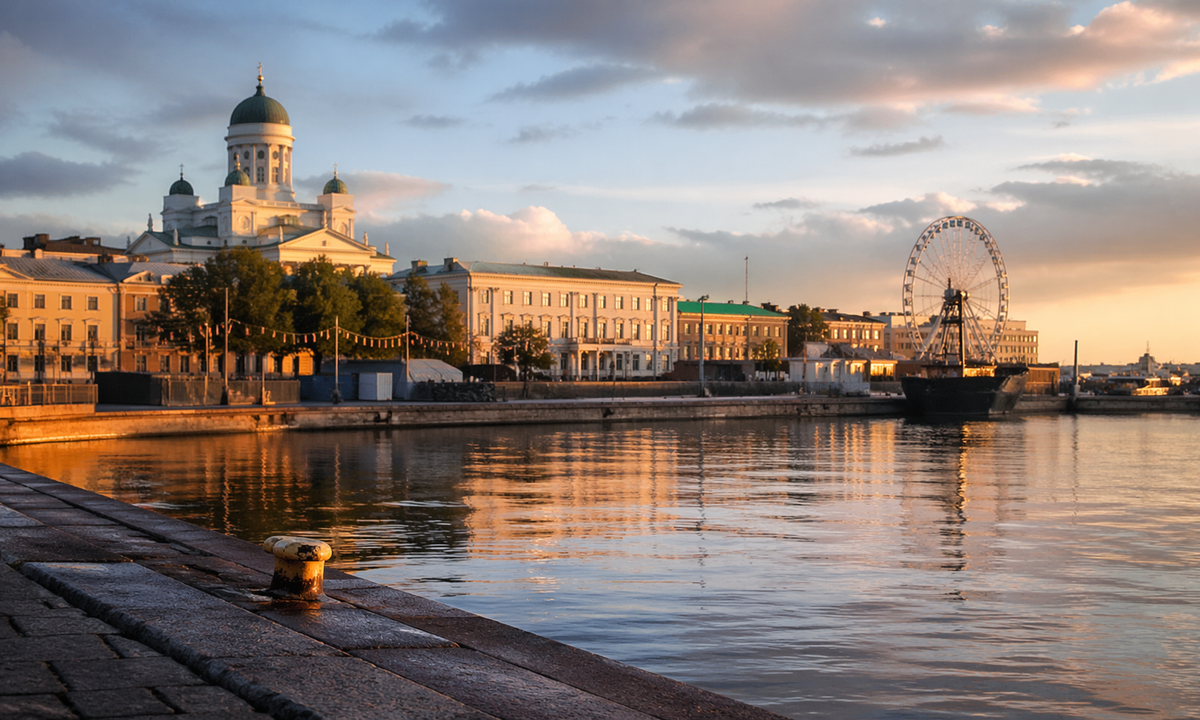
The capital of Finland is all about granite, ferries and the constant feeling that the sea is somewhere very close, even if you are a couple of blocks inland. For a photographer, this means one thing: there is almost always water in the frame, the main thing is to know the right spots.
South Harbour (Eteläsatama)
Here, ferries depart for Suomenlinna, tourist boats wait along the quays, and the water reflects the facades and masts. In the morning, you can catch the soft golden light, in the afternoon — the clear contours of the buildings, and in the evening — the lighting and deeper shades of blue.
Katajanokka and its bridges
The peninsula with its brick houses and view of the cathedral offers excellent angles, where bridges and piers become the leading lines. Wide-angle lenses and shooting from the knees work well here — the lower you lower the camera, the more the water turns into a mirror.
Canals near Kallio
This area is a little rougher, a little less open to postcards — and that's exactly why it's perfect for more atmospheric, "cinematic" shots. In cloudy weather, it's ideal for scenes with a touch of melancholy: a bridge, water, a tram in the distance and a lone passer-by.
Turku: a city where the river takes centre stage
In Turku, water is no longer just the sea — the Aurajoki River takes centre stage. It runs through the entire city centre, and almost any photo of the urban landscape captures it in one way or another.
The old pier at Forum Marinum
Near the maritime museum are ships, historic vessels, frigates and pleasure boats. The textures of wood and metal, plus the calm water, provide ideal conditions for classic maritime photography, where both detail and scale are present.
Bridges over the Aura River
Each bridge is a chance to play with perspective. One bridge looks better head-on, another at an angle, where the railings and lights draw the eye into the depth of the frame. It is convenient to shoot in series here, moving from bridge to bridge: then it is easy to put it together into a story.
Embankments at dusk
When the lights come on, the water turns into a dark glass surface with golden paths of light. Add people walking, a leisurely bicycle, reflections of shop windows — and you have a lively city photo in which the water does not dominate but connects the elements.
Oulu: the northern geometry of bridges and rivers
Oulu is located further north, the light here is sharper and more honest, and the water almost always feels cool, even in summer. But it is precisely this atmosphere that gives the frame clean lines.
Toripolku Bridge and neighbouring crossings
Minimalist architecture, smooth railings, wide spans — all of this loves symmetry. It is convenient to work with a central composition here: the bridge goes forward, the water on both sides creates a calm background, and the city neatly folds in the distance.
Fishing harbour and red warehouses
A classic of Finnish visual tradition: wooden buildings by the water. If you choose a slightly foggy morning or a cloudy day, the colours become softer, and you get a "painting, not a postcard."
The mouth of the Oulu River, where the river meets the sea
A good place for wide panoramas: the horizon, low clouds, a long line of water. Here it is easy to capture shots in which the city is felt but does not overwhelm — the emphasis remains on the open space.
Hanko: the southern edge and long piers leading nowhere
Hanko seems to have been created for those who love shots "of the horizon and a few trees." The water here is softer in colour, the light is airier, and the piers and jetties stretch straight out into the sea, as if painted.
Long wooden piers
This is the perfect place to photograph silhouettes: a person at the end of the pier, the setting sun behind them, the water turning from orange to blue in a soft gradient. Minimal objects, maximum mood.
The old port and working berths
If you move away from postcard views, you can find scenes with buoys, ropes, rust and old structures. This is good ground for more "journalistic" or "documentary" shots.
Hanko Lighthouse and surroundings
Lighthouses are always a bit about eternity. The combination of a lighthouse, water and sky requires almost no processing : just wait for soft side lighting and minimal haze.
💧 Table: when to photograph water in different cities
📋 Mini-route along water points
- Start at dawn in Helsinki's South Harbour.
- In the afternoon, travel to Turku and walk along the Aura River.
- The next day, fly or drive to Oulu to photograph the bridges and the river mouth.
- End the trip in Hanko: piers, lighthouse and sunset over the sea.
FAQ
South Harbour, the market piers, the Katajanokka area with views of the cathedral, as well as the canals near Kallio and the routes to Suomenlinna.
In spring and summer, the most pleasant shots are taken at dawn and during the evening golden hour: the light is soft, the water is calm, and there are fewer people.
The embankments along Avarajoki in the centre, the area near Forum Marinum and the bridges, where you can clearly see the reflections of the lights in the river.
Yes, the Toripolku Bridge and other pedestrian crossings by the river and estuary offer clean geometry that is easy to play with using symmetry and leading lines.
On the south coast and near the old harbour: there are piers there that go straight out into the open sea, with minimal visual noise around them.
Yes, you can and should: instead of reflections, you get cracks in the ice, snow patterns and graphic lines that look great in black and white.
Most often in the early morning and late evening in August–September, especially near rivers and sea bays.
A universal set: wide angle (16–24 mm) for bridges and panoramas, a fixed 35/50 mm for walks along the embankments, and 70–200 mm for shooting details at the piers.
In open areas, you can go anywhere, but in service areas there may be restrictions and signs; it is best to respect them and not go beyond the barriers.
Choose routes along the embankments: in Helsinki and Turku, the water is literally intertwined with the city centre, so you can combine shots of water, architecture and city life without unnecessary travel.

0 comments
Log in to leave a comment